
Politics taz
Who will be SPD chairman?: Waiting for Manu
SPD women complain about the Union's sexism - but their own party is also a men's club after Bärbel Bas' withdrawal. Is Manuela Schwesig coming now? more...
Deutsch (original) ·Auto-translated to English
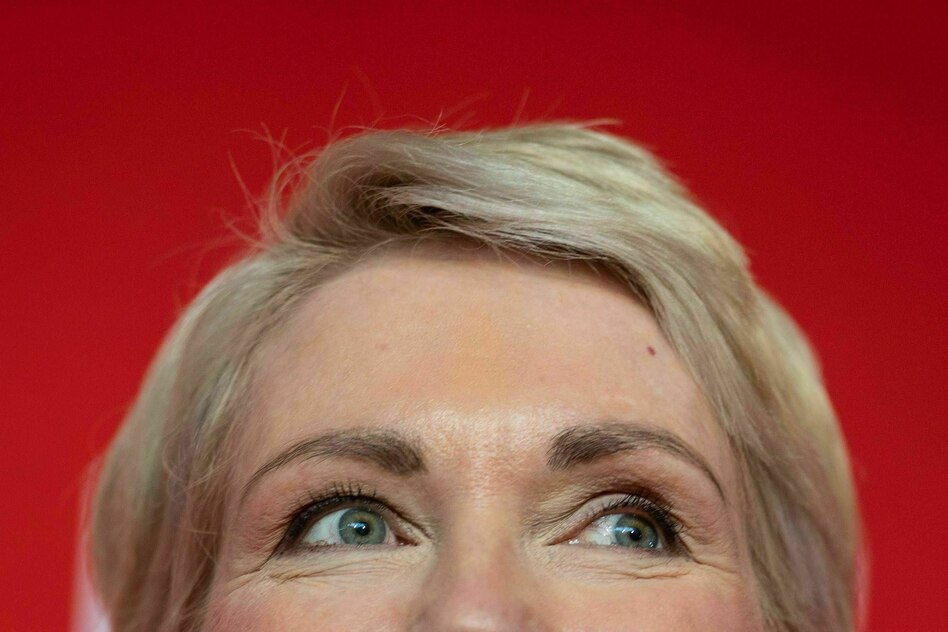
On Tuesday of this week, Manuela Schwesig is sitting in a fairytale castle with a view of the water. With her hands folded on the table in front of her, she stoically follows the first session of the new state parliament of Mecklenburg-Western Pomerania, which resides here in Schwerin Castle. Today everything is going smoothly: There is no scandal like in Magdeburg, the red-green-red majority is there. Runs with her.
And yet one cannot shake the feeling that this state parliament with its 71 members could become too small for Schwesig in the long term. If she even has this thought every now and then, Schwesig can hide it well. She doesn't even pick up her phone; unlike most MPs, she follows the debate closely. Schwesig is patient, she can wait.
If you're sitting in a castle by the water - why would you voluntarily go to Berlin?
There are one or two reasons: save the social democracy and the so-called center at the same time. These are the expectations that some have of Manuela Schwesig. Anyone who can stand up to the AfD in East Germany and get over 35 percent for the SPD will be expected to achieve greater things. There is also a Schwesig hype in surveys. As of this week, she is the second most popular politician in the country after Boris Pistorius. And 82 percent of SPD supporters would like her to be SPD chairman.
If you ask around in the party who would be considered as Bärbel Bas's successor, they say: We are waiting for Manu. So far she has not ruled out running for office. First the coalition has to stand in Schwerin, then it will make a decision. It should happen at the beginning of November. Then Manuela Schwesig, the Prime Minister from the fairytale castle, should give the SPD a winter fairy tale. “Everyone is waiting to hear what she says,” said a leading SPD politician.
Manuela Schwesig has also been identified as a danger in the Union. She has already clashed with Friedrich Merz in the Chancellery. “You have destroyed the democratic center,” the Chancellor is said to have accused her. She wouldn't accept that, said Schwesig, "neither as Prime Minister nor as a woman." Last weekend, the head of the Junge Union, Johannes Winkel, accused her of allowing herself to be “bought by Russia” because of her role in the Nord Stream gas pipeline.
“I had to intervene,” says Carmen Wegge to the taz. Wegge is chairwoman of the Women in the SPD working group and thus represents 150,000 social democrats. In an interview, she accused the Union of “systematic sexism” in its dealings with Schwesig. Women with power would not be placed politically, but would be attacked personally. “Her competence is denied, her tone is criticized, her credibility is undermined.”
Wegge has learned a lesson from Bärbel Bas's resignation: She wants to object more quickly and clearly when, in her view, boundaries are being exceeded in criticism of women. “I don’t want them to go after the next woman they can destroy.” But Wegge also holds her comrades accountable. “It is also the job of men to contradict.”
If you listen to leading SPD women, there are also self-critical tones. Sarah Philipp, the chairwoman of the SPD in North Rhine-Westphalia, says: "Women's solidarity is also an important issue. But we are socialized in a system that teaches us: There can only be one." It is often men who dominate decisions in the background. Women would then often compete against each other in candidacies. That has to change. As head of the largest regional association, Philipp wants to play an important role in the reorganization of the party.
And so Manuela Schwesig is not only seen as a hope for a credible and successful SPD. It should also solve the party's women's problem. After Bas' resignation, the SPD no longer has a woman in the front row of Berlin politics. Which is why it is probably more precise to speak of a men's problem. Many Social Democrats are outraged by the men of the CDU/CSU who explain the world to them behind closed doors and also cross boundaries when criticizing them publicly. But many also say: The SPD itself has a problem with equal rights.
On the same day that Bärbel Bas resigned as minister, Lars Klingbeil introduced Alexander Schweitzer as her successor. He made the decision largely alone; the party currents were not informed. There would have been women for the job who were already working on labor and social policy: the deputy parliamentary group leader Dagmar Schmidt or the Berlin Social Senator Cansel Kiziltepe, to name just two.
But now the important SPD ministries with the big budgets, i.e. defense, finance, labor and social affairs, are led by men. The organizational power in the SPD also lies exclusively with men: Lars Klingbeil as party leader, Matthias Miersch as parliamentary group leader, Dirk Wiese as parliamentary manager, Tim Klüssendorf as general secretary. “The demand for equality is currently not being sufficiently met,” say several leading social democrats.
Alexander, Boris, Lars, Matthias, Dirk and Tim. Which society does this represent?
“Women always had to fight particularly hard in the SPD,” says historian Heike Specht. She wrote the book “The First of Their Kind” about women in politics. Specht is regularly invited by SPD local groups to give lectures. What the comrades don't like to hear so much: how women were repeatedly thwarted.
Specht can tell many anecdotes about this: For example, that of Elisabeth Selbert, one of the authors of the Basic Law, who pushed through the wording in Article 3 despite opposition within the party: “Men and women have equal rights.” She was thwarted in the party and was no longer able to hold higher office.
Or about Willy Brandt, who liked to tell jokes at the end of every cabinet meeting. “Käte, listen to me,” Brandt said to the first female SPD minister, Käte Strobel. Helmut Schmidt replied: “Why, I always thought Käte was a man.”
But you don't just have to remember the distant past. During the red-green coalition in the early 2000s, the ministers met for a “witch’s breakfast” to support each other and to be able to stand up to the alpha males Fischer and Schröder.
Even today the party must ask itself the question: “Does the SPD protect its women enough?” It's easy to shoot against Union men now - it closes ranks, says historian Specht. The SPD itself took its time with its own party leadership. It was only in 2018 that Andrea Nahles became the first female party leader. Her successors Saskia Esken and Bärbel Bas had a difficult time in dual leadership alongside men. Specht therefore sees “crocodile tears” in Lars Klingbeil after first Esken and now Bas failed alongside him.
And the SPD's last major appearance also tells something about the role of women: When Boris Pistorius stood on a drinks crate on Bebelplatz a few weeks ago, outraged by the AfD's success in the Magdeburg state parliament, his appearance went viral. But it was a woman who had the idea at the parliamentary group meeting to set an example in this historic hour: Maja Wallstein, MP from Brandenburg. When the speaking list had already closed, she asked “whether we were all outraged enough to cancel all our appointments and go out on the streets.” That's what she tells the taz. Everyone now knows the pictures of Pistorius on Bebelplatz. Not the name of the woman who initiated it.
The SPD, which has fought so hard for women's rights throughout its history, is no longer a pioneer today. The first female chancellor was a Christian Democrat. “When things got serious, one man was always given preference in the SPD,” said Specht. This has consequences: Young women today primarily vote for left-wing and green parties. Not only, but also for reasons of representation. A leading SPD woman says: "The Left and the Greens are often perceived as having a better offer for young women, especially in external perception. Many people can identify with Ricarda Lang and Heidi Reichinnek. We cannot be satisfied with that."
This is also why so many in the SPD are waiting for a sign from Manuela Schwesig. SPD women's spokeswoman Carmen Wegge says that the SPD can learn a lot from Schwesig's success: "As a woman, she particularly focused on issues that appeal to women in the election campaign." Schwesig promoted herself as a “woman against blue” and focused on issues such as daycare, family and affordability.
Schwesig's decision will also depend on whether, as chairwoman, she would be part of a dual leadership team - and with whom. Lars Klingbeil's support in the party is low and he has not yet announced whether he will run again. “I hope that Manu does it alone,” says a leading social democrat. If she were to take over the party leadership as Prime Minister in Schwerin, she would otherwise always be at a disadvantage compared to a man in Berlin. Then the men would sort things out among themselves in the capital again.
It would also be possible that Schwesig would give up the party chairmanship and would rather become a candidate for chancellor. That way she wouldn't have to defend the coalition's compromises for two years. Schwesig would then be the first candidate for chancellor in the history of the SPD. “It’s about time,” says a leading social democrat.