
Germany · taz · · 1h
World Suicide Prevention Day: “Talking can save lives”
Deutsch (original) · Auto-translated to English
From Speyer Shoko Bethke (text) and Miriam Stanke (photos)
Oliver Wildenstein was in his early 30s when the illness began. He had problems concentrating, had trouble sleeping and was constantly tired. When he read a book, at the end of the page he no longer knew what was at the top. When he went to sleep in the evening, he woke up two hours later bathed in sweat. He only saw problems everywhere.
“Gardening became too much for me,” says Wildenstein. “Mowing the lawn, trimming the hedge, taking out the greenery… What if someone notices that I’m unwell?”
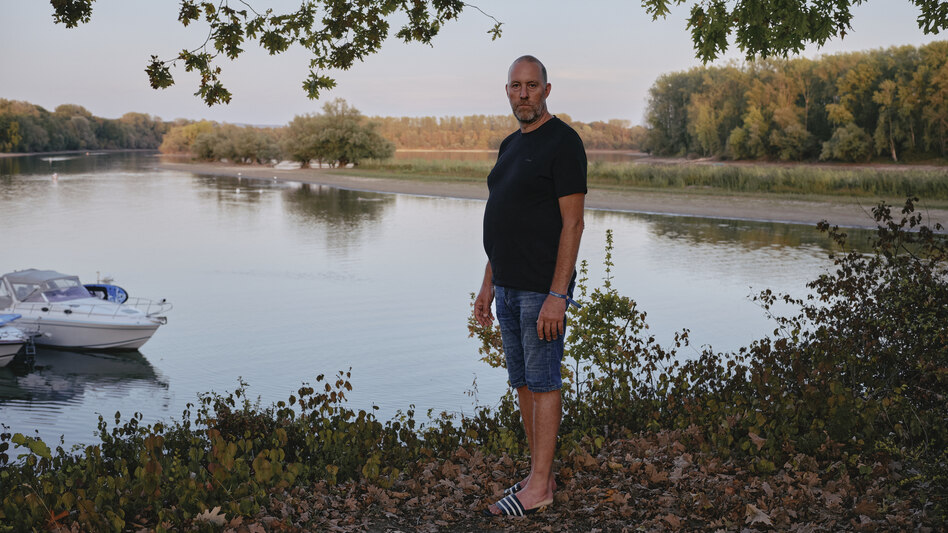
Wildenstein sits in the back corner of his trailer during the conversation with the taz. When he thinks, his eyes wander to the ceiling. The former senior project manager is 55 years old and has been living with depression for 25 years. There was no specific trigger. “A lot of factors came together.”
Among other things, he put a lot of pressure on himself at work. From the outside, he worked: he was responsible for the budget, negotiated contracts and held discussions with employees. He was able to hide the fact that he was mentally unwell: “Like an actor.” He loved his work and received a lot of positive feedback. Nevertheless, he was convinced that it wouldn't be long before everyone noticed that he wasn't good at anything. Looking back, Wildenstein knows that these fears were not real.
In addition to the responsibility at work, there was also responsibility at home. When his children were born, his wife at the time went on parental leave and Wildenstein was responsible for the household income. After work, he just wanted to go to bed - instead of spending time with his family. “My ex-wife was helpless because she didn’t know how to deal with it.” Wildenstein also became increasingly withdrawn socially. At some point, the friend with whom he regularly played squash stopped asking about him. “It would have been nice if he had continued to ask if we wanted to play together,” says Wildenstein.
His condition lasted for several months. At some point he also had suicidal thoughts. He thought about taking his own life almost every day.
He couldn't talk about it. Instead, he became increasingly silent, no longer showed any emotions, and was always exhausted. He heard from his ex-wife, colleagues and friends that everyone has bad days. “Pull yourself together,” he often heard. This in turn made Wildenstein feel unseen in his condition.
“Many people still don’t know how to deal with depressed or suicidal people – often out of insecurity or fear,” says Ute Lewitzka, psychiatrist and professor of suicidology. “They don’t realize that saying things like ‘go for a jog’ isn’t helpful.” It is more helpful to listen, ask questions and tolerate the other person's condition.
But having such conversations at all is a big problem, especially for men. They belong to the high-risk group: out of 10,000 suicides every year in Germany - the most common cause of death in this country - three quarters of them are men.
According to information from support services such as the Strengthen Men website and the National Suicide Prevention Program network, women are less afraid to accept help, while men are taught not to show weakness. Women therefore often have a broader social network that supports them. The fact that the number of men who take their own lives is so much higher than that of women is also due to the fact that they often choose more aggressive suicide methods. This makes your suicide attempts more successful.
Because there is a lack of sensitivity to the topic, many myths surrounding suicide are still circulating - even among medical professionals. The classic is still that many people believe that a person's wish to die only wants to attract attention, says Lewitzka.
“We know from studies that a significant proportion of people who die by suicide have previously spoken in some way about their suicidal thoughts, their intentions or their despair,” says the psychiatrist. “So when someone says, ‘I don’t want to live anymore,’ we have to take it very seriously,” ask more questions and offer support. However, it must be clear that a conversation is no guarantee that suicide will be prevented.
The second myth: If you convince a person not to carry out the planned suicide method, the person will resort to the next method. But only 5 to 15 percent of people who are prevented from committing suicide at a given moment actually die of suicide later. "85 to 95 percent don't do it. I hold them back at that particular moment," says Lewitzka.
Oliver Wildenstein himself decided to stay alive. “I couldn’t put my children through that,” he says. “Neither did my wife at the time.”
Because of his difficulty sleeping and concentrating, Wildenstein consulted a family doctor. “He always said: ‘Yes, yes, now let’s do autogenic training and then it’ll work.’ It wasn’t clear to him that it was depression,” says Wildenstein. But autogenic training - a relaxation technique - didn't help, and Wildenstein got worse and worse. He then visited his former family doctor. He remembered a completely different, healthy Wildenstein, prescribed him medication and sent him to a psychiatrist. There he also talked about his suicidal thoughts for the first time. The psychiatrist then diagnosed him with depression and registered him in a clinic. Wildenstein allowed it to happen, but was convinced that he did not need to stay in the hospital. He still held out hope that he would feel better in a few weeks.
“The most valuable help is when the other person ensures that the person affected gets into the help system,” says psychiatrist Ute Lewitzka. Because those affected by depression themselves often have no drive and are often completely hopeless. “If you call a practice and get a rejection straight away because no new patients are being accepted, this negative experience may increase your depressive experience,” she says. “In such a case, relatives and friends can stay with the person, encourage them and ensure that they get into the help system.�� This doesn't necessarily have to be a psychiatric clinic or a therapy center - a joint call to the local crisis service can also be a first attempt.
Wildenstein did not see the improvement he had hoped for - he went to the clinic. There, the doctors discovered that it wasn't just work and household chores that were putting a strain on him. Above all, it was the death of his father that he was unable to come to terms with. In the same year that his father died of kidney cancer, Wildenstein moved to Heidelberg with his future wife. He wrote applications and started a new job as a software developer. He took care of his mother. There was no time for mourning - even though he had had very close contact with his father.
Since his diagnosis 25 years ago, Wildenstein has had five hospital stays. He is still in close contact with his outpatient therapist and his psychiatrist. He was able to build a good therapeutic network for himself.
Wildenstein is happy today that he is still alive. The psychiatrist Lewitzka says: "Suicidal thoughts and depression often go away again. Depressive episodes get better at some point, and then the suicidal thoughts stop." When dealing with her patients, she has experienced that after a certain amount of time and at a distance, they evaluate their previous situation differently. “This feedback also encourages us to take prevention,” she says.
But there is still a huge lack of prevention - which starts with the fact that many people are very afraid of the topic. This also applies to medical staff.
“Some people who are less familiar with the topic often have the impulse to immediately call the police or an ambulance because the difference between acute suicidality and tiredness of life is not known,” says Nora Fieling, whose real name is different. Fieling gave himself the pseudonym for a blog eleven years ago. She wrote about her own experiences with depression, anxiety disorders and suicidality. Today she is a peer counselor and gives workshops for those affected at the Berlin self-help contact points Sekis and Kis Pankow.
At work she always experiences people talking about how tired they are of life. This is not a medical term, but in colloquial terms it describes a feeling of exhaustion and meaninglessness. This ranges from “I can’t do it anymore”, “I can’t do it anymore” to “I don’t want to wake up anymore”. Most people would say such statements in passing. Here it is important to ask a question: “What do you mean exactly?” instead of immediately panicking. “Not every expression of tiredness of life needs to be treated in a clinic, and not every tiredness of life is per se an acute suicidality,” explains Fieling.
So you have to try to assess the threat: the more detailed the ideas about suicide are, the more acute the danger is - as in the case of Oliver Wildenstein. Fieling explains that many people who are tired of life often want a space where they can talk openly about their thoughts. If the other person calls the ambulance or the police, it is counterproductive. "People have dared to speak up. If supporters raise the alarm immediately, they are building a bridge. The likelihood that people will turn to someone in the event of another crisis decreases," explains Fieling.
Ute Lewitzka adds that relatives and friends can also ask about potential suicide intentions if they have the impression that there is more behind stories of being overwhelmed and overworked. For example: “Man, you have so much going on right now, are there any thoughts that you don’t want to live anymore?” Addressing this could even relieve the other person's burden. In any case, if you have suicidal thoughts, it is important to ask what triggers them. You can also ask directly: “Are they thoughts that come and go, or that you can’t get out of your head at all?”
This makes it possible to estimate how alarming the situation is. If the suicidal person explains that the thoughts are there often and that it is difficult for him to push them away, relatives should ask whether the person has already thought about a method of suicide. This is important because it provides an indication of how easy it would be to implement a suicidal impulse.
Relatives should not approve of a wish to die, but they should also not deny the person concerned this wish. Only when the person does not have to defend or hide the suicidal thoughts does there arise space for an open conversation and the search for alternatives.
For those affected, a possible suicide is often one of several supposed solution options. “Suicidal people are often ambivalent,” says psychiatrist Ute Lewitzka. “If I don’t fight the idea but take it seriously, a conversation can arise about what else is possible besides suicide,” she says.
It is therefore important to talk about triggers: What is particularly stressful right now? If there are severe physical complaints, an idea for a solution would be better treatment of pain; In case of social isolation, more support in everyday life. “Sometimes it’s not initially about a long-term solution, but rather about safely bridging the next few hours or days, not leaving the person alone and getting professional help,” says Lewitzka.
The second condition in such a one-on-one conversation: “I am not allowed to evaluate why a person is suicidal,” says Lewitzka. Because the feeling is individual and very different. "If a 16-year-old wants to take her own life because her first boyfriend left her, I shouldn't say with my life experience: 'Oh girl, he wasn't the right one anyway.' Because then I'll have lost her trust."
It is important here to acknowledge the young woman's feelings and to accept that the current condition is very bad for the person concerned.
Such a conversation is not easy for relatives and friends of people at risk of suicide. That's why Lewitzka also advises setting limits - and, if in doubt, seeking professional help. Something like: "Thank you for confiding this to me. But I am very worried about you and would like us to go to a family doctor together or present ourselves at an outpatient clinic together."
Even if Oliver Wildenstein is not currently having suicidal thoughts, he still has depressive phases today. But he can now deal with it better and talk about it. Symptoms such as difficulty concentrating remain. He still finds it difficult to read a book. When he reads, he has a piece of paper next to him on which he writes the names of the characters and their connections to each other so that he can follow the story.
He separated from the mother of his children, but today his new partner Tina Dix is at his side. Dix also struggled with depression and suicidality, which is why the two of them were able to talk openly about it right from the start. They exchanged experiences about social withdrawal, anxiety disorders and difficulty concentrating.
“The conversations didn’t have to start from scratch because I could easily understand how Oli was feeling,” says Dix, who joins in the conversation from time to time. “This inner torment that is difficult to explain to outsiders when you have depression – it was immediately understandable for us.”
Professional help is therefore essential. But getting it is becoming increasingly difficult: the current federal government is planning savings in statutory health insurance, which also includes cuts in psychotherapy. Professional associations fear that those with statutory health insurance could ultimately receive fewer therapy hours - waiting times for therapy places could also lengthen.
The draft law to strengthen national suicide prevention also leaves a lot to be desired: It relies exclusively on coordination and networking, without mentioning specific financing channels or implementation requirements. There is no reliable long-term financing for existing crisis aid and advisory services.
The psychiatrist Ute Lewitzka still hopes that more awareness will be created about the topic in the future. “People have to look and have the courage to address the topic,” she says. Because: “Talking can save lives.”
Do you have suicidal thoughts? Then you should seek medical and psychotherapeutic help immediately. Please contact the nearest psychiatric clinic or, in acute cases, call the emergency number on 112. You can find a list of further offers at taz.de/suicidethoughts.
Read the full story at the source →
Source: taz