
Germany · taz · · 3h
Voting behavior in Saxony-Anhalt: They are fascists – and not just unhappy idiots
Deutsch (original) · Auto-translated to English
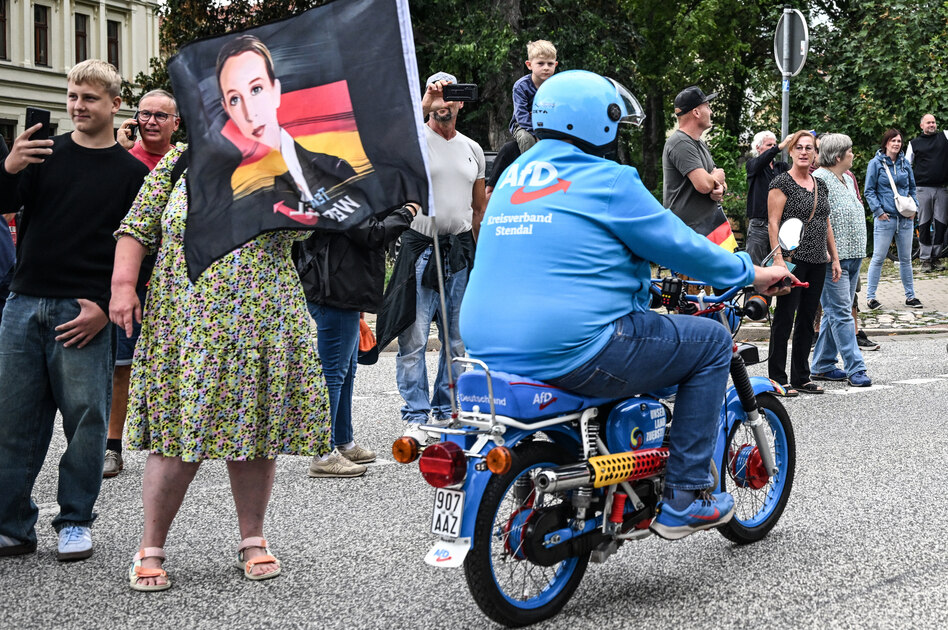
The polling stations in Saxony-Anhalt had only just opened when the trivializing language games began, which are always set in motion like a Tibetan prayer wheel: They're not all Nazis, most AfD voters are simply frustrated. But after this election campaign, everyone probably knew the radical figures behind the permanently grinning Uli with the hamster look. Every voter could know what a radical party the AfD in Saxony-Anhalt is. Nobody chose the wrong number out of frustration.
Anyone who fully consciously votes for a fascist party is a fascist, and not just an unfortunate idiot who doesn't know what he's doing. Certainly the outcome would have been less catastrophic if it were not for the well-founded feeling of uncertainty, fear of the future and even insults that many people feel; It would probably have been easier if Berlin hadn't been governed by a largely dysfunctional coalition led by Friedrich Merz, incompetence personified.
But none of this eliminates the responsibility of the voters who were prepared to vote against hate preachers - and who, to a large extent, did so with enthusiasm. 43.8 percent in Saxony-Anhalt, that's like laboratory proof of how people are transformed, how agitation and propaganda are used to get them to celebrate the malice, the malice and the joy of taking revenge on their apparent enemies.
After the elections in Saxony-Anhalt and Mecklenburg-Western Pomerania, there is a threat of an AfD government for the first time. The taz reports what is at stake - and who is now defending democracy. All texts about the series can be found here.
Be it artists, internal enemies, the “fraudsters” from the “old parties”, the foreigners, whoever. The agitation and propaganda with which the fascists and their accomplices in the tabloids and pseudo-media bombard people day after day puts them in a state of constant excitement and indignation and into a paranoid pseudo-reality by hammering it into their heads that the world is a dark place in which they come under the wheels every day; a den of violence and crime.
In the second step, it is explained to them that this is not simply a deplorable process, but is insidiously orchestrated by sinister forces and deceitful enemies of the people. But then, thirdly, they are called out: Rescue is approaching, in the form of the leader or group of saviors who will not only bring salvation, but will also settle accounts with the forces of evil. What will be done to them is immediately the subject of lustful imagination, of intoxication with cruelty and ecstasy of hardness.
The taz is an independent, left-wing and opinionated daily newspaper. We have been arguing in our comments, essays and debate texts since the taz was founded in 1979. We often cannot and do not want to agree on an opinion. That's why you'll find some completely opposing positions here - all part of the very broad left-wing spectrum of opinions.
With the message of fear and the fomentation of pleasure in cruelty, people are gradually transformed into others. Empathy is eliminated, sadism is increased, and for everyone else a process of habituation is reinforced. The process of fascistation cannot be understood without this mass psychology, especially since the followers are not simply “seduced” but are also mutually radicalized through their highly affective participation.
Followers are transformed into angry people, driven into a frenzy, resentment becomes second nature to them, and bitterness becomes a central character trait. At the same time, as we can see, this can also be accompanied by euphoria. Studies have shown that when people fall into the clutches of this agitation, they initially become significantly less happy - until the (un)happiness curve moves slightly upwards again.
The angry person, whose negativism is radicalized, feels a sense of community in the group of other angry people, which lifts his mood again. This sense of community was clearly visible in this election campaign; observers have not wrongly described that the AfD campaign had taken on the characteristics of a euphoric “movement”.
Since none of this can be accurately described without the vocabulary of mass psychology, one will not be able to understand the transformation of the followers into rabid and bitter people without the terms of psychology. Ironically, one sometimes hears that one should not pathologize people with views that differ from one's own. Which, of course, would be theoretically correct if they were just opinions and not obsessions expressed with great affective fury.
But it is precisely these people who turn the supporters of the fascist movements into bitter followers. The agitation is aimed directly at their psychological apparatus. And of course we also know from other, more personal crises what instability, irritability, darkening of being, chronic stress and other things can do to us, namely a gradual transformation of our nature. The same is true where the social and the individual intersect.
Thus, the political crisis in which a society finds itself, in which right-wing radicals are once again receiving such support, is one that demands “healing” in a more significant sense than just in a metaphorical one. One can almost say that it has become a maxim from the topic of “Woken” not to say anything derogatory about people’s psychological state, while the right-wing radicals understandably resist being portrayed as crazy in any way.
Funnily enough, this is probably the only issue where there is a woke-fascist alliance. In an era without such sensibilities, decades after the “Studies on the Authoritarian Character” in the 1960s in the Federal Republic of Germany, Theodor W. Adorno spoke of the fact that the individual who follows the authoritarians is “similar to being trapped in a certain form of mental illness, namely paranoia” and ends up in a state in which “aggression has no end.”
Right-wing radicalism promises its followers sadistic pleasure. Firewalls against parties are not enough. They don't hold back against the rawness of emotions without barriers.
Read the full story at the source →
Source: taz