
Germany · taz · · 60m
Election day in Bosnia and Herzegovina: Fight for votes and identities
Deutsch (original) · Auto-translated to English
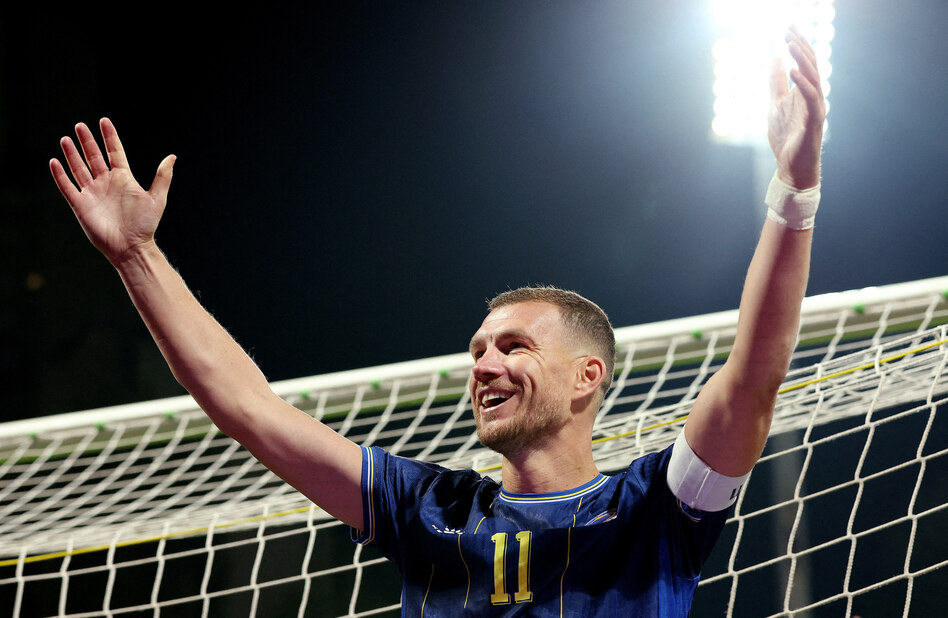
Nobody in Bosnia can ignore the number 11 these days. If you order Ćevapi in Sarajevo, you will find 11 and not the usual 10 of these Bosnian grilled sausages on the plate garnished with onions. And not even the blue jersey with the number 11 on the back, which is emblazoned oversized on the walls of houses and worn by thousands of children, musicians and chess players in the center of the city.
The 11 is the shirt number of the accurate Bosnian center forward Edin Džeko, who once played for Wolfsburg in Germany and led the club to the championship in 2009. On Thursday, in the Nations League game against Sweden, Džeko was allowed to play in the multinational team again for half time and then enjoyed the announced farewell with indescribable cheers.
The cheers also apply to his attitude, as a Bosnian soul who looks for what has something in common and not what divides him, who was saved from a grenade in Sarajevo by his mother as a child and who later donated a lot of money to war victims as a footballer. He would have won hands down in this Sunday's elections if he had been a candidate.
The successes of the multinational football team at the World Cup have contributed a lot to the community spirit. That's why the Serb and Croat nationalists don't want to have anything to do with the national team, even though many of their people secretly watch when they play. It will be interesting to see whether this also provides the motivation to vote out the nationalists in the elections.
Whatever the outcome of the elections in Bosnia and Herzegovina this Sunday: the fragmented political system, which can only reflect partial aspects of the real mood of the people in the divided country in the elections, is a major obstacle to the equal recognition of Bosnians in Europe. The constant discussion about corruption and manipulation rubs off on people; they are not perceived as equal citizens in Europe, even though this system was forced on them by foreign powers - including Europe - in Dayton in 1995. They weren't even asked.
Whether things will change after the elections remains to be seen, despite the new electronic voting system. At least there will no longer be excesses like those in the last elections in 2022, when the voting trend in Banja Luka, the capital of the Serbian entity in the divided state, changed dramatically on counting night. At that time, according to all polls and at the beginning of the counting, the autocrat Milorad Dodik was far behind, only to then “surprisingly” win.
This changed with an intervention by the last High Representative, the German Christian Schmidt. Schmidt implemented a new counting procedure in electoral law. So Christian Schmidt pulled the ripcord just in time before his dismissal. For the first time, voters will have to have their ID checked by a biometric reader and use a fingerprint scanner at the polling station. The completed ballot papers are then read into a scanner. The ballot papers remain intact and can be recounted by hand if necessary. This procedure will be used in around 6,000 polling stations.
Not least because of this 'election procedure', Milorad Dodik did everything in her power to overturn Schmidt as High Representative with the help of Trump. Which he also succeeded in May 2026. The question arises whether he himself will have to pose as a plucked rooster after the elections.
Read the full story at the source
Source: taz