
Politics · taz · · 3h
AfD election success in Saxony-Anhalt: trust beats facts
Deutsch (original) · Auto-translated to English
It's still not easy for me to grasp what happened last Sunday in Saxony-Anhalt - in the state in which I am responsible for an institution that is dedicated to social discourse. Will the cultural, educational and religious policies oriented towards state-imposed patriotism actually take hold, as announced in the election manifesto?
It is unimaginable to me that every second person in my environment would consider this desirable! This is a shock for a church institution in the tradition of the Peaceful Revolution and with strong ties to the civil rights and environmental movements.
At the time of the Peaceful Revolution, it was the small, networked publics of grassroots groups made up of young communities, peace groups and the environmental movement that brought about the change. Today I see a momentous weakness in political communication right here, at the grassroots level.
After the elections in Saxony-Anhalt and Mecklenburg-Western Pomerania, there is a threat of an AfD government for the first time. The taz reports what is at stake - and who is now defending democracy. All texts about the series can be found here.
For me, one explanation for the election result in Saxony-Anhalt is that the battle for the “small publics” was lost. Hardly anything could be countered by the AfD's long-term, strategic and highly professional actions in these areas.
Small publics are socially manageable communication spaces between the private and the public mediated by mass media. They arise wherever people in clubs, parishes, municipal contexts, neighborhoods, initiatives or circles of friends negotiate socially relevant questions.
In contrast to the “large publics” mediated by mass media, communicative authority here arises less from institutional position, expertise or media reach. A special role is played by local people who are respected and trusted, whose credibility is based on personal knowledge, social reputation and proven relationships.
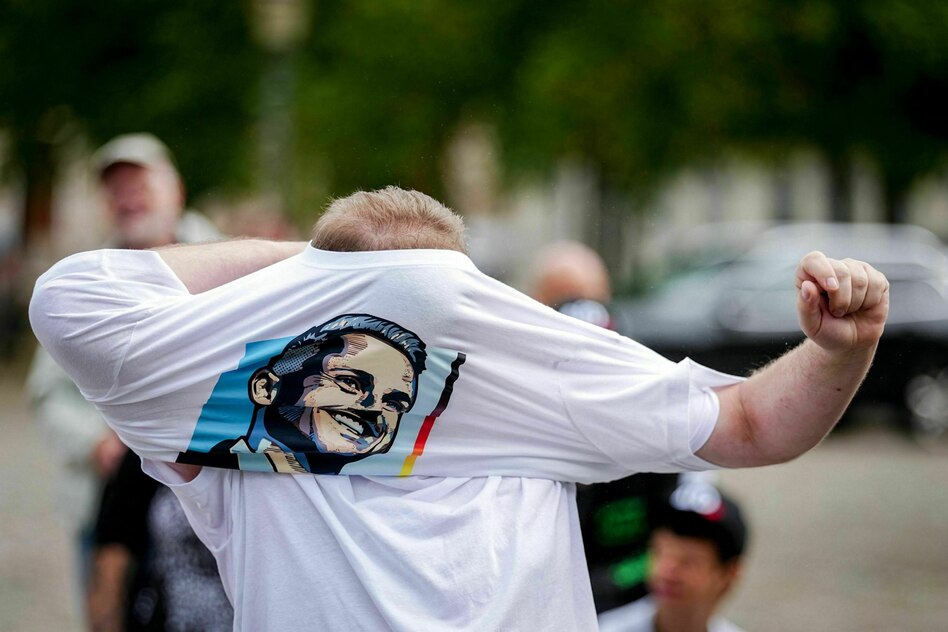
This is exactly where the charismatic candidate Ulrich Siegmund was able to score points. He was constantly present in these small public spaces, filled village inns and market squares and knew how to present himself as a person of respect and trust.
The taz is an independent, left-wing and opinionated daily newspaper. We have been arguing in our comments, essays and debate texts since the taz was founded in 1979. We often cannot and do not want to agree on an opinion. That's why you'll find some completely opposing positions here - all part of the very broad left-wing spectrum of opinions.
In the larger public sphere, in talk shows and political debates, the emphasis was instead on facts and arguments. People rubbed their eyes in amazement that statistics and scientific studies - for example on the financial viability of election promises - could not scratch the credibility of the Blues. Even tangible scandals such as nepotism – otherwise a knockout criterion for the outrage-sensitive public – could not harm the AfD.
The perplexity about this reveals a blind spot in the analysis of political communication: Credibility can arise in very different ways and claims to truth can come from very different sources.
The conversation about social reality is not limited to the question of whether a statement is empirically true or false. We can ask whether a factual statement is true, a norm or action is correct, and a speaker is truthful. Small publics can be democratically significant precisely because truthfulness and truth, experience and evidence, person and thing can be linked together without confusing them.
However, it is precisely this ability to differentiate that is in danger of being lost. Populist communication benefits from consciously pushing different modes of validity into one another. Personal experience then becomes a statement of fact, subjective certainty becomes evidence, sincerity becomes a criterion of truth, and belonging becomes a prerequisite for being able to recognize “what it really is like.”
Martin Luther found a drastic picture of a completely different historical constellation. When distinguishing between spiritual and secular government, he warns against their mixing: “The annoying devil does not stop cooking and brewing these two kingdoms together.”
Luther's two-empire doctrine cannot be easily transferred to the modern democratic public. But the image of “cooking and brewing together” meets the communicative challenge. It is not the churches that have become too political, which they are often accused of, but rather that too many religious expectations are placed on politics.
Where religious communication and confessional speech have become alien, there may also be a lack of practice in distinguishing between different forms of truth claims. Secularity alone does not guarantee an enlightened society - neither in the large nor in the small publics.
While observing the election campaign, I sometimes had the impression that I was watching less a political debate than an ethno-pluralistic religious community with a charismatic preacher. Where political beliefs become confessions, affiliation takes the place of justification and contradiction only strengthens one's own beliefs, the character of the democratic public sphere changes radically.
Fact-checking and campaign-like polarization in the “big publics” are hardly an effective remedy for trust that is built in small publics through personal relationships, shared experiences and social reputation. To avoid misunderstandings: Of course, this does not make this trust-based knowledge any more true than verifiable facts. But it explains why refuting a factual statement does not undermine a person's credibility.
is director of the Evangelical Academy of Saxony-Anhalt in Lutherstadt Wittenberg. As head of studies for theology and politics, he oversees the “Am Gartenzaun” project, which creates small public spaces in rural areas. This is currently being financed from state funds, which will no longer flow in the future.
Enlightenment requires recognizing, identifying and relating different claims to validity. It is not the diversity of truth claims that endangers the democratic public sphere. Things become dangerous where their categorical differences are no longer recognized and politics is assigned to be responsible for hope, confidence and a positive narrative.
Read the full story at the source →
Source: taz