
Politics · taz · 7h
Election in Saxony-Anhalt: victory disaster
Deutsch (original) · Auto-translated to English
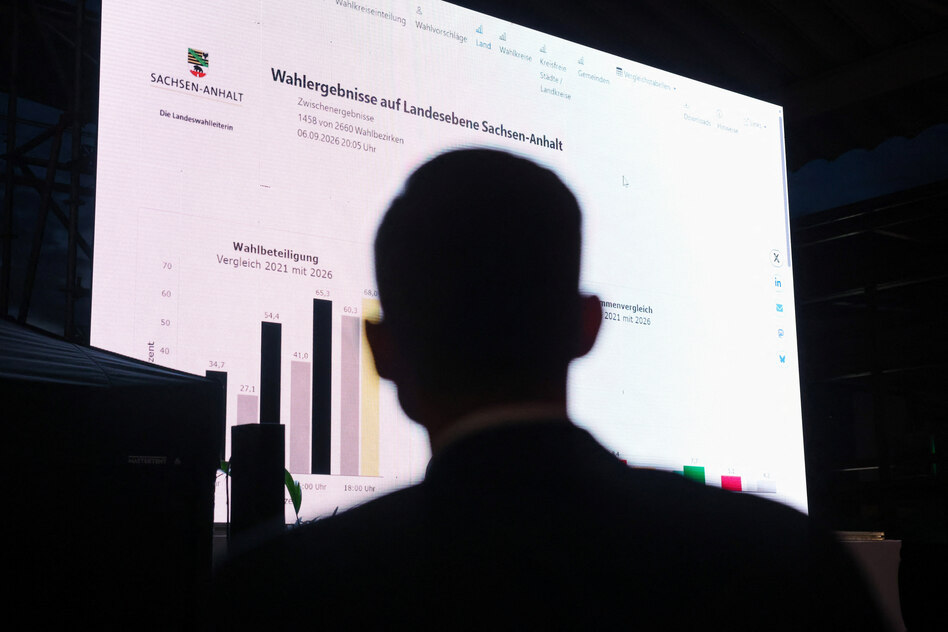
• A new state parliament was elected in Saxony-Anhalt, around 1.7 million were entitled to vote. The voter turnout of around 76 percent was higher than ever before in Saxony-Anhalt.
• The right-wing extremist AfD wins the election. The previous Germany coalition of CDU, SPD and FDP has clearly been voted out. According to the latest projections, the BSW will make it into the state parliament. This would make forming a government extremely difficult. The choice in graphics.
• A first demonstration has already taken place through Magdeburg. On Magdeburg Cathedral Square you can hear: “All together against fascism.” Hundreds of people also gathered in Berlin in the evening.
taz | According to the latest projections from ARD and ZDF, the BSW is certainly represented in the new state parliament. Both broadcasters see BSW at 5.1 percent. According to the state election management, almost 97 percent of the constituencies have now been counted, so the result is unlikely to change.
This means that the model that the current Prime Minister Sven Schulze (CDU) can remain in office with support, however defined, from the SPD, the Greens and the Left Party is off the table. Because even these four together have fewer seats than the AfD and BSW. In a vote in the state parliament, Schulze would not have a majority.
In the evening, the AfD repeatedly emphasized its claim to form the government. Ulrich Siegmund is apparently speculating on defectors from other parties. The right-wing extremist party is three seats short of an absolute majority. (ga)
taz | According to the organizer, 300-400 people met in front of the Saxony-Anhalt state representation near the Bundestag in the evening to demonstrate for a ban on the AfD. The rally was organized by the Association of Those Persecuted by the Nazi Regime - Association of Antifascists. “It’s very difficult to sit at home alone on an evening like this,” says Cornelia Kerth, the association’s chairwoman. “We want to send a signal that this election result does not mean the end of anti-fascism.” In addition to the Association of Anti-Fascists, speakers from the Alliance Resist also spoke at the rally. “Although we are all shocked today, our spirit remains resolute in the fight against fascism,” said Kerth. The rally was accompanied by two right-wing streamers and a large police presence. (ctt)
taz | At the AfD election party, a remix of Gigi d'Agostino's "L'Amours toujours", the AfD youth's foreigner-out anthem, is playing. Meanwhile, Siegmund gives interviews to the right-wing extremist Compact magazine. A bald security man, who has a skull tattooed on one side of his bald head and “Old School” in cursive script on the other side, pays attention to his safety. (gjo)
taz | According to infratest dimap, the AfD won 50 percent of the votes of all men voting and 40 percent of women voters. By age group, 42 percent of 18 to 24 year olds voted for the far-right party, 44 percent of 25 to 34 year olds, 53 percent of 35 to 44 year olds, 52 percent of 45 to 59 year olds, 47 percent of 60 to 69 year olds and 31 percent of people aged 70 or older. The analyzes also show that support for the AfD is highest among people with a basic education (57 percent), among workers (61 percent) and in a poor financial situation (65 percent). (efi)
taz | The AfD party leader Tino Chrupalla thanks the rich major donor Winfried Stöcker on the stage of the AfD election party in the “Altes Theater” in Magdeburg and then praises “our best election campaign supporter Friedrich Merz,” who would have insulted the East Germans as angry citizens. Merz's strategy in dealing with the AfD is essentially a hard anti-migration policy that is decoupled from facts, and today it has been shown again that this is paying off with the original. Chrupalla happily spreads this on Merz and the Union: "Friedrich Merz's motto was to halve the AfD. That was the motivation for us to say: We'll halve the CDU!" Rejoicing over the eroding party system follows immediately. (gjo)
taz | The BSW is well on its way to breaking the 5 percent hurdle. The ZDF, which saw the Wagenknecht party in the evening just below the mark for entry into the state parliament of Saxony-Anhalt, is now quoted by the BSW at just 5 percent in the current projection. On ARD it rose even further to 5.1 percent. Two thirds of the polling stations have been counted. If the trend is confirmed, the AfD will be a few votes further away from the absolute majority of votes. Since the BSW has already made it clear that it will abstain from voting in the event of Ulrich Siegmund being elected Prime Minister, the way could be clear for the first right-wing extremist to head a German government. (rru)
taz | The AfD achieved the strongest result of a right-wing extremist party in Saxony-Anhalt since 1945. Could it now also come to power, asks Gareth Joswig? He reports live from Magdeburg.
dpa | On the evening of the state elections in Saxony-Anhalt, several people took to the streets in Berlin against the AfD. A protest march marched through the government district under the motto “Defend democracy! – AfD ban now!” to the state representation of Saxony-Anhalt. Hundreds of demonstrators came - in the low three-digit range, the police said. According to the information, things remained quiet. A larger rally at the Brandenburg Gate has been announced for Monday evening under the title “NoAfD Protest”.
taz | Reactions to the result in Saxony-Anhalt are only relevant for Berlin if it means that an alliance of the CDU, SPD and Greens is eliminated as a coalition alternative, says Stefan Alberti
On election evening we will deliver initial analyzes from Saxony-Anhalt and speak to our correspondents and civil society. How do you assess the results and what do they mean for your work? Despite numerous threats, civil society has been at its best in recent months, but its work would be jeopardized if the AfD were to participate in government. How prepared is she for this? And how can you support them or become active yourself?
🐾 David Begrich is a social scientist and theologian as well as an employee of the right-wing extremism office at Miteinander e.V. in Magdeburg. He says the AfD was socialized in the West. But she found her socio-political resonance space in the East.
🐾 Robert Fietzke is a social worker for the socio-cultural center ZORA in Halberstadt and a member of the city council for Die Linke.
🐾 Bettina Schlauraff is the regional bishop in the district of Magdeburg.
dpa | After the FDP failed to re-enter the Magdeburg state parliament, Saxony-Anhalt's FDP state chairwoman Lydia Hüskens has announced her resignation. “Tomorrow we simply have to talk about how we do it, whether we do it with immediate effect or use the state party conference in April to make the change,” she told the German Press Agency.
taz | While the Left has suffered significant losses at the state level, it is heading for success in the two major cities of Magdeburg and Halle. In Magdeburg II and Halle III, their direct candidates Mustafa Groener and Jannik Balint are currently in the lead. Groener is at 28 percent in more than half of the constituencies counted, 5 percentage points ahead of the second-placed AfD candidate. And in Halle the left's lead is even larger: 40 percent for Jannik Balint, followed by the AfD candidate with 19 percent. Both constituencies most recently went to the CDU. (dmn)
taz | The Greens and the SPD performed significantly better than expected in the state elections in Saxony-Anhalt. However, at the expense of the CDU, David Muschenich and Tobias Schulze report from Magdeburg
taz | According to the voter migration analysis by infratest dimap, 83,000 of the previous CDU voters now voted for the AfD. This would mean that this party would have lost most of the votes to the AfD. In addition, 19,000 of the former FDP voters switched to the AfD. But even those who voted for left-wing parties in the last state election are now AfD voters: the right-wing extremist party was able to win over 11,000 former Left voters, 7,000 former SPD voters and 2,000 former Green voters. However, it received the most support from non-voters: 157,000 in number. However, the AfD lost 2,000 votes to the BSW. (efi)
dpa/taz | The AfD's top candidate in Mecklenburg-Western Pomerania, Leif-Erik Holm, described his party's victory in the state elections in Saxony-Anhalt as a turning point. “This fantastic success gives us in Mecklenburg-Western Pomerania a real tailwind for the last two weeks of the election campaign,” said Holm, who traveled to Magdeburg on election day. The blue wave will now continue to spill from Magdeburg to Schwerin, he predicted. He announced that he wanted to end the “red-red government disaster” under Prime Minister Manuela Schwesig. A new state parliament will be elected in MV on September 20th. In recent surveys, the extreme right is also ahead in Mecklenburg-Western Pomerania, but is stagnating at 35 percent. In contrast, the SPD has recently caught up strongly and is currently at 32 percent. The CDU, which has just suffered a crushing defeat in Saxony-Anhalt, is threatened with the next disaster in two weeks. In surveys it is at 8 percent. (rru)
taz | CDU Prime Minister Sven Schulze also blames the “Tactically Vote” campaigns for his party’s catastrophic performance in the state elections. That played a role, he said on ZDF. At the same time, he admitted that until a few weeks ago the CDU had “not really succeeded” in bringing the differences between state and federal issues to the forefront. When asked whether he would allow himself to be tolerated by the left, he explained that it was still “too early” to answer that question. In the current ZDF projection, the CDU is at 18.2 percent, minus 18.9 percentage points compared to the 2021 election. (rru)
taz | Top candidate Armin Willingmann arrives at the SPD election party. The comrades welcome him with cheers and a standing ovation. They form a crowd and fall silent, as if they were expecting a speech. But he only turns to one TV team. The SPD people are slowly dispersing again. (dmn)
taz | After the clear vote for the AfD in Saxony-Anhalt, other, new answers are needed. Democratic forces must now stick together, comments taz editor-in-chief Katrin Gottschalk.
taz | The postal vote counting in Magdeburg is organized centrally in the Otto von Guericke vocational school and a building at the Magdeburg University. Election workers who are not doing this for the first time report that there have never been so many election observers. In some rooms there are several people walking around and taking notes. The right-wing extremist association “One Percent” even called for reinforcements on X. The narrative of voter fraud in postal voting is popular with the right. (CD)
taz | Before the election, the AfD in Saxony-Anhalt is raising doubts about postal voting and warning of possible fraud. In Magdeburg, election workers meet right-wing election observers. Clara Dünkler observed the postal voting for the taz.
taz | After the AfD's election victory in Saxony-Anhalt, BSW top candidate Claudia Wittig explained on ARD that it was "completely undemocratic" not to allow the extreme right to participate in the government. In any case, the Wagenknecht party is preparing for cooperation: “There are of course projects that we can very well imagine working together with the AfD,” says Wittig, smiling friendly next to AfD leader Alice Weidel. She makes it clear: “We talk to every sensible party.” What the BSW means. In the current projection, ZDF sees the BSW still at 4.8 percent, the ARD still at 5 percent (rru)
taz | The buffet at the Green Party's election party in Magdeburg has now opened. When AfD top candidate Siegmund appeared on the TV screen in an ARD interview a few minutes after 6 p.m., the event management had turned down the sound. The next moment, Federal Chairman Felix Banaszak came onto the stage and, to cheers, spoke of “probably the best election result of all time”. Immediately afterwards, with a view to the overall result, he added: "There will be at least two hearts beating in your chest. We also have to give space to the heart that is full of fear." (tsc)
taz | FDP federal leader Wolfgang Kubicki appears in front of the cameras in Berlin, visibly contrite. “This is a bitter day for the entire party and it is also a bitter day for me,” says the 74-year-old, who has only been in office since May. He would have liked a different result. “But wishes don’t come true on a regular basis.” According to ZDF's current projections, the FDP is out in Saxony-Anhalt.
Just a few days ago, Kubicki had hoped for over 5 percent. On Sunday he gave the slogan that we now have to look ahead optimistically: “This will not stop us as Free Democrats on our path.” Finally, he wishes the press “a lot of fun”. (rru)
rtr | The AfD in particular benefits from the exceptionally high voter turnout in Saxony-Anhalt. According to an analysis by ARD, eligible voters who did not go to the polls in the last state election primarily voted for the AfD. The party gained around 157,000 votes. Another 83,000 votes went from the CDU to the AfD. According to ZDF, voter turnout was 80 percent, significantly higher than the 60.3 percent in the last state election in 2021.
taz | The first projections from ARD and ZDF are here. Accordingly, the right-wing extremist AfD has 44.1 to 44.5 percent. The CDU plummets to a catastrophic 18.5 percent. The left loses and is at 9.2 to 9.4 percent. The SPD and the Greens are each fighting for fourth place. The Social Democrats are seen between 8.2 and 8.8 percent, the Greens between 8.7 and 8.9 percent. The BSW continues to tilt, the ARD sees the Wagenknecht party at exactly 5 percent, the ZDF just below at 4.8 percent. But one thing is certain: the FDP is out. The AfD would not have an absolute majority. (rru)
rtr | Prime Minister and CDU leader Sven Schulze admitted the CDU's defeat and congratulated the AfD on its election victory. Schulze leaves open on ARD how he and the CDU will proceed. However, he emphasizes that this is not a “black day” for Saxony-Anhalt. “I say this is democracy and people went to vote today,” he says. “It is now important for those who have responsibility in the state parliament, but also beyond Saxony-Anhalt, to deal with it and to recognize this sign.”
afp | CDU General Secretary Franziska Hoppermann has ruled out federal political consequences from the CDU's defeat in the state elections in Saxony-Anhalt. There will now be no discussion about Chancellor Friedrich Merz (CDU) and the federal government, said Hoppermann on Sunday on ARD. “The federal government and the German Bundestag have been elected for four years,” and this was not up for debate in Saxony-Anhalt.
Hoppermann acknowledged the defeat of the CDU, which, according to initial forecasts, achieved its worst result in history. “This is an overall defeat for the Christian Democrats,” said the CDU general secretary. Hoppermann categorically ruled out a coalition with the AfD, which will be by far the strongest force. “We do not work with extremes and especially not with right-wing extremists.”
taz | A menacing siren. That's what you hear first when the first election forecasts come over the cell phones of the approximately 400 people who gathered on the cathedral square in Magdeburg for the rally of the Saxony-Anhalt Weltoffen civil society alliance. The siren sounds from the converted demonstration vehicle of the Center for Political Beauty. Smoke also emanates from this.
At first almost nothing happens. Shocked, some people hold their hands to their mouths and can hardly believe the initial forecast. 44 percent for the AfD, which is said to be just one seat short of an absolute majority - that's even worse than many here expected. It takes five minutes until “All together against fascism” is shouted for the first time. (tk)
taz | At the postal polling station at 6 p.m. sharp, the still closed letters with the ballot papers are tipped onto the table. The first ones are now being opened. An election observer wants to know whether she can ask a question. Actually not, the election workers have to be undisturbed. But she still asks the question: “How do you know that you don’t have any of the duplicate voting letters?” the woman asks. This has already been checked before, the election worker answers. The constituency counted here was not affected by the postal voting documents that were issued twice. Magdeburg had already declared the 440 sent twice as invalid and reissued them accordingly. (CD)
taz | Stunning spreads across the Hotel Maritim in Magdeburg when the first forecast appears on the big screen. Embarrassed faces, loud exhalations, a sip of beer - this is how the Christian Democrats reacted who gathered here at the Hotel Maritim in Magdeburg for what is commonly called an election party. But the CDU is light years away from a party atmosphere. Shock is much better.
In the first forecast, 18.5 percent are recorded for their own party, 44 percent for the AfD. ZDF calculates that the right-wing extremist party is only one seat short of an absolute majority. “I’m speechless,” says one woman. She had expected a bad result, but not that bad. “The voters don’t want it any other way,” says a stunned man. He was very involved in the election campaign, sometimes handing out flyers in front of the bakery at 8 a.m. on Saturdays. And now this. (sam)
taz | The first forecasts after the polling stations closed confirm the expected election victory of the right-wing extremists in Saxony-Anhalt. According to ZDF, the AfD around top candidate Ulrich Siegmund received 44 percent of the vote. The ARD sees the AfD at 44.5 percent. Siegmund's goal was “45 percent plus X”. Either way, the right-wing extremist party in Saxony-Anhalt has recorded a massive increase compared to the 2021 election, when the AfD got 20.8.
Far behind the AfD is Prime Minister Sven Schulze's CDU. ZDF and ARD see the CDU at 18.5 percent. A crash like no other: in 2021, the CDU got 37.1 percent.
The Left is weakening and is at 9 percent on ZDF and 9.5 percent on ARD (2021: 11 percent). The SPD achieved 9 percent (ZDF) and 8 percent (ARD), thus remaining secure in the state parliament (2021: 8.4 percent).
The same applies to the Greens, who are making significant gains. In the forecast they are estimated at 8.5 percent (ZDF) and 9 percent (ARD) (2021: 5.9 percent).
The Sahra Wagenknecht Alliance (BSW), which is the only one of all parties to have announced that it wants to work with the AfD if it enters parliament, must be trembling. The BSW forecasts 4.8 percent (ZDF) and 5 percent (ARD).
On the other hand, the FDP, which is still co-ruling in Magdeburg, is safely out with forecast values of between 2.5 percent (ZDF) and 2 percent (ARD) (2021: 6.4 percent). The fall of the Liberals continues. They not only lose another parliamentary representation, but also the last German participation in government. (rru)
taz | Maritim Hotel, Magdeburg. People are slowly arriving at the CDU election party, and there are still more journalists than party members on site. The mood is “tense,” says a Christian Democrat. Sven Schulze, the CDU Prime Minister, is expected here at around 6:15 p.m. (sam)
taz | The SPD election party is taking place in the “Magic Kitchen” in Magdeburg. A small buffet is prepared. The first candidates arrive. Shaking hands here, laughing there. The conversations revolve around the election. Is the high voter turnout a good sign? The postal votes are definitely there. There are jokes about the long election campaign. Otherwise everyone is waiting for the first forecast. (dmn)
epd | The Catholic Bishop of Magdeburg, Gerhard Feige, called for social responsibility and humane coexistence on the occasion of the state elections in Saxony-Anhalt. In his sermon for the diocesan pilgrimage on the grounds of the Huysburg monastery near Halberstadt on Sunday morning, Feige warned of a social climate in which prejudices, demarcations and self-interests were increasing: "At the moment that means in a special way resisting the nationalistic and xenophobic evil spirit," he said. According to the diocese, around 3,000 people took part in the pilgrimage on Sunday. Its motto was “You shall be a blessing!”
rtr | The voter turnout in the state election was 65.3 percent at 4 p.m., significantly higher than in the 2021 election. At that time, the turnout was 41 percent at the same time. Only in 1998 was overall voter turnout higher at 71.7 percent. It is likely that this mark will also be broken: these numbers do not even include postal voters. The total of around 2,130 polling stations in the country are open until 6 p.m.
What does it do to a place when neighbors can no longer talk to each other because one half votes for AfD and the other half is fearfully silent? A well-read report from a visit home to Ziegelsleben in the Börde district in Saxony-Anhalt by taz author Juliane Baxmann.
taz | There is a lot of work going on in front of the state parliament on the cathedral square in Magdeburg, where a rally by the broad civil society alliance Saxony-Anhalt cosmopolitan is taking place in the evening. About two dozen people crawl on the ground to line up colorful papers and secure them to the ground with rocks. This will one day become a huge lettering “We remain colorful”. "Just to show that we don't want this brown shit. We want diversity, we want to live like that," explains a woman with dreadlocks, laughing. “No matter how the election turns out!” she reiterates. (tk)
taz | In the vain search for left-wing riots that right-wing media have been painting on the wall for weeks, the concentrated collection of right-wing streamers besieged around 50 young activists from dogmatic communist groups. They hold banners in the air that say “socialism or barbarism”. They try in vain to protect themselves from the cameras and microphones that the streamers shamelessly shove in their faces so that they can still hear some sentence that they can exploit.
Then the communists change their strategy - and begin to loudly explain to the audience of the right-wing streams how East Germany has been systematically left behind since the "annexation" in 1990. “Voting tactically” now is just shifting the problem because the other parties don’t stand for real change either. In the end, everyone would represent the interests of the corporations. Change therefore only occurs when young people “organize themselves collectively and become a subject of the revolutionary struggle”. The activists are about to walk to Hasselbachplatz and back. (tk)
taz | At the Otto von Guericke vocational school in Magdeburg, election workers begin checking the validity of the voting slips that are included with the postal voting documents. First, the letters are sorted neatly. There are an estimated 500 pink letters on the table. Sorting is done by electoral district and in stacks of ten. A total of 7 election workers have come together in one room and are doing their work in a very focused manner.
After an initial count, they came to 424 postal voting documents submitted. A guest who is wearing an AfD shirt and an AfD cap and is looking at the work of the election workers causes some irritation. “I am from Canada,” he says when the taz asks him what he is doing at the polling station. (nka/cd)
taz | Saxony-Anhalt's CDU Prime Minister Sven Schulze is worried about the future of his state in the face of the AfD - and was not alone in this at the taz election forum in Magdeburg. Previously, four volunteers from Saxony-Anhalt reported on their fight for democracy at the Civil Society Forum. Here is the recording of the discussion of all the top candidates and the discussion of the volunteers.
taz | Streamers from the extreme right spectrum and a lot of police cars gather in front of the main train station in Magdeburg. The “No Tomorrow for Fascists” demonstration is about to begin here. It was advertised from the spectrum of the dogmatic left. No participants have been identified yet. That's why the streamers are content to ask passers-by about the election. Meanwhile, the first officers get out of the police cars and put on protective equipment. (dmn)
taz | The election in Saxony-Anhalt not only showed a significantly higher turnout, but now even a record one. As of 2 p.m., voter turnout was a whopping 54.4 percent, according to the state returning officer. For comparison: In the last state election on June 6, 2021, it was only 27.1 percent at 2 p.m. In general, turnout at this time has never been this high since the first post-reunification election in 1990. Only the ballot box vote is counted here. (rru)
taz | At halftime, Hertha BSC has not yet saved democracy. Die Zeit had expressed the hope that right-wing football fans from Magdeburg would not make it to the polling stations. “Complete nonsense,” comments Vincent Bruckmann-Levinson in the taz: “The polling stations open at 8 a.m. and the game starts at 1:30 p.m.” And on top of that: “Football fans, especially those who organize themselves, are important for democracy.” By the way, the game is 1-1 at halftime. Around 7,000 people from Magdeburg are said to have traveled to Berlin for the game. (ras)
taz | It is reminiscent of the band on the “Titanic”, which played until the end: On the side of the state parliament building in Magdeburg there is a small stage where a jazz band plays. “The best feel-good songs from different eras,” the moderator announces the saxophone troupe. A man in his 60s is walking on the sidelines with his German flag. Another rushes after him and strikes. The band continues to play stoically. (CD)
taz | Sahra Wagenknecht from the star that bears her name senses a big conspiracy. “We know that shortly before elections we suddenly get very bad results in some surveys,” she explained in an interview with t-online when it was pointed out that her BSW in Saxony-Anhalt was consistently rated below 5 percent in all pre-election surveys. “Perhaps certain institutes are not in a position to collect reliable data,” added Wagenknecht. (rru)
taz | FDP leader Wolfgang Kubicki is also concerned with the supposedly dubious value of surveys. The Liberals in Saxony-Anhalt were recently stuck at 3 percent. Kubicki still believes that his party will get 5 to 6 percent after the polls close. The low party loyalty in the East, the many undecided people: In the state elections five years ago, the institutes ultimately missed the mark by 10 points, Kubicki told the taz.
What he is right about: In 2021, all opinion research institutes predicted a neck-and-neck race between the CDU and AfD just a few days before the election. In the end, the CDU got 37 percent, the AfD 21 percent. In retrospect, the last Insa survey before the election in particular seemed embarrassingly wrong, with a maximum deviation from the election result of 10.1 percentage points to the disadvantage of the CDU.
Now discrepancies between surveys and results are more the rule. In the election in Baden-Württemberg in March of this year, for example, the maximum Insa deviation was 6.2 points, in this case to the disadvantage of the Greens. An imbalance like that in Saxony-Anhalt in 2021 is still exceptional. Even the ZDF election research group, which is considered to be highly reputable, came up with a maximum deviation of 7.1 points.
A small setback for Wolfgang Kubicki's hopes: Five years ago, of all things, all the institutes in the FDP in Saxony-Anhalt were almost right. The forecast was 6.5 to 7 percent, and in the election the Liberals got 6.4 percent. (rru)
taz | Jörg Schönenborn, the ruler of bar, pie and column charts and thus something like the Gereon Asmuth of ARD, is now again referring to the “special features of the federal state of Saxony-Anhalt” as a precautionary measure with a view to the pre-election polls. Precisely the low party loyalty and the high willingness of voters to change. “If the result on Sunday in Saxony-Anhalt comes very close to the pre-election polls,” that would be “really unusual” for Saxony-Anhalt, said Schönenborn. (rru)
Thousands celebrated democracy and civil society on Saturday in the Saxony-Anhalt state capital Magdeburg. Before the election, they take courage and promise to stay together - no matter what happens. taz correspondent David Muschenich was there.
afp | In the state elections in Saxony-Anhalt there was a significantly higher turnout at midday. By 12 p.m. on Sunday, 34.72 percent of those eligible to vote had cast their votes, as the state returning officer in Magdeburg announced. At the same time in 2021, in the last state election, it was only 22.4 percent.
taz | The polling station in downtown Magdeburg is quite quiet, two voters are currently casting their votes. Nevertheless: “A good 200 people were already here today,” says the returning officer. The journalist was referred to him. “Difficult cases for him,” one of the election workers had said when she identified herself as taz. There are almost 1,200 eligible voters in the constituency, says the returning officer. 50 percent of them had already voted by postal vote. (CD)
taz | The top candidate of the AfD and right-wing extremist sunny boy Ulrich Siegmund cast his vote in the state elections in Saxony-Anhalt on Sunday morning. With his wife he drove up to the polling station in Tangermünde on a Simson.
The AfD is doing particularly well among the workforce. The taz looked into Magdeburg and Rügen to find out what moves people and what would change their minds.
dpa | Hape Kerkeling receives the Golden Hen - and uses the moment to make a recommendation for the state elections in Saxony-Anhalt. “If you cast your vote on Sunday, then you are also voting for the MDR, the Mitteldeutscher Rundfunk and its radio waves,” said the 61-year-old in his acceptance speech at the weekend. “And if you don’t do it, I’ll come by personally with a flashlight and a microphone and broadcast to you alone,” Kerkeling continued.
The AfD in Saxony-Anhalt had announced that it would terminate the state broadcasting contracts in the event of a sole government. The party is in favor of a fundamental reorganization of public broadcasting.
taz | In the morning, Magdeburg's streets are empty on Sundays. In front of the train station and in the pedestrian zone, there is little to indicate what decisive election Saxony-Anhalt is facing today. The first election poster that greets travelers at the station forecourt is from the party “Die Party”. There is an alarm clock that says 7:33 p.m. Above this is the sentence: “You must have overslept.” (CD)
dpa/taz | The election campaign is over, today the decision is made: If the SPD, Left and FDP fail to pass the five percent threshold, the AfD can govern alone. But at least the party with the right-wing extremist Sunnyboy as the top candidate will be the strongest force in the state parliament. If the AfD misses this goal, a CDU-led minority government could come into play. However, this could rely on votes from the left – similar to Saxony and Thuringia. The problem: In a party conference resolution, the CDU rejects a coalition and “similar forms of cooperation” with the Left as well as with the AfD.
Prime Minister Sven Schulze's (CDU) wish scenario: a majority for the so-called center parties - such as the CDU, SPD and the Greens. Given the polls, that seems very unlikely. A coalition of CDU, SPD and FDP currently governs Magdeburg.
On the eve of the election, thousands of Antifa march through Halle and Magdeburg. Always there: the struggle to continue on site - or to leave. Timm Kühn was there for the taz.
In the state elections in Saxony-Anhalt, the AfD could succeed in winning an absolute majority for the first time. Several organizations have therefore called on eligible voters to cast their votes tactically in order to prevent an AfD government.
Because the five percent threshold excludes small parties from allocating seats, the right-wing extremists do not necessarily need more than 50 percent of the two votes for an absolute majority. If a particularly large number of parties fail just at the hurdle, a good 40 percent of the second votes could be enough.
Anyone who wants to vote tactically can therefore vote for smaller parties that could fall below the five percent threshold. In Saxony-Anhalt, the SPD and Greens in particular were above the polls with 8 and 6 percent respectively. If both make it into the new state parliament, the AfD's chance of an absolute majority will decrease significantly.
In the prefabricated buildings in Halle-Neustadt, younger people with a migration background and older people with a GDR background live next door to each other. Some are allowed to vote in state elections, others are not. taz reporter Anne Fromm was there before the election.
taz | Voters have been able to cast their votes at around 2,600 polling stations since 8 a.m. All Germans over the age of 18 who have lived in the state for at least 3 months are eligible to vote - around 1.69 million people. The polls close at 6 p.m.
Direct candidates are elected in 41 constituencies. In addition, 42 additional representatives are usually elected via the second vote.
taz According to all surveys, the AfD is the strongest party. Last seen between 40 and 43 percent. She did particularly well at the Insa Institute, which conducted many surveys on behalf of the right-wing populist website Nius. Insa also saw the BSW close to the five percent threshold several times, which had offered itself to the AfD as a possible partner.
The second strongest party will probably be the CDU of incumbent Prime Minister Sven Schulze. It was most recently at 22 to 23 percent. That would be a dramatic loss compared to the last election 5 years ago. After a surprising final spurt, the CDU reached 37 percent and left the AfD far behind.
The left is seen by the institutes at between 11 and 13 percent. The SPD has recovered slightly after a poll low that threatened to fall below the five percent threshold and was most recently at 8 percent. The Greens must probably be worried about getting back into the state parliament.
Nowhere is it better known that surveys do not predict election results than in Saxony-Anhalt. In the last election, the Union won 7 to 10 percentage points more than it had been given in surveys. Conversely, the AfD was around 5 percentage points weaker than expected. Such postponements cannot be ruled out on this election Sunday either. But you could also go completely in the other direction.
taz | Statisticians at the Ludwig Maximilians University in Munich have created a tool that can be used to calculate the probability of different election outcomes based on the surveys.
At koala.stat.uni-muenchen.de you can see, for example, that in Saxony-Anhalt it is very unlikely that any conceivable coalition will achieve a majority. According to statisticians, there is only a 7 percent chance that the AfD will achieve a solo victory. Everyone else has no chance at all.
What is particularly interesting is the analysis by the various survey institutes. If you only use the values of the Insa commissioned by the right, the probability of an AfD sole government increases to 38 percent.
Read the full story at the source →
Source: taz