
Politics taz
Election in Israel: Kingmaker without connection
The Arab Ra'am party could decide Israel's next government. She fights against violence and for more rights for her voters - including electricity in houses. more...
Deutsch (original) ·Auto-translated to English
Waleed Al-Hawashleh is a member of the Knesset, the Israeli parliament. And he also looks like a deputy: his light blue shirt is wrinkle-free and neatly tucked into his pants, his glasses are frameless, his haircut is practical and short. He commutes a little over 100 kilometers between his work in Jerusalem and the village of Sa'wa, where he lives. So far, so normal.
But on the roof of Al-Hawashleh's house there is a row of solar panels, and there is another one in the garden, set up vertically. Behind it stretches the Negev desert, called Naqab in Arabic. Al-Hawashleh nods towards the solar panels and says: “I am a member of the Knesset, but my house does not have electricity.” The entire village, like many here in southern Israel, is not connected to the state electricity grid.
Al-Hawashleh is Bedouin and therefore part of the Arab minority in Israel. Around 2.1 million of a total of around 10.3 million citizens in Israel grew up with Arabic as their mother tongue. The largest proportion of them are Muslims, just over 80 percent, the rest Christians and Druze. Many of them, with the exception of the Druze, describe themselves as Palestinians or as “48ers” – that is, Palestinians who remained on its current territory when the state of Israel was founded in 1948.
Like Jewish citizens, they have the right to vote and to stand for election. There will be elections in Israel on Tuesday. Al-Hawashleh, who already sits in the Knesset, is running again.
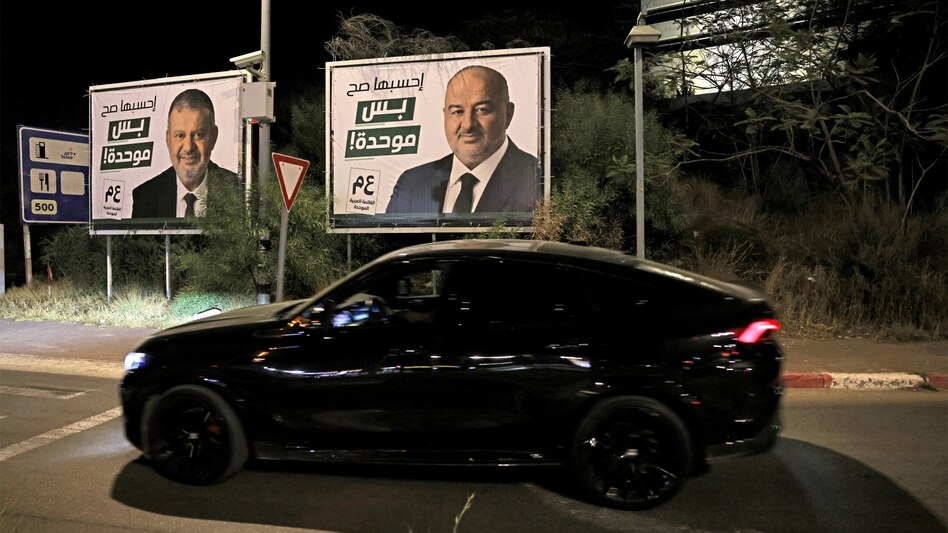
Two Arab parties are on the electoral list this time: the Joint List, which consists of the Hadash, Ta’al and Balad parties. And the Ra’am, Waleed Al-Hawashle’s party. In this Knesset election they could be decisive for the formation of a government. According to surveys, neither the opposition bloc nor the bloc of current Prime Minister Benjamin Netanyahu achieve the necessary 61 seats for a government majority. Both blocs are missing around six to ten seats, depending on the survey. In order to get over the hurdle, they would need partners.
The Joint List is more secular, left-wing, and partly Arab-nationalist in orientation. All three parties that make it up are opposition parties. They have no aspirations to help form an Israeli government.
Completely different Ra’am. The party has already been in the government coalition once - under the so-called Government of Change from 2021 to 2022. And in this election it also wants to be part of a government coalition again.
So will Ra’am become the kingmaker? What does the party stand for? And who chooses them?
Mansour Abbas is the party leader and is number one on the Ra’am candidate list. The taz meets him in a party office in Zarzir, a Bedouin village near Nazareth in northern Israel. Eight seats, he says, are Ra’am’s goal in the elections. He calculates: The opposition parties will probably get around 53 seats in the Knesset in the election, as various surveys suggest. They were therefore eight seats short of a majority. “They would have to include us in their coalition negotiations,” emphasizes Abbas.
The opposition bloc includes Yashar, the center-right party of former general Gadi Eisenkot, as well as B’Yachad of Yair Lapid and Naftali Bennett. Lapid is considered a centrist, Bennett is further to the right of center. There is also Yisrael Beitenu, Avigdor Liberman's right-wing party, which for a long time found support primarily among Israelis with roots in the former Soviet Union. The camp is completed by the center-left Democratic Party.
But apart from the Democrats, hardly anyone shows any willingness to form a coalition with Ra'am. And this despite the fact that Lapid and Bennet were already in a coalition with the party. Since October 7, 2023, Israel has changed.
At that time, Hamas and other Palestinian militias from the Gaza Strip invaded the south of the country; Around 1,200 people were killed and 251 hostages were taken to the Gaza Strip.
A joint study by Tel Aviv University and the Ramallah-based Palestinian Center for Policy and Survey Research (PCPSR) recently showed that only about one in ten Jewish Israelis still trusts Palestinians. Pain, fear, but also hatred run deep. Many people in Israel lack trust in their fellow Arab citizens in the state.
Among the victims on October 7th were 21 Bedouins, five Arab Israelis from the north, a Palestinian from East Jerusalem and five Palestinians from the Gaza Strip who were legally staying in Israel as workers. Seven of the 21 Bedouin victims were killed by rocket fire from the Gaza Strip, and 14 were killed at close range. Seven Bedouins were also taken hostage; not everyone survived. Also among the soldiers who died in the wars after October 7th are Druze and Bedouins, Arab citizens of Israel.
The Bedouins were the largest Arab casualty group on October 7th. A large part of Israel's Bedouin population lives in the Negev - and therefore close to the Gaza Strip. A smaller part lives in the north, in the Galilee. The Bedouins are also Ra'am's main constituency. In the 2022 election, two-thirds of Bedouins in the north voted for Ra’am; In the south it was slightly higher at almost 74 percent.
There are several reasons why so many Bedouins were killed on October 7th. One of them: Many of those killed and kidnapped worked in the kibbutzim along the border, which were particularly heavily attacked.
Like Hamed Abo Arrar. On October 7, 2023, his pregnant wife Fatma Alttalaqat takes him from their home in Ar'arat an-Naqab to his work in the fields near the Gaza Strip. Her six-month-old son is also in the car. They stop at a red light at an intersection. Hamed Abo Arrar says he saw them there today in his house in Ar'arat an-Naqab: Hamas fighters, several of them.
“You saw that my wife was wearing a headscarf,” he says. “They saw that we had a Koran in the car.” Still they shoot. Fatma Alttalaqat dies immediately, along with her unborn child. The baby is injured in the shoulder. The fighters apparently also think Hamed and his son are dead. They leave the dead behind.
Hamed Abo Arrar is hiding in an electrical box with his son. From there he watches as more Hamas fighters arrive. He contacts the military and the police. He talks to them again and again for three hours, he says. Then his phone battery runs out.
When the military finally arrived at the intersection hours later, he heard Hamas fighters preparing an ambush behind his hiding place. He makes a decision. He says he ran, carrying his son in his arms, straight towards the soldiers. He warns them about the ambush. The soldiers survive. Hamed and his son too.
For his courage, he will later receive a permanent residence permit in Israel. Because Abo Arrar comes from the Gaza Strip, a Bedouin from Rafah. His wife was a Bedouin from Israel. Their nine children are also Israeli citizens.
He says he knows many Jewish fellow citizens. “They all want to live in peace, and I want to live in peace too.” He continues to believe that good relationships are possible. Despite October 7th - and despite the right-wing radical forces in the current Israeli government.
The ideology of ministers Itamar Ben Gvir and Bezalel Smotrich is similar to that of Hamas, he says. And both would destroy Israel, just as Hamas destroyed Gaza. Israel, he says, was built by great men. A work that Ben Gvir and Smotrich destroyed today.
All eligible Arabs in Israel should go to the polls on October 27, he emphasizes. This is the only way to replace the right-wing government and restore security for Arabs and Jews. From the election on October 27th. depends a lot, he says. If a right-wing to right-wing extremist government were to come to power again, everyone in the country would have “a big problem”.
"I support any Arab party that wants to get involved in politics in Israel, including in the government. And I am against any party that threatens the Arab-Jewish partnership in this country," says Abo Arrar.
It is therefore quite clear which of the Arab parties he likes, without Hamed Abo Arrar explicitly saying their name. Party leader Mansour Abbas said in an interview with the taz that they naturally wanted to poach votes from the other Arab electoral list, the Joint List: “You don’t need them.” In the opposition, a seat is more or less irrelevant.
Ra’am currently holds five seats in the Knesset. So she is missing three more seats to achieve Abbas’ wish of eight mandates. The declared goal is to win new voices from all parts of Israeli society: liberal Muslims, Christians, Druze, Jews – they are all being courted by Ra’am. We open ourselves up to everyone, emphasizes Abbas. The most important topic of Ra'am, the increasing violence in the Arab community, may also be relevant for some Christians and Jews. The attacks also affect places with mixed Arab-Jewish populations, such as the city of Lod.
When Ra'am first took part in elections in 1996, she represented a very specific group within Arab Israeli society: conservative Muslims. Ra'am has its origins in the Islamic movement in Israel, which was close to the Muslim Brotherhood. Sheikh Abdullah Nimar Darwish founded the movement in 1971. For a while it stood for violence: at the end of the 1970s it supported armed cells, which, however, mainly caused property damage. Their goal was an Arab-Muslim state on the entire territory of the former British Mandate of Palestine - i.e. in today's Israel, the West Bank and the Gaza Strip.
The Israeli authorities arrested Darwish in 1981 and he was released in 1983, apparently a reformed man. The new narrative of the Islamic movement was that one had to be politically active in Israel with Islamic values without breaking the law. And it worked: She won mandates at the local and municipal level in more and more places.
In the mid-1990s, the movement split into a north and a south wing. The reasons for the separation: The attitude to the Oslo peace process between Israel and the Palestinians, which the more pragmatic south wing supported, but the more ideological north wing rejected. There was also disagreement over the question of whether participation in the Knesset elections in Israel could be legitimate. The South Wing spoke in favor of it; obtained appropriate Islamic jurisprudence and separated from the north wing. This was officially banned in 2015, and well-known faces of the group are still calling for a boycott of the Knesset election in 2026.
The political arm of the south wing eventually became Ra’am. Its chairman became Mansour Abbas and he continued to drive the de-radicalization process forward. At the beginning of 2026, he announced his separation from the Islamic Movement and its Shura Council, the religious advisory body that had previously determined the fate of the party.
Abbas also put a Zionist-Jewish politician on the electoral list for the first time. Yoav Segalovich is now in second place, directly behind himself. “Right-wing parties and politicians repeatedly make racist statements against the Arab part of Israeli society,” he says. “With Segalovich we are setting an example for cooperation.” Segalovich is also a pioneer in the fight against criminal groups, both Jewish-Israeli and Arab-Israeli. He therefore has supporters on both sides of society.
In fact, a wave of violence is currently holding Israel's Arab society in suspense. Since the start of the term of the current government - and of the Minister of Internal Security, Ben Gvir, who also oversees the police - incidents have increased significantly. 2025 was the deadliest year to date with 252 victims. In the first half of 2026 alone, 144 murder victims were counted.
However, the development of criminal structures goes back further: in an attempted assassination attempt on a Jewish mafioso in Tel Aviv in 2003, three people were killed because they were in the wrong place at the wrong time. The police then took tough action against organized crime in Jewish society. The power vacuum was filled by Arab criminal groups that had previously functioned more as henchmen of the mafia. One of their businesses: granting informal loans to Arab Israelis. If you can't pay it back with hard currency, you'll pay differently.
It is a matter of great concern to many citizens that the state is finally doing something to counteract this violent crime in the Arab community. It is also one of Ra’am’s key campaign promises.
The second promise is aimed at the core Bedouin electorate. Ra'am politician Waleed Al-Hawashleh is one of many in the Negev who do not have electricity in their homes. After all, he says, his village has been officially recognized since 2003. But little has changed since then.
The path to his house is a gravel road; only a few paths in the village are paved. There is a mosque, a few houses and containers that act as apartments. A tanker truck brings drinking water and electricity comes from the solar panels on the roofs.
The situation is even more precarious in the villages that Israel has not yet officially recognized. Many residents there are threatened with the demolition of their houses because they do not have the necessary building permits. The number of demolitions has continued to rise since 2022, from around 2,800 to over 5,000 in 2024. Itamar Ben Gvir even advertises that he is proud of the demolitions. Law and order will be restored in the Negev and state control will be restored.
This is also why Ra'am is calling on the people in the villages to go to the polls: against the demolition madness of Ben Gvir.
But the polling stations are often far away from the Bedouin villages. And women vote less often in this extremely conservative society characterized by traditional Islam. Israeli initiatives are trying to remedy the situation: They are organizing bus trips to the polling stations, especially for women.
The Israeli government's calculation: It wants to gather the Bedouins in so-called planned cities. Hamed Abo Arrar's house is also in such a planned city, Ar'arat an-Naqab. The concept of making the Bedouins sedentary and settling them in cities is not an Israeli invention. The southern Israeli city of Beer Sheva was once established under Ottoman rule for this very purpose, then under the name Bir As-Sab.
Waleed Al-Hawashleh says: He doesn't know anyone whose relatives haven't had a house demolished. And Mansour Abbas says: Taking action against the house demolitions is one of the party's concerns.
In Israel, Abbas says, political parties often represent certain social groups. There are, for example, two ultra-Orthodox parties: one for the Ashkenazi Jews, whose ancestors came to Israel from Europe. And one for the Mizrahi Jews who came from the countries of West Asia and North Africa. This influences the government, he says, everyone makes politics for their clientele. “And if you are not part of the coalition and the government, no one cares about the concerns of your own group.”
Eight mandates for Ra'am could mean that the Arab and especially the Bedouin community will get their issues on the government agenda, as Abbas and Al-Hawashleh see it. Eight mandates could also ensure that the anti-Netanyahu bloc comes to government power - if it decides to work with Ra'am.
And what about the Palestinians who are not Israeli citizens but live under Israeli military occupation in the West Bank or continue to suffer the consequences of war in the Gaza Strip? They all say they believe in a two-state solution – Al-Hawashleh, Abbas, Abo Arrar. But you have to concentrate on the concerns of your own electorate in Israel, say Al-Hawashleh and Abbas.
If Ra'am becomes the kingmaker and with her help an opposition coalition emerges, Waleed Al-Hawashleh might actually be able to get electricity for his village. Perhaps a new government will call for an independent inquiry into Black October - the day on which Abo Arrar lost his wife and almost his own life.
“He doesn't sleep well,” says Hamed Abo Arrar about his son, who survived with him hidden in the electrical box and holds him tightly in his arms. He never married again; his family helps the widower raise his nine children. He is traumatized - like many in this deeply divided, conflict-stricken Israel. “The future of the country depends on this election,” says Abo Arrar. This applies to everyone – to Jews as well as to Arabs.