
Germany · taz · · 2h
EU Commission proposal: Canada could become an “associate EU member” – what does that mean?
Deutsch (original) · Auto-translated to English
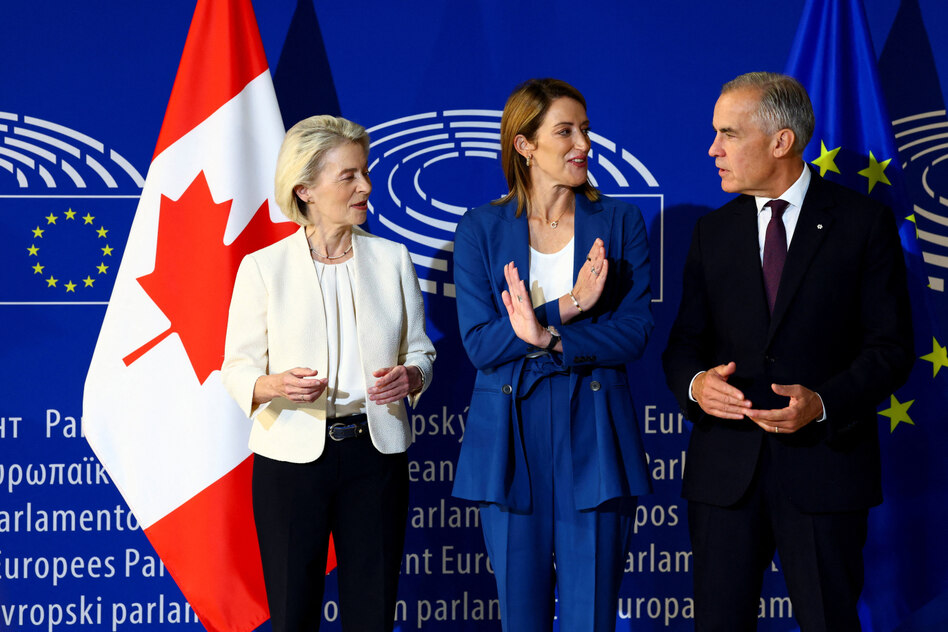
It is a novelty in many respects. To great applause, Canadian Prime Minister Mark Carney entered the plenary session of the European Parliament in Strasbourg on Wednesday, becoming the first sitting prime minister ever to listen as EU Commission President Ursula von der Leyen outlined her political plans for the coming year to parliamentarians in her “State of the European Union” speech. Listen as something is proposed that doesn't exist yet: Canada could become an "associate EU member." What's behind it?
“We want to take the relationship with Canada to the highest possible level,” von der Leyen announced in her speech. In the direction of Carney, she said: "Dear Mark, I mentioned that we urgently need to rethink our partnerships. I would like to work with you towards Canada becoming the first associated member of the EU." Von der Leyen left it open what exactly an associated member should be.
“Nobody really knows what that means,” the Reuters news agency quoted an EU diplomat as saying. There is a fear in EU circles that the head of the Commission will promise things that she will ultimately not be able to keep. The member states alone and unanimously decide on enlargement policy. The EU Commission can only make recommendations.
According to political scientist Laura von Daniels from the Science and Politics Foundation, associate membership could mean Canada taking part in EU summits in the future. “But of course without the right to vote,” she told Deutschlandfunk. Such membership could also mean holding an observer position at the EU institutions such as the Commission, Parliament and Council or “opening up individual EU programs to Canada,” said von Daniels. Canada has already joined the Safe defense procurement program and is taking part in Pesco joint EU defense projects.
Associated membership is also being discussed for Ukraine. Chancellor Friedrich Merz (CDU) made this suggestion last May because the country cannot join the EU in a state of war. Accordingly, Kyiv should be allowed to take part in summits and councils of ministers, have the right to speak, but not the right to vote. Merz suggested something similar for the Western Balkan states. However, this has not yet been implemented - many member states view such interim memberships with skepticism.
An alternative to EU membership is joining the European Economic Area (EEA). The EEA is a free trade area that includes all 27 EU countries as well as three states of the European Free Trade Association (EFTA): Norway, Liechtenstein and Iceland. Only Efta member Switzerland is not part of the EEA.
Anyone who has access to the EEA is committed to the “four fundamental freedoms” of the European internal market: free movement of goods, people, services and capital. This means that the three Efta states have to adhere to all EU rules without having a say in determining them themselves. Only the areas of agricultural and trade policy are excluded.
According to the Efta Treaty, “any state” can join the organization, whereas the EEA agreement refers to “European states”.
It is questionable whether Efta or EEA membership could be interesting for Canada. Experts assume that Canada is primarily hostile to the principle of free movement of people.
Canada already has simplified access to the European market through a joint trade agreement with the EU. “Ceta” was signed in October 2016 and has been applied provisionally since 2017 as not all member states have ratified it nationally.
According to Article 49 of the EU Treaty, “any European state” that respects EU values can theoretically become a member, provided it meets the political, legal and economic criteria for membership. Many therefore argue that full membership for Canada is not legally possible.
However, what exactly “European state” means is not defined in more detail. At least a purely geographical attribution is not meant, because EU member Cyprus is geographically completely part of Asia. Rather, a “cultural affiliation” is crucial, for which there is no definition.
Therefore, one could argue, for example, that according to the census, around 50 to 60 percent of Canadians say they have European roots, so “cultural belonging” is a given. In the past, the EU has always been happy to resort to its legal bag of tricks in order to somehow implement what was politically desired.
However: Morocco's application for EU membership failed in the 1970s. The North African kingdom was given the reason for not being a European state. However, this could also have been a pretextual argument. Or a diplomatic rejection because Morocco did not meet other accession criteria.
If Canada were to become a proper EU member with voting rights, this would significantly shift the balance of power in Brussels. In terms of population, Canada would be the fifth largest country after Germany, France, Italy and Spain - with corresponding voting power. It would also be the fourth largest economy and definitely a net contributor to the EU budget.
Prime Minister Mark Carney said a few days ago that his country was seeking a “unique alliance” with the EU, but not full membership.
“The hurdles for this are also very high,” says political scientist von Daniels. “This is of course completely clear to a rational planner like Mark Carney.” Ultimately, Canada's aim is to reduce its enormous economic dependence on the USA.
According to a Canadian official quoted by the Brussels news portal Politico, the idea of associated membership came from Brussels and was not a suggestion from Carney.
This Thursday, the Canadian Prime Minister will speak to the European Parliament and specify his ideas for deeper cooperation.
Expectable. The US President has threatened the EU with a trade ban if it develops a closer partnership with Canada. “I think it’s ridiculous,” Trump told reporters on Wednesday about EU Commission President Ursula von der Leyen’s plan. “If they do that and I see it as even the slightest bit of a hostile act, I will impose very high tariffs or stop trade with Europe.”
Read the full story at the source
Source: taz