
World taz
Before midterm elections in the USA: Cuban exiles turn away from Republicans
The Little Havana district in Miami is traditionally considered a Republican stronghold. But that could change in the US congressional elections in November. more...
Deutsch (original) ·Auto-translated to English
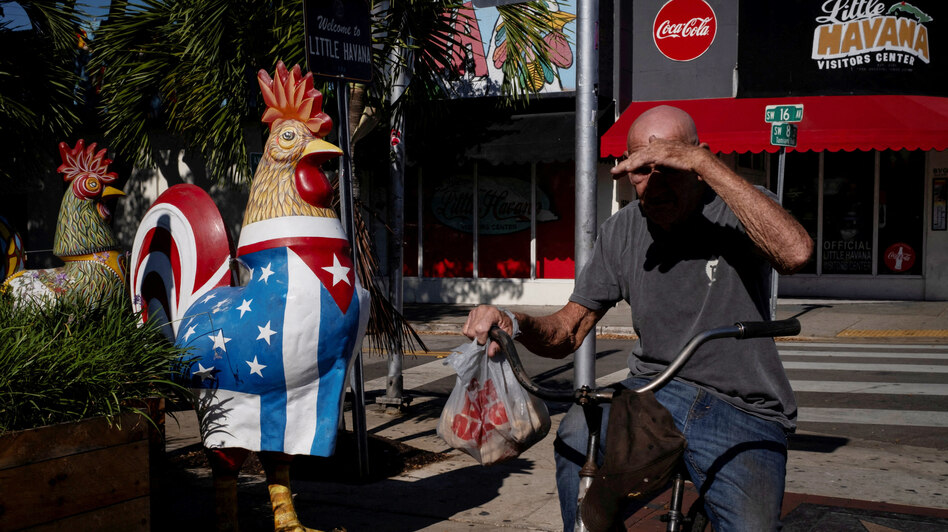
T he Café Versailles calls itself “the most famous Cuban restaurant in the world”. At the “ventanilla”, the legendary street stall in Versailles, you can get classic Cuban coffee – strong and very sweet. A few tourists come by to eat typical Cuban food. And then there's this plaque hanging there. “In recognition of the Cubans who have never resigned themselves to living without freedom,” it reads, along with the outline of Cuba, the country that over 1.2 million people call home here in Little Havana, Miami. A home that is only a few hundred kilometers away - and to which many have not been able or willing to return for years.
Away from the tourists, almost only Spanish is spoken in Little Havana. In some corners you get the feeling of being in Cuba.
This is also his home, says the middle-aged man in the ironed shirt who coordinates the Café Versailles, while the service staff in green uniforms hand out one coffee after the next. “Versailles is an iconic place,” he says. The Cuban exile community has met here since it was founded in 1971, and demonstrations have also taken place here from time to time. But recently things have become quiet. On October 16th, two and a half weeks before the congressional elections, there is hardly any talk about politics at the bar, more about the heat or salsa.
This text first appeared in wochentaz, our weekly newspaper from the left!
Every week, wochentaz is about the world as it is – and as it could be. A left-wing weekly newspaper with a voice, attitude and the special taz view of the world. New every Saturday at the kiosk and of course by subscription.
And yet things are rarely apolitical in Little Havana. “La lucha”, the liberation struggle against the autocratic Cuban regime of the Castro brothers, which is now continued by Miguel Díaz-Canel, is always present here. For 67 years, this fight from exile has been waged in a variety of ways, often with armed force.
Today's Secretary of State Marco Rubio also promised to "liberate the island from communism" during the election campaign together with Donald Trump two years ago. Rubio, who grew up in Miami as the son of Cuban exiles in the tradition of the liberation struggle, enjoys great popularity within his community. In the nearby “American Museum of the Cuban Diaspora” he is celebrated as “a new force in American politics”, a glimmer of hope for the Cuban exile community.
The Cuban-Americans in Miami-Dade County, the regional administrative unit, have always been considered rather Republican. But in the 2024 presidential election, almost 70 percent of them voted for Trump - a historic high that was decisive in the Republicans winning the district that has been dominated by Democrats for almost 40 years. This is probably due to Rubio's promises.
Little has happened in US foreign policy regarding Cuba since then, apart from a tightening of the economic blockade and some half-hearted hints from Donald Trump about possible deals. And the arrest warrant against Raúl Castro, the 95-year-old former head of state of Cuba, which was issued in Florida in mid-October. Actually, Cuba needs to be opened up economically, says the Versailles operator, so that the infrastructure can be rebuilt. He also still has family in Cuba and the situation is worse than ever. “But nothing will happen under Trump,” he says firmly, but quietly, as if he didn’t want to be heard by the guests. "He made the promise just to get our votes, but he didn't deliver. This time he will lose."
And there is something else that will cost the Republicans Cuban votes in the congressional elections, he says: their migration policy. The deployment of the immigration agency ICE and the deportations of migrants have also hit the Cuban community hard. Since Trump's second term in office, there have been repeated cases of Cubans who had actually applied for a residence permit in the USA but were arrested instead. Some are said to have been deported to Cuba or even to third countries.
There are many Cubans with insecure residency in Little Havana; they are friends and family members of Cuban-Americans who are eligible to vote. The deportation cases cause resentment and fear. And they could complicate the re-election of Republican Congresswoman María Elvira Salazar. She also comes from Little Havana and is the daughter of Cuban refugees. A few weeks ago she publicly spoke out against Donald Trump's immigration policy in a video. He “went too far”.
“Sure, last minute because the elections are coming up,” says Guena Rodriguez disapprovingly. Since 2020, he has been running the Spanish-language YouTube channel “23 y Flagler” with daily videos and live streams on US politics, primarily aimed at the Cuban community. Rodriguez is in his early 40s and grew up in Cuba, where he studied law. He came to the USA in 2013, during the Obama era. "My goal was to transform Cuba by opening up the market. We failed catastrophically," he says. Today he has US citizenship and calls himself “the Cuban face of the opposition to Trumpism.”
Salsa music is playing in Latin Café 2000, not far from Versailles. According to Rodriguez, the Cuban food is much better here. He says he is waging a “personal war against María Elvira.” When he speaks, he speaks clearly and with the appropriate hand movements of a Youtuber. “What she has done over the last two years, such as supporting Alligator Alcatraz, is unforgivable,” he says, referring to the migrant detention and deportation facility near Miami, which has since been forced to close following protests against inhumane detention conditions and violations of the protection of indigenous lands. "Salazar will lose. She has the wind against her."
“Migration terror,” said Rodriguez, and rising inflation have led some Cubans to change their attitude toward the “demagogue” Trump. It's not just Rodriguez who says that, it's also what the polls show, which see both candidates neck and neck. And: In December 2025, Eileen Higgins, a Democrat, won the election as mayor of Miami for the first time in 30 years.
On his channel, Rodriguez openly supports Democratic candidate Eliott Rodriguez, also the son of Cuban immigrants. “The outcome in our district is unclear, but it will be an indication of whether the majority of Cubans are still on Trump’s side,” says Guena Rodriguez, and then, after a pause: “The Cubans change when they come to Miami.” Many are getting lost in the materialism and consumerism of the USA. But the new generation has a harder time than those who came to Miami in the 80s, had money and helped build the city. Many Cubans now worked in low-paying jobs, often in the service sector, in a city that had become very expensive.
Nevertheless, according to Rodriguez, the tough Trump supporters are mostly those who have immigrated in recent years: There is a certain pressure in the community to prove that you are not a communist in order to find connection and work. A statement that you come across here again and again. “I too have been accused of being a Cuban agent,” he says. “It’s not that everyone loves Trump, there’s also a lot of fear, adjustment and interests.”
And Marco Rubio's promises? "It's all a lie. In the end, the real sufferers are the Cubans on the island, who the US government doesn't care about," says Rodriguez, also referring to his family, whom he hasn't seen in over seven years. For him, the three Cuban representatives in Congress are “traitors.” “They had Cubans deported, prevented stays from being regulated, and imposed sanctions on Cuba so that people there can’t even go to the hospital,” he says angrily.
The open attitude that Rodriguez represents on his channel is rarely found in Miami's Cuban community. The progressive Cubans mostly live in New York or New Jersey. In Miami, on the other hand, the decades-long unsuccessful struggle against the Castro regime is glorified. This is particularly noticeable along Calle Ocho, one of Little Havana's main streets. Old Cuban men play dominoes in the park and smoke cigars.
In addition to folklore, cigar and salsa shops, there is also a monument with an eternal flame. It is intended to commemorate the failed Bay of Pigs Invasion in 1961, a CIA-backed military attack on the island by Cuban exiles. The message is clear: communism must be fought. If necessary, with a weapon in your hand. A liberation can only come through an invasion from outside. Or?
Finding an alternative to this entrenched black and white narrative is difficult. Brian González knows this too. He is 28 years old, works in the tech sector and is a supporter of the Democratic Socialists of America (DSA). On October 17th, around 70 people of all ages gathered on the No Kings day of action against Donald Trump, which itself took place in conservative Miami. There is music, home-baked food, speeches, lots of flyers and stickers. González stands at the DSA stand in a red “DSA Miami” shirt. He is the only Cuban-American here.
He makes it clear: "Cuban-Americans are just Americans. Outside of the Cuba issue, they vote the way the average American votes. If the price of gas goes up, they vote for the other party." González came to Miami as a child; his parents are Cuban and, politically speaking, now “average Americans,” he says. They would have voted for Obama and for Trump. Regarding Cuba, they are clearly in favor of military intervention, as promised by Marco Rubio.
González himself is involved in the “Cuban-Americans for Cuba”, a newly founded organization that opposes the US blockade of Cuba and strives for a normalization of relations. He wants to create a space, especially for Cuban-Americans who have never been to Cuba themselves, to reconnect culturally with Cuba. "We are Americans and Cubans, and we don't want to see our people starving. Or being bombed," he says firmly. “We don’t want American intervention like in Iran and so many other places around the world.” That's a shame for everyone. Nevertheless, there is a consensus among Cubans in Miami that everything in Cuba must be destroyed in order to then rebuild it according to capitalist ideas.
Brian González would rather give local people the opportunity to decide for themselves what they want. For him, Rubio's promises are a personal vendetta on which he built his political career. He fears that Cuba will ultimately become a second Puerto Rico, a satellite state with a Trump Tower and tax advantages for large companies that then exploit the cheap labor on the island.
González cannot talk about his left-wing stance with his family, which is influenced by communism on the island. He knows that. "There are parallels to the Israel-Palestine conflict. I have spoken to many anti-Zionist Jews. Their family dynamics are similar to my experience with my parents. It is difficult to talk about other perspectives," he says somewhat resignedly.
Cuban exile Ramón Saúl Sánchez has been trying to create a different perspective within the Cuban community, away from the vicious circle of violence, for decades. About 30 years ago he founded the “Movimiento Democracia” movement, which exercises peaceful resistance against the Cuban regime from exile. Today Sánchez is 72 years old. He hasn't lost his fighting spirit. His desk is in a meeting room in the building that he manages full-time, with a computer, camera and recording device on it. Here he regularly records political podcasts. He even used to have his own radio show, he says.
When Sánchez speaks, he appears humble and reflective. A person who has a lot to say. Photos of dissidents and victims of the Cuban regime hang on the walls. The shelves are full of folders with photos and newspaper clippings from the actions of the last 30 years. The archive of his movement.
He openly describes Donald Trump as an anti-democrat. Since his candidacy, he has publicly advocated against him and against a solution for Cuba like in Venezuela. At the beginning of the year, US forces kidnapped dictator Nicolás Maduro and his wife in order to bring them to trial in the US. At the end of August, Trump reached an agreement with current President Delcy Rodríguez that guaranteed the USA more than 65 billion barrels of Venezuelan oil reserves.
“It is not freedom to make an agreement with a dictatorship so that American companies can do their business,” Sánchez said. Not everyone within the community agrees with him. He points to comments under his videos. “Viva Trump,” someone writes, for example. Sánchez tries to explain: "Not everyone is right-wing. The right-wingers just have a better understanding of how to properly address the Cuba issue. They talk to us and they trick us."
Ramón Saúl Sánchez belongs to a different generation than Guena Rodriguez and Brian González - the generation that grew up with the idea that the only way to resist the regime in Cuba was through armed struggle. Born on the island in 1954, his parents sent him into exile at the age of 12 on the “vuelos de la libertad”, the freedom flights. At 15, he joined the paramilitary group Alpha 66. “I trained in armed combat in the Everglades, I’m a guerrilla,” he says with a laugh.
In the early 1980s, he was scheduled to testify before a grand jury as part of the investigation into a planned assassination attempt on Fidel Castro. Sánchez refused and was sent to prison for four and a half years. When he got out again, he decided that the way of fighting had to change: away from violence and towards non-violent resistance and civil disobedience. He pauses as he tells the story and fights back tears: “In fact, many were prepared to give up what they had learned out of love for Cuba and take this step with me.”
“Movimiento Democracia” began helping Cubans trying to get to Florida in boats. With lawsuits, media campaigns, blockades, hunger strikes and sit-ins, they campaigned to ensure that refugees were not sent back. On his cell phone, Sánchez shows phone numbers that have contacted him over the years because there is no official contact point for boat refugees. There are hundreds. Then he talks about the flotillas with their ship “Democracia”.
He shows a video of an action from 1995: Sánchez at the bow of the ship, 30 years younger, wearing an orange life jacket. Escorted by speedboats and planes, they entered Cuban waters to the place where a year earlier the Cuban regime had sunk a boat carrying refugees, killing 37 people, including 10 children. They symbolically lay flowers there. The images of them being chased by the Cuban Coast Guard could have come from an action movie.
“Under the current conditions, freedom for Cuba means having access to clean drinking water or keeping medicine in the fridge,” says Sánchez. Trump plays with these feelings. And Marco Rubio? “He owes it to the community that raised him to come here and listen to their opinions.”
Sánchez is convinced that many Cubans will vote for the Democrats this time. He himself has no right to vote. “I have fought for democracy my whole life and have never been allowed to exercise the right to cast a ballot,” he says. He has been waiting for US citizenship for 25 years. For some time now he has had to fear being deported himself. A court has stopped this for the time being. But what Sánchez is most worried about is what could happen on and after November 3 if Trump does not accept the election results.
Giving up is not an option for him. "Sometimes my wife asks me: What have you changed? At least I haven't surrendered. I want to do what I can until the last day of my life," he says. "Hopefully the moment will come at some point when we no longer think in terms of walls and borders and see ourselves as people. But that depends on each individual."
The research was made possible by the Daniel Haufler scholarship from the taz panter foundation.