
Politics taz
Rape trial in Hamburg: FLINTA* are spreading
A man accused of rape wants to deny the allegations as publicly as possible. Now there is protest on behalf of those affected. more...
Deutsch (original) ·Auto-translated to English
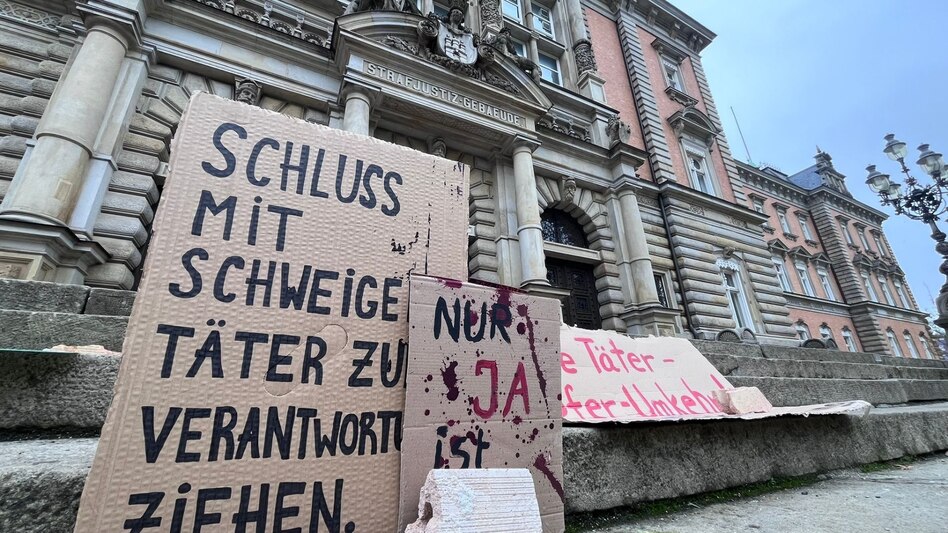
Every single one of the 25 seats in the audience is occupied before the start of the hearing. There is not a single man among them. Those who no longer fit in are standing down in front of the criminal justice building. "No perpetrator-victim reversal! Solidarity instead of intimidation," reads a sign that the protesters placed on the stairs in front of the criminal justice building.
35-year-old Omar Habeid* is accused of raping and mistreating his ex-wife Yara Sayed*. Sayed testified in court on Wednesday. At the start of the trial in September, the chamber wanted to exclude the public from the trial. The defendant protested his innocence and said he wanted to do this in public.
“We suspected that her ex-husband would appear with a lot of male company at the time of her testimony,” says Michaela Wolf, who accompanies 21-year-old Sayed as a social and trauma educator. “I didn’t want Yara to have to deal with this situation alone.” That’s why Wolf turned to the “Stop Femicide” network via Instagram. In a short time, dozens of supporters from different directions came forward.
Already on Monday evening there were more than would have fit in the courtroom. Therefore, as a precautionary measure, a member of the anti-feminicide network registered an event in front of the courthouse. "Actually, my goal was just to have as many women as possible in the courtroom. After the appeal on social media, it got bigger," says Wolf. “Both I and Yara are very grateful for the support.”
FLINTA* stands for women, lesbians, intersex, non-binary, transgender and agender people. The star symbolizes a placeholder for all people who cannot be identified in any of the letters, but are still affected by marginalization due to their gender identity.
The word is intended to make gender diversity more visible. For example, if a group is called a “women’s group” even though there is a non-binary person there who looks like a woman to most people, they could feel left out.
The spectators keep throwing glances at the entrance. The expectation of meeting the defendant's supporters is in the air. It is not known whether Habeid did not mobilize at all in the end or whether his companion dropped out. In any case, no one came.
To hear Sayed's statement, the crowd of supporters has to go outside again. Even if the process as a whole is public, the court can exclude the public from individual points of the hearing. This is common, for example, if the expected statement mentions things that, if discussed publicly, would violate interests worthy of protection. This will be revoked if the person concerned objects.
When Sayed testified, her ex-husband and his lawyer Gabriele Heinicke were also in the room. She is a left-wing scene lawyer, but believes that defense in sexual crime cases has “nothing to do with feminism, sexism or discrimination.” It is the rule that witnesses testify in the presence of the accused. Spatial separation is only possible in exceptional cases if there is “an urgent risk of serious disadvantage” for the well-being of the witnesses, as the Code of Criminal Procedure states.
Sayed's lawyer is unable to attend today. In contrast to the defendant, the presence of a lawyer is optional for her as a witness. But Sayed has psychosocial support during the process. For example, she can request breaks or provide Sayed with psychological support if she is very stressed by the process. The Bundestag recently passed a change in the law that will make access to this type of assistance easier and improve the pay of the companions.
At the time of the alleged crime, Yara Sayed was only 16 years old and was probably married to 31-year-old Omar Habeid according to Islamic law. He explained the injuries, some of which were documented by a doctor, at the start of the trial by saying that his wife quickly got bruises due to an illness.
“Even though the supporters had to leave the room to testify, Yara felt very encouraged by all the support,” says Wolf after the appointment. She was allowed into the courtroom as a confidant because she did not know Sayed at the time of the alleged crime. A verdict is expected to be made at the end of November.