
Germany taz
Uruguay's timber industry under scrutiny: An agreement with a green coat of paint
The downside of monocultural forestry is evident on the Río de la Plata. It uses huge amounts of water and harms the environment. more...
Deutsch (original) ·Auto-translated to English
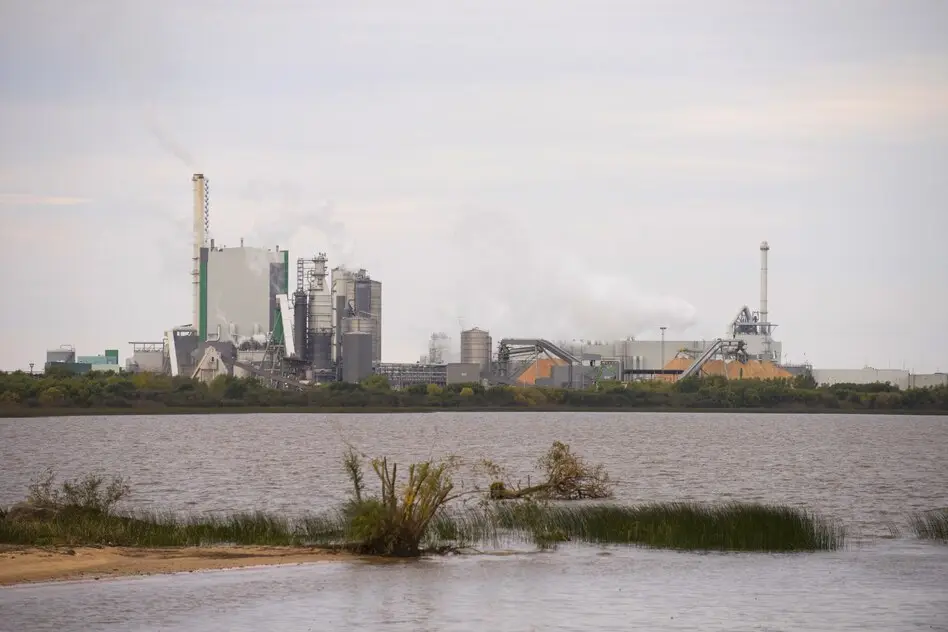
When it rains heavily, the mouth of the Río de la Plata is covered with green algae. Igor Alexandro already knows this. The toxic algae are caused by cyanobacteria, which form in the river due to the influence of agrochemicals. “The bacteria are a clear indicator of the pressure from the agricultural industry,” says Alexandro.
When he is asked what he thinks of the EU-Mercosur agreement, he begins to complain. “The asymmetry of the agreement will mean that nothing changes,” he is certain. In any case, it will not lead to anything good for the environment and the people living in the region. Instead, there will be more forestry and poorer soils and an increase in extracted raw materials that are exported without adding value.
15 journalists from 12 Latin American countries are taking part in the “Euromérica” workshop organized by the taz panter foundation. It's about the opportunities and challenges of the EU-Mercosur agreement and Latin American-European relations. A supplement will appear in the taz on December 5th, and there will be a public talk in the taz canteen on December 9th. All texts can be found here.
Alexandro is a 69-year-old retired sailor who lives a few minutes from the Río de la Plata on his farm near Colonia del Sacramento, where he grows vegetables, tends local fruit trees and raises animals for his own use.
Cattle, soy and wood are the most important export goods in the Río de la Plata basin and at the same time the greatest threat to its environment. The European Union is the second-largest buyer of wood from Uruguay after China, importing $687 million worth of wood products last year. Colonia is one of the most fertile departments in the country and home to Montes del Plata, one of the youngest pulp mills. It was built with Chilean and Finnish capital.
“In our country, eucalyptus and pine monocultures have been expanding for more than 35 years, coupled with promises of jobs and development,” warned “Ni una Hectárea Más Forestada” (No More Hectares of Reforestation) last year. This is an alliance of 75 civil society organizations concerned about the impact of reforestation projects in Uruguay and to which Igor Alexandro belongs.
The alliance noted that to date, almost half of forestry workers work in the informal sector. At the same time, it is the economic sector in which wealth and land are concentrated like no other - more than 700,000 hectares of forest are in the hands of 39 large companies alone.
There is strong evidence that forestry plantations are causing serious damage to the environment in Uruguay. Watersheds located in reforestation areas reduce their water runoff by up to half and lose up to 30 percent of their flow, studies from the Universidad de la República (UDELAR), the country's largest university, show. The recharge capacities of groundwater reservoirs are also affected.
Uruguay shares the Guaraní groundwater reservoir with its neighbors Argentina, Paraguay and Brazil. It is the third largest in the world and is located exactly where forestry monoculture is most pronounced. The Finnish company UPM's two pulp mills in Uruguay alone require 12,000 million liters of water every day.
Support the taz panter foundation and its international projects with a donation. Learn more
This corresponds to the consumption of 96 million people in a country with only around 3 million inhabitants that already has major problems with water supply: In 2023, Uruguay suffered from a severe drought for over a year - and two thirds of the population were without drinking water for three months.
However, monocultural forestry also affects biodiversity and the populations of native fauna and flora. The herbicides used by the forestry industry have long been banned in Europe - but are still common in Argentina, Brazil, Paraguay and Uruguay.
Between 2009 and 2023, Montes del Plata and UPM, the two pulp mills with Finnish participation in Uruguay, were fined or sanctioned at least 65 times, says researcher Daniel Pena from UDELAR, who analyzed the fines against the transnational companies. They had “repeatedly violated environmental regulations” or their “reporting to the authorities” was inadequate.
The plants use the infrastructure financed by the state: In order to encourage UPM to invest, the Uruguayan government covered the costs of building a railway network primarily used by the Finnish group, the cost of which was estimated to be up to 3 billion US dollars.
In addition to “tax exemptions and benefits in free trade zones, wealth, water and soil fertility are exported in the form of wood and cellulose,” said the coordination group against deforestation in Uruguay.
After putting the chickens in their coop and air-drying a freshly slaughtered lamb, Igor Alexandro speaks openly about his fears at his Laguamanda farm. He does not believe that cyanobacteria will disappear from local waters with the EU-Mercosur agreement. Quite the opposite. Things could get worse.
For Alexandro, the free trade agreement alone is “deepening a development model that in our latitudes only benefits a very privileged minority from the financial sector and multinational corporations”.
Guillermo Garat is a freelance journalist from Uruguay. He works, among other things, for the cooperative daily newspaper la diaria.
Translated from Spanish by Ole Schulz