
Germany · taz · · 2h
On the way with the Deutsche Bahn: Hope is the last stop
Deutsch (original) · Auto-translated to English
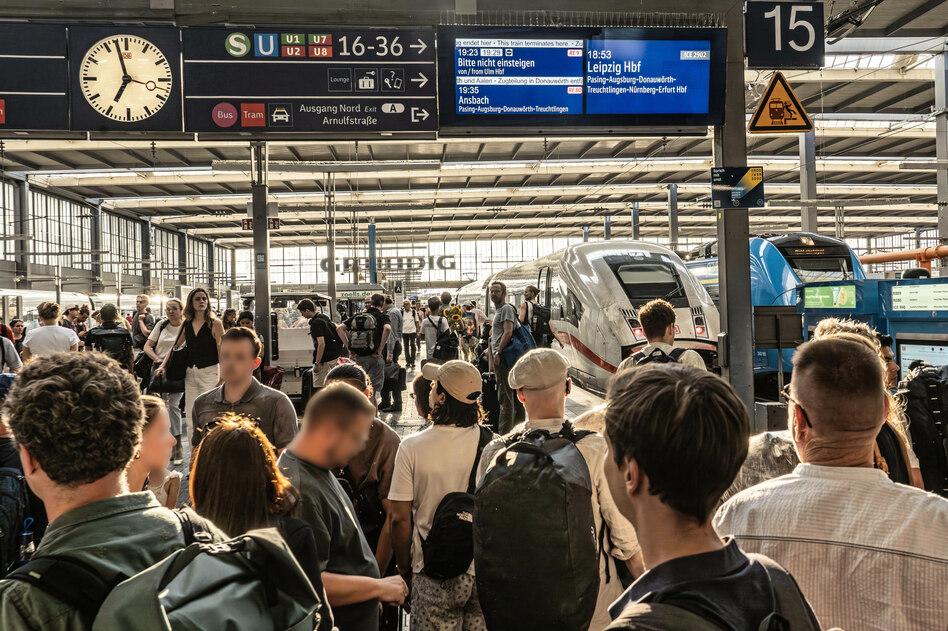
I travel by train a lot. Very much. There are weeks when I'm on a reading tour where I drive every day. Or have to drive. And the cliché is true: So many things go wrong on these trips that I keep asking myself: If this state can't even manage regular rail traffic - how is it supposed to cope with challenges such as the climate crisis, wealth inequality and the rise of an authoritarian party?
Yes, that is exaggerated and exaggerated. At the same time, I can't help myself if I end up in an abandoned regional train station at night again because the train isn't coming. If I have to leave three hours early in case there are delays again, or if I can't work on the train because the WiFi doesn't work or I don't have a seat. After this week, in which I took the regional train over long distances over four days, I did the math: I lost five hours of sleep, ten hours of working time and ultimately 150 euros because a trip was canceled and I had to pay for a taxi.
Such complaints have a tendency to sound self-centered, I understand that. And in a world of wars and crises, that is a privileged view in every respect. There is actually a fair amount of annoyance in these complaints. At the same time, sometimes I wonder whether people who don't travel by train often actually know how big these problems are. And whether the urgency of having to solve these problems in the midst of a climate and energy crisis has really reached political decision-makers.
The taz is an independent, left-wing and opinionated daily newspaper. We have been arguing in our comments, essays and debate texts since the taz was founded in 1979. We often cannot and do not want to agree on an opinion. That's why you'll find some completely opposing positions here - all part of the very broad left-wing spectrum of opinions.
I'm always happy when people say that their train journey went really well, the train was on time, the on-board bistro was open and the toilet was clean. That gives me a bit of hope that it will work somehow. At least until the next train ride. The new “infraplan” that the Ministry of Transport is presenting this week should also promise a bit of hope. It is intended, it says, to “bring transparency, trust and reliability back to the rail system”.
The reality looks like this for now: A few days ago I was standing on a regional train between Karlsruhe and Stuttgart. The app already showed: Several cars are missing. I thought: Should I go for it or wait for the IC? I finally dared to do it - and thought: It can't be that bad. I think that often. My brain tricks me into thinking it's a good idea to take the train.
There were actually quite a few cars missing. There were only two. We travelers gave up all fear of contact, bags and suitcases were stuck somewhere between our legs, faces touched, breathing became difficult. A woman in front of me said “this country really can't do anything anymore”, another woman next to me kept shaking her head and said “my leg hurts”, a man two rows away made jokes and lightened the mood. It helped a lot to smile; I felt myself becoming more relaxed. At the next train stations more people tried to squeeze in, but most of them gave up in frustration.
Another time I was sitting in the on-board bistro of the ICE when the train attendant stepped into the aisle, threw her hands in the air and shouted with a heavy sigh: “Everything is broken!” We laughed at her endearing authenticity and settled in with snacks. In general, the railway employees: they really deserve a prize, every day. They too come home late, they too are deprived of free time and they also have to work overtime. But they shouldn't be annoyed, like me, but they have to remain polite, listen to the travelers' anger and then try to find solutions to their problems.
A few weeks ago I was sitting on an ICE train from Berlin to Frankfurt, again hours late. The train driver who made the loudspeaker announcements explained what was going on at every unplanned stop, he freely admitted that he didn't know when things would continue, and promised to keep us travelers informed about everything. At the end of the trip, he expressly thanked his colleagues for their good work and for putting up with all this stress. And he said that he hoped that the employees would soon get a well-deserved end of work. When I got out, I thanked him for putting so much effort into keeping spirits up and for showing so much appreciation to everyone, employees and fellow passengers.
That was great – and shouldn’t be necessary. The railway is another one of those institutions in Germany that has been and is being cut for years. What doesn't make any sense from a purely economic point of view: the number of working hours that are lost every year due to the rail chaos must be immense. It is almost certainly far higher than the loss of working time due to, for example, the telephone sick note that the federal government wants to end - employees could cheat! The prioritization in current politics is sometimes astonishing.
The route between Berlin and Hanover has been being renovated for a few days. It now takes almost an hour and a half longer to travel this route by train. A train journey to Cologne or Bonn can easily take seven, eight or even more hours, depending on how much delay there is for other reasons. Can you really blame frequent travelers for business or pleasure for thinking about domestic flights again? The route closure was originally supposed to last 10 months, but now it should be at least 14 months. Such reports are hardly noticed anymore.
Traveling by train is incredibly beautiful. I have so many stories of special moments and encounters on the train that I can't even count them. I just wish they would eventually be free of signal interference, overhead wire problems and completely inexplicable stops. Traveling by train in Germany: the principle of hope.
Read the full story at the source
Source: taz