
World taz
Media repression in Venezuela: fines, arrests, closures
To restore democracy in Venezuela, freedom of expression and freedom of the press are needed. But restrictive laws still apply there. more...
Deutsch (original) ·Auto-translated to English
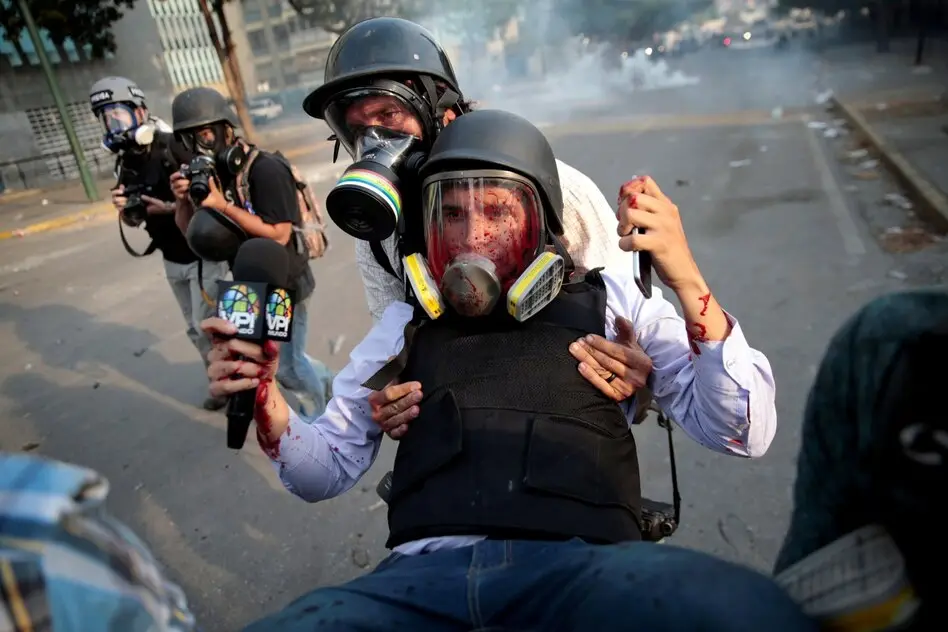
Imagine not being able to find out from the media or social networks that the far-right AfD party took over the presidency of a German state parliament for the first time after the September elections in Saxony-Anhalt. Or that the police or military arrest you on the street just because you criticize the tardiness of the train. Or that you are accused of terrorism because you took part in mass demonstrations in defense of democratic values.
Now put yourself in the position of a journalist who is regularly denied access to government press conferences and who only has the door slammed in her face by officials instead of information of public interest.
15 journalists from 12 Latin American countries are taking part in the “Euromérica” workshop organized by the taz panter foundation. It's about the opportunities and challenges of the EU-Mercosur agreement and Latin American-European relations. A supplement will appear in the taz on December 5th, and there will be a public talk in the taz canteen on December 9th. All texts can be found here.
A reporter who, in the worst case scenario, is criminalized and tried for "incitement to hatred" and faces a maximum of 20 years in prison for the mere exercise of her profession - while the media outlet for which she works is fined or banned from publishing content that is seen as violating a law supposedly enacted for "peaceful coexistence and tolerance."
And although press freedom is also coming under increasing pressure in Europe and fewer people there now trust public broadcasting and supposed “mainstream media”, such a scenario is hardly imaginable for European citizens. There, freedom of expression as a pillar of democracy is expressly protected by the Charter of Fundamental Rights of the European Union. In Germany it is considered an indispensable basis for political debate - and its “constitutive character of democracy” was expressly confirmed by the Federal Constitutional Court.
To Europeans, the circumstances in Venezuela described above may seem exaggerated. But they are a reality in a country that experienced the decline of democratic freedoms for three decades under the governments of Hugo Chávez (1999-2013) and Nicolás Maduro (2013-2026). These were ultimately suffocated in a dictatorial apparatus of suppression of civil and political rights, concentration of power, persecution of the opposition and police and military repression.
The media and journalists in Venezuela are responding to the repression in their homeland with a lot of creativity: in order to protect their identities, moderator avatars with a Venezuelan accent were created with the help of AI.
The El Bus TV team, on the other hand, reads the news out loud in public spaces to inform people. Other media have joined forces and are cooperating online with Venezuelan colleagues in exile. You can read more about media in Venezuela here.
The sobering record of freedom of expression and press freedom in Venezuela over the last quarter century is as follows: More than 400 media outlets, including radio and television stations, print media and online portals, have been closed, confiscated or forced to cease operations. By September 2026, almost 150 domains remained blocked at one of the two major Internet providers alone, more than half of which belong to independent media and national and international news portals. All of these numbers have been meticulously documented by local organizations.
Between 2020 and 2024, more than 20 reporters and photographers were imprisoned on charges of terrorism and forming criminal organizations. The legal basis for this is the “Constitutional Law against Hatred, for Peaceful Coexistence and Tolerance”. It was enacted in 2017 as a tool to criminalize the journalism profession and promote one of the most damaging forms of social control – censorship – and drove many Venezuelan journalists into exile.
While censorship is explicitly banned in Europe, in Venezuela it is practiced through digital blocks, fines and government shutdowns. Although the 1999 constitution recognized freedom of expression as a right, it was subordinated to concepts such as “stability of the state”, “social peace” and “communicative hegemony”.
Support the taz panter foundation and its international projects with a donation. Learn more
In the logic of Chavismo, a journalist is not a guardian of a pluralistic democracy enjoying legal protection, as is the case in the European Union, but an actor subordinate to the government.
It remains to be seen what will happen next under interim President Delcy Rodríguez. The restrictive “anti-hate” law of 2017 remains in force today. According to digital rights organization VE Sin Filtro, 17 news websites and media that had previously been censored for years were unblocked in mid-September. But many others are still blocked - 188 websites are still said to be unavailable, including 79 news portals.
It remains to be seen whether the current period of political and economic change triggered by Maduro's kidnapping to the United States on January 3, 2026 can lead to a transition to true democracy. To achieve this, Venezuela could follow Europe's principles on freedom of expression - instead of continuing to allow itself to be patronized by the USA. Its President Donald Trump is also known to have a difficult relationship with the free press.
Lisseth Boon Bartolozzi is an investigative journalist from Venezuela. She is, among other things, worked for the independent media platform Armando.Info.
Translated from Spanish by Ole Schulz