
Germany · taz · · 2h
Ultra group Horda Azzuro: “Of course I lie to the cops’ faces”
Deutsch (original) · Auto-translated to English
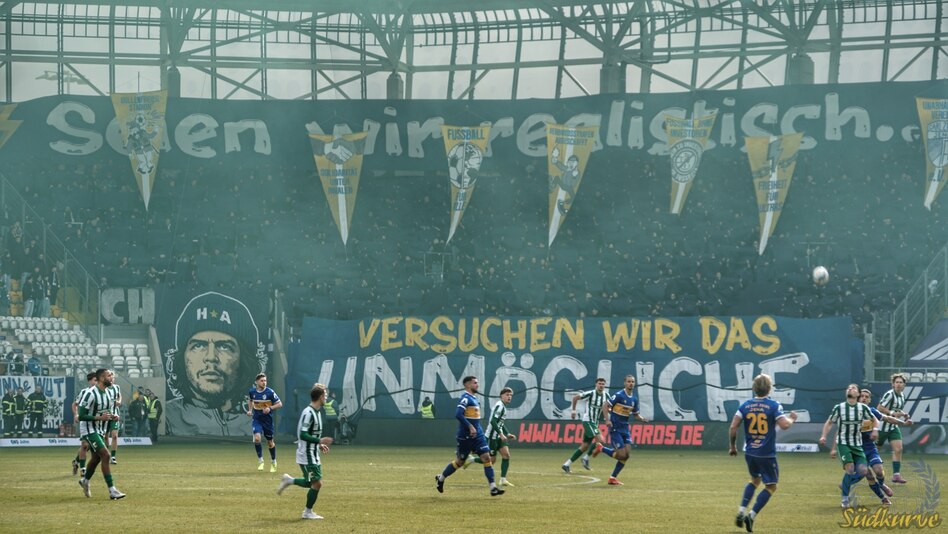
taz: Mr. Schley, Mr. Ringmayer, the Horda Azzuro is part of the first big wave of the East German ultra movement and is celebrating its 25th anniversary in October. What constitutes an ultra life?
Toni Schley: We didn't call ourselves ultras from the time the group was founded, and I'm proud of that. Ultra - that's something magical, a word that radiates something particularly worth protecting. If we had called ourselves that too early, we would have disenchanted the term and this special quality would have been lost. Ultras is a commitment to a certain way of life that you have to be able to prove. Not through words, but through his actions and actions.
Clemens Ringmayer: Looking back, it took me a few years until I really understood ultras. I can drive to every game, paint choreos, set off pyrotechnics and put up stickers. But that doesn’t have to mean that you have this “Mentalità Ultra” within you.
40, founded Horda Azzuro in October 2001 as one of three 15-year-olds. He is a father of three and the lead singer of the Südkurve Jena.
Schley: Mentalità Ultra is when you narrowly avoid prison, are a reliable spouse, raise your children, go to wage work, friends of yours die and you still have the feeling inside you every day that you can and want to make a difference in and with your group for your club. We fight for an ideal image and want to channel madness and anger into positive values.
Ringmayer: One of the main values is honesty. Of course I lie to the bulls' faces, but I maintain a fundamentally honest attitude in life. Ultras are confident and assertive, we don't just take things and accept them. We learn from each other what solidarity is and how to stick together when a sister or brother in the group is going through shit. Ultra does so much in character building because our lives are so intense. That never ends either. But there isn't one code - I like having this freedom to act as an Ultra as I want and see fit.
32, member of Horda Azzuro since 2015. He first studied curative education and now educational science.
Schley: Horda Azzuro is an ultra group that supports FC Carl Zeiss Jena, a football club that has had its best days behind it and is desperately striving for the success it had before the fall of the Berlin Wall. Our group is leading the Jena south curve and we want to compete with other German ultra groups and curves. We always strive for more and for greater things. We are well organized, have clear political aspirations and try to take responsibility in the stadium, in our city and in our region.
taz: How can the group best be described?
Schley: The approximately 65 members of our ultra group are a reflection of society. There's everything from unemployed construction workers to doctors. Academics and workers – side by side for FC Carl Zeiss Jena.
taz: What does life as an Ultra look like?
Ringmayer: Every weekend is football, which sets a certain pace. Otherwise we paint waving flags, double holders and choreographies, think of songs and sticker motifs, organize events, fan marches and the journey to the games or just meet up - every now and then the city, association or cops come with stadium bans and repression. There isn't a day where we don't deal with something - 24 hours isn't actually enough.
taz: Who does what work in the group?
Schley: There are so many fields of activity in the ultra spectrum that everyone can let off steam. One prefers to paint trains for us or spend hours thinking about a new choreo, the other films our performances for YouTube or writes for our curve magazine. There is a core that has to sit with everyone. The cohesion, this honesty and the willingness to defend the people, flags and clothes of his group, even with violence. That's out of the question, it's part of ultra culture.
Ringmayer: The public image of us as drunk, primitive, bullying football fans doesn't fit. Everyone can now see that ultras are pretty well organized and produce increasingly impressive images in the curves week after week. None of this would work if there weren't smart and committed people behind it. Of course there are drunk football fans, but they are less likely to be ultras. Neither of us drink alcohol at all. When you're drunk, you can't support your club to the extent that we ultras imagine, you can't defend your flag or defend yourself against arbitrary police operations.
taz: Is there a common political self-image?
Schley: We see ourselves as anti-fascist. We have a mission statement that clearly states that we take a stand against racism, queer hostility, sexism and other forms of discrimination. This is not shared by all FCC fans either. You have to stretch your elbows a bit to leave your mark on your club.
Ringmayer: We have a few political slogans or motifs on our flags. But first and foremost we are ultras and not a purely politically active group.
taz: In Egypt and Turkey, organized football fans have played an important role in protest movements. Could you imagine something similar in Germany?
Schley: In Germany we are fundamentally far away from something like that. If in a few years politics has developed in such a way that people really care, then ultras in Germany could play a larger role in protests. We are well organized, are becoming more and more numerous and differ from other social groups with a certain radicalism. At Ultras in Germany, the focus is more on the fight for better football.
Schley: We want football that is free of discrimination. Football should no longer allow itself to be exploited. For me, exploitation here means that there are private interests who use football to line their own pockets. Football is a popular sport and not designed to be exploited in a capitalist system. I don't think we have to get rid of capitalism to make football better. With the efforts of the ultras, football could be an example of how basic capitalist interests are stopped in their development - an example of how the logic of exploitation can come to an end. We have also changed things in football - it's not all utopia. And if so, then we prove that supposedly utopian conditions are achievable.
taz: With the closed fan demonstration of almost all fan scenes against the Interior Ministers' Conference in Leipzig, the protests against foreign investors and the prevention of the Monday games, the Ultras have repeatedly prevented things. Designing it yourself seems to be much more difficult.
Schley: This is a big issue for us ultras: How can we get out of this reactive position? Basically, to date we have only been driven by our counterparts – the associations, the state, the police. But it is achievable and possible to draw a proactive picture of a different, better football and thus get ahead of the times. Starting in our clubs and in the next step networked and together as a mature counterpart of the ties.
Ringmayer: There are already examples where ultras act themselves. We do a lot in the social sector, for example in helping refugees. Our group currently has an exhibition in Jena to mark the anniversary of our 25-year group history, where we give pretty deep insights into our group history and life as an ultra. We have arrived at the center of society, but at the same time we don't want to lose our character. It is also a double-edged sword.
taz: Doesn't this anti-attitude of the Ultras get lost when Ultras talk to newspapers?
Ringmayer: Ultras is not an anti-attitude, I would rather call it an oppositional role. That depends on how we do it. But I don't think we're softening our values. Quite the opposite. I feel like we as a group and our positions are getting stronger.
Read the full story at the source
Source: taz