
World taz
Ukraine under massive fire: cold death announced
Russia is deliberately and increasingly attacking civilian infrastructure in Ukraine - across the country. There are already massive power outages. more...
Deutsch (original) ·Auto-translated to English
Alyona Tovbuch covers the cracks in the walls of her apartment with plastic film and plywood sheets. Earlier this fall, a Russian missile damaged her home in Boryspil, a city near the Ukrainian capital Kyiv. Now that the first cold has set in and there are power outages, the walls in the damaged apartment are becoming damp and forming mold.
"You can't live here anymore. We bought this apartment that we had dreamed of all our lives. Shortly afterwards, my husband died at the front. Two months later, the Russians destroyed our house," says the 38-year-old, who wears a black scarf as a sign of mourning and also wants to take a few things with her that day.
The technical assessment of the house is still ongoing, but she has most likely lost her home forever, says Alyona. Their situation is becoming increasingly difficult due to the constant power outages and Russian attacks on Kyiv and the surrounding area, which have increased this autumn.
On Monday, Ukrainian President Volodymyr Zelensky warned of the preparation of a new massive attack on the energy and logistics infrastructure. The very next night, Russia carried out a combined attack on Ukraine. "In Kharkiv, the Russians directly hit a city hospital. 73 people were injured, the cardiology department was damaged," Zelensky wrote on his Telegram channel on Tuesday morning.
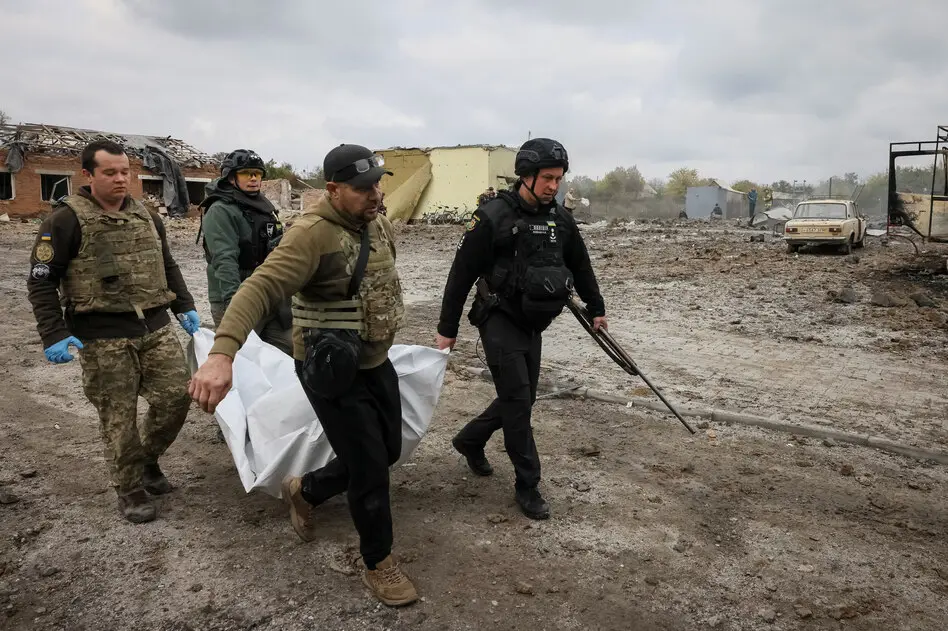
In the village of Komyshuwacha, in the Zaporizhzhia region, 33 people have been killed so far following the attacks on Tuesday, and over 50 people are still believed to be under rubble. "My condolences go out to the relatives and survivors. The rescue work is continuing as far as the security situation allows - because there is a risk of renewed Russian attacks - as sneaky as they always are," said the President. The city of Dnipro was also affected. Mayor Borys Filatov posted pictures of a hospice showing two destroyed hospital rooms.
On Tuesday morning, Ukrainian energy company DTEK said three of its thermal power plants had stopped generating electricity. "As a result of several waves of attacks, there was widespread destruction and significant damage to the equipment and infrastructure of the plants. The power plants have stopped generating electricity," the company said in a statement.
For security reasons, DTEK does not disclose the location of the damaged facilities. At the same time, the residents of Kyiv and the Kyiv region are already feeling the consequences of the tense situation in the energy system. Electricity is supplied on a fixed schedule; in some parts of Kyiv, electricity is only available for a few hours a day.
The situation is not yet critical, but rescue workers in Kyiv are prepared to set up mobile aid stations in case there is a power outage for several days. "We went through this last winter. If there is a power outage for three days, we are prepared to set up points where people can charge phones. In Kyiv there are buildings where everything depends on electricity: heating, water supply and preparing meals. For the people living there, there must be a place where they can drink hot tea and warm up," says Pavel Petrov, a representative of the Kyiv Emergency Management Service (DSNS). However, there is currently no point in setting up such facilities preventively.
According to military experts, the Russians have fundamentally changed their attack tactics. While the majority of targets in the summer were military in nature, economic facilities and civilian infrastructure have increasingly been attacked in recent months.
"They are targeting food retailers, the pharmaceutical industry, gas stations and traffic routes. Now 60 percent of the targets are civilian in nature, 40 percent are military. This trend will continue until spring 2027 as long as the cold weather lasts. The main targets this winter remain bridges, energy infrastructure and vehicles on railways," explains military analyst and former employee of the SPU secret service, Ivan Stupak.
"Kyiv is 200 kilometers from the border. The Russians cannot physically get here, so they are destroying the civilian infrastructure and the economy. Unfortunately, we are seeing a decline in Ukrainian economic output for the first time in years," says Stupak.
He points out that the National Bank of Ukraine has changed its economic development forecast due to increased Russian attacks on industry, energy supplies and logistics. "The National Bank of Ukraine (NBU) has revised its forecast for the development of real GDP in 2026 downwards - to -0.4 percent. The greatest impact on the worsening of the forecast was the consequences of increased shelling. Its negative contribution to GDP is estimated at 1.9 percentage points," NBU head Andriy Pyshnyi said at a briefing in Kyiv on October 29.
Alyona Tovbuch, who is mourning her husband, doesn't follow the news. But she and her family felt that the situation was getting worse every day. Alyona and her daughter are currently living with relatives. The electricity in their apartment is switched off for almost 12 hours every day.