
World taz
Social protests in France: where does the common anger lead?
Hundreds of thousands are protesting again in France. But the merger of the various concerns is not yet working everywhere. more...
Deutsch (original) ·Auto-translated to English
The students stand in a circle on the lawn of the Square de la Bourse in Mulhouse in Alsace. Some smoke, others devour the filled baguettes that are distributed at a stand a few meters away. Lena Meloni holds a cardboard box in her hand that she described herself. With abbreviations from the student protests in which she was involved from the beginning: FTG stands for “Fuck the Government”, ACAB for “All Cops Are Bastards”. The 16-year-old drew two black hearts next to it, as if she wasn't serious about insulting the police. The 12th grade student saw police officers beating up her friends during school blockades. “Some were bleeding from their heads,” she reports. “I took videos of it.”
Lena attends the Louis Armand high school in Mulhouse. Like the other high schools in the eastern French city, her school was blocked before the autumn break. But after the end of the fall break, classes continue as normal. The young woman with pink-colored hair is therefore looking for other forms of protest. That's why she stands on the Square de la Bourse next to people in their mid-fifties wearing the orange and red vests of the unions. Like everywhere in France on Thursday, they invited people to demos against the high cost of living.
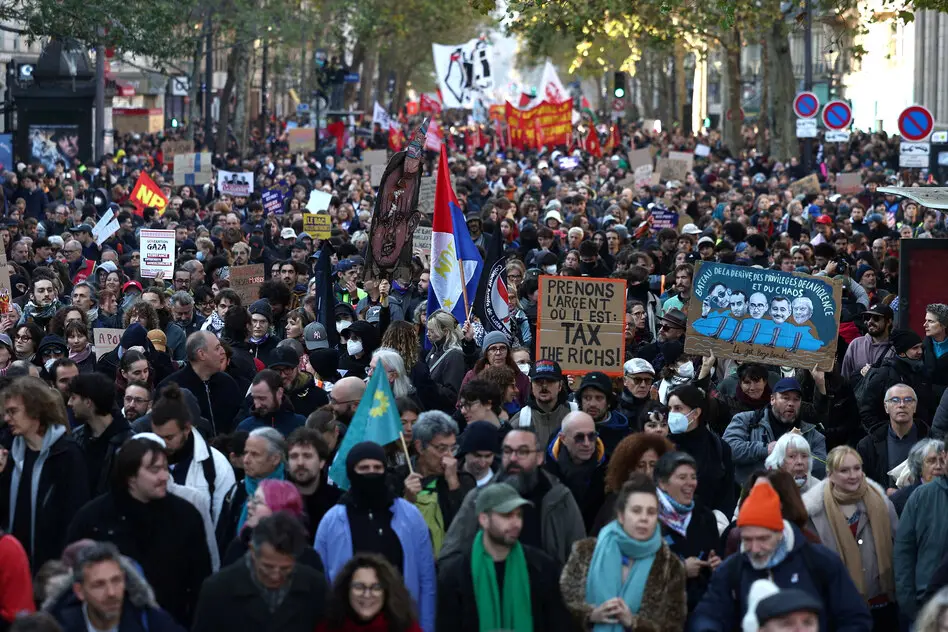
Several hundred thousand people, probably close to a million, took part in around 250 rallies across France. The pupils and students who have been fighting with strikes, blockades and rallies for better study conditions and against the current selection process called Parcoursup, which President Emmanuel Macron had introduced, also demonstrated with the unions.
But the “convergence”, the joining of the various concerns into a large protest movement, is not yet working. Students and trade unionists are neatly separated from each other. People hardly talk to each other. The young people are standing together in groups, the unions have set up their loudspeakers a few meters away.
The CFDT, France's largest union, drove up in a white truck. “Paroles, paroles” is heard from the loudspeakers by the chanson singer Dalida, while the CFDT official Jean-Luc Rué explains that petrol, food and additional costs are becoming more and more expensive: “But the wages are not following suit.” There are hardly any large employers in the region. The car manufacturer Stellantis alone has a factory where 2,000 people work. Rué says little about the students’ concerns. Except that the union supports the demands of the teachers.
The left-wing party La France insoumise is also represented at the Square de la Bourse, where a total of around 500 people gathered on this sunny Thursday afternoon. Florence Claudepierre distributes the purple LFI flags with the Greek letter Phi on them to the students. The woman in her mid-fifties ran for city council, but was not elected.
She is upset by the numerous shop windows that are barricaded with chipboard in the city center. “Touche pas à mon commerce” (roughly: “Hands off my business”) is written on yellow and black stickers. “The city administration would have better spent the money for these panels on meeting the demands of young people.”
The state leadership is now confronted with a “convergence” of anger from different directions. The fact that it could come to this is less the result of a political strategy from “ultra-left” circles or Jean-Luc Mélenchon’s left-wing party LFI. Rather, it is the result of a manifest inability of the government of Sébastien Lecornu to conduct a serious and promising dialogue with the various movements. The Prime Minister had hoped in vain that the protesting young people would calm down over time and return to class or would be intimidated by the repression.
The students in Mulhouse, on the other hand, hope that their concerns will not be forgotten. “We are tired,” say some of those who have been protesting since mid-September. A 17-year-old thinks that the time of blockades is now over. Rallies would take their place. What will happen to him after he graduates from high school next year? “I am an anarchist.” As such, he is not worried about the future.
The yellow vests are already calling on the networks for the protests to continue on Friday and Saturday - with or without official approval. Emboldened by Thursday's mass demonstrations, they are challenging the state's authority in a showdown on the streets.