
Politics · taz · · 39m
Ukraine and state elections: choice of weapons
Deutsch (original) · Auto-translated to English
The election results in Mecklenburg-Western Pomerania and Berlin are likely to have triggered mixed feelings among many. Even in Berlin, which is so cosmopolitan, one in six voters voted for the AfD. At least it wasn't a complete catastrophe like in Saxony-Anhalt two weeks ago, where the right-wing extremists triumphed overwhelmingly.
Does the great success of the left in the capital mean that love and justice have won over hate, as the left-wing top candidate and designated governing mayor Elif Eralp (unconsciously?) varied the well-known saying of the Czech dissident Václav Havel?
Her party's social agenda is of course welcome. One can also be pleased that the incumbent Prime Minister Manuela Schwesig in Mecklenburg-Western Pomerania was able to dampen the success of the right-wing extremist AfD due to her personal popularity - her “Woman against Blue” campaign was successful overall. And the fact that the CDU is now being thrown out of the state parliament is something the Christian Democrats have truly earned with their backward-looking domestic policy.
The taz is an independent, left-wing and opinionated daily newspaper. We have been arguing in our comments, essays and debate texts since the taz was founded in 1979. We often cannot and do not want to agree on an opinion. That's why you'll find some completely opposing positions here - all part of the very broad left-wing spectrum of opinions.
What should worry us all, however, is that from now on many people who understand Russia will sit in the parliaments in Magdeburg, Schwerin and also in the House of Representatives in Berlin.
In view of the looming AfD-led state government in Saxony-Anhalt, the reservists' association and Defense Minister Boris Pistorius (SPD) considered withdrawing the "German Operational Plan" from the state chancellery there because there was a fear that defense-relevant information would flow to Moscow.
The organization HateAid writes, with reference to research by the think tank CeMAS, that there has never been as much disinformation from Russia as in the run-up to the three elections in the past few weeks.
The Kremlin also knows that although no direct foreign policy decisions are made at the country level, the elections of the past few weeks have, on the one hand, indirect effects on them, and on the other hand, the war in Ukraine influences the behavior of voters.
Schwesig said on Sunday that the SPD had also lost votes to the AfD because of its stance on Ukraine. There are many in her state who reject financial and military support for Ukraine and want gas to flow through the Nord Stream pipelines again.
Schwesig has an interesting relationship with Russia, to say the least. As Prime Minister, she aggressively supported the Kremlin's Nord Stream 2 project, which was intended to make Germany even more dependent on Russian gas than before.
Schwesig condemned the Russian war of aggression and described the stop of Nord Stream 2 as a result of the invasion of Ukraine as a good thing. But in the committee investigating the issue at the end of last year, she defended her state government's actions and shifted all responsibility to the federal government.
It was her government that set up a dubious climate foundation to circumvent US sanctions and complete the pipelines with Gazprom money. A naive Russia policy made the Russian invasion possible.
The left are not dedicated Putin friends, but they don't seem to care much about the fact that more and more civilians are dying in Ukraine.
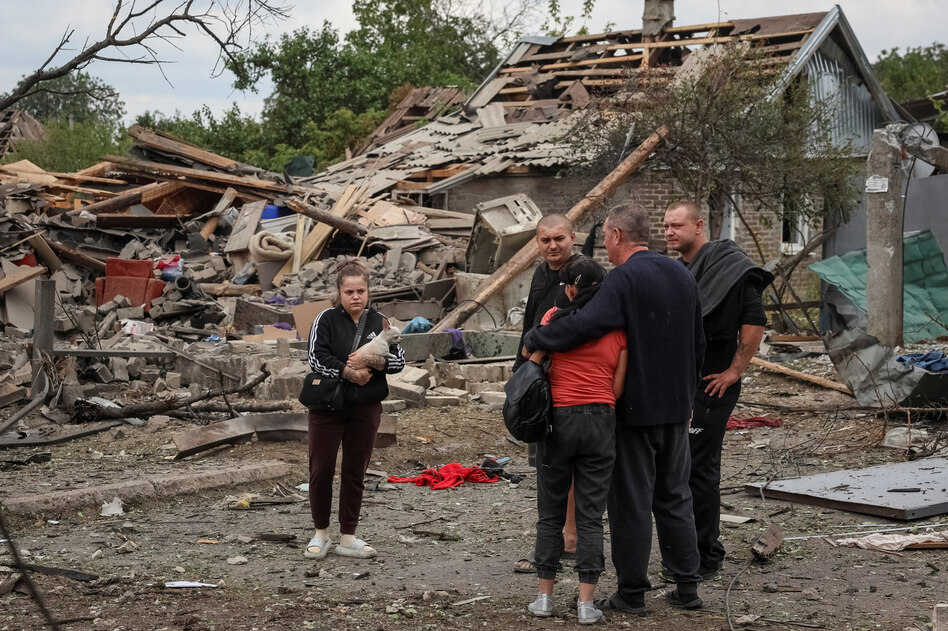
In a summer interview, the party's co-chair Luigi Pantisano spoke out against the supply of weapons to Ukraine, despite the devastating Russian air strikes on civilian targets.
Like many of his party colleagues, after more than four and a half years of full-scale invasion, he still does not understand that Russian missiles cannot be brought down from the sky with nice words, but only with other missiles. In any case, the left has no love and justice for the people of Ukraine. Instead, they criticize the closure of the Russian House in Berlin, which the Kremlin allegedly used for espionage purposes.
There are two groups on the left at the grassroots level that stand for a more sensible foreign policy: the “Russian-speaking Left” and the “Ukrainian Left Initiative”. But they have little influence.
If the left, with its increasing popularity, soon has more say in the federal government, it would have devastating consequences for all of our security. In any case, I would like to see that in an emergency, anti-aircraft systems (yes, the ones with the rockets!) can shoot rockets out of the sky and NATO partners can come to help - and that a solid defense policy makes such an attack unlikely at all.
After all, contrary to what initial forecasts suggested, the BSW did not get over the five percent hurdle in the two elections last Sunday. A little cause for joy.
Read the full story at the source
Source: taz