
Politics · taz · · 56m
Panic before the Left Party: Three decades of red scare
Deutsch (original) · Auto-translated to English
The day after the Berlin election, the Chancellor spoke out. Jewish life is no longer safe in Germany. Not only, but especially Berlin, has been experiencing “increasing radical, openly expressed anti-Semitism for several months,” said Friedrich Merz. And, in obvious reference to the Left Party in Berlin, he went on to explain: The fact that this remains unchallenged by parts of society deeply disturbs him. Merz then warned the SPD and the Greens: He “very much hopes” that they will give a “very clear answer, especially here in Berlin.” One can only read this as an invitation to reject a coalition with the left.
Since the Left won the election in Berlin with almost 26 percent, a campaign against a new left-led government has not stopped. The election party of the Neukölln district association of the Left provided the necessary fodder. Not only did Issa Remmo, a suspected figure from the city's organized crime group, appear there, but also the Palestine activist Ibrahim Ibrahim, who is attributed to the PFLP, the Popular Front for the Liberation of Palestine, which is considered a terrorist organization. And just a few weeks ago, the district association had to deal with allegations of anti-Semitism because a rapper had, among other things, positively sung about the Intifada at an election campaign event.
The Bavarian Prime Minister Markus Söder (CSU) announced that he would end the state financial equalization in a left-wing Berlin state government. Sigmar Gabriel (SPD) explained that the left had “fished for voters among anti-Semites and Islamists,” which is why the SPD should not “open the doors to the town hall to the hate preachers.” And FDP leader Wolfang Kubicki equated a left-led state government with a coalition of CDU and AfD. The SPD chairwoman Bärbel Bas demanded that Elif Eralp “clearly distance himself from it” and draw conclusions. The Left declared that they had sent Remmo out as soon as he was recognized. She also distanced herself from Ibrahim.
The vehemence of the current debate is reminiscent of an old pattern. Whenever the Left in Berlin is faced with participating in government, the possible coalition question is spun into a fundamental debate about its ability to govern. But the history of the past three decades shows that the dramatic warnings about the left rarely come true - but can certainly be successful.
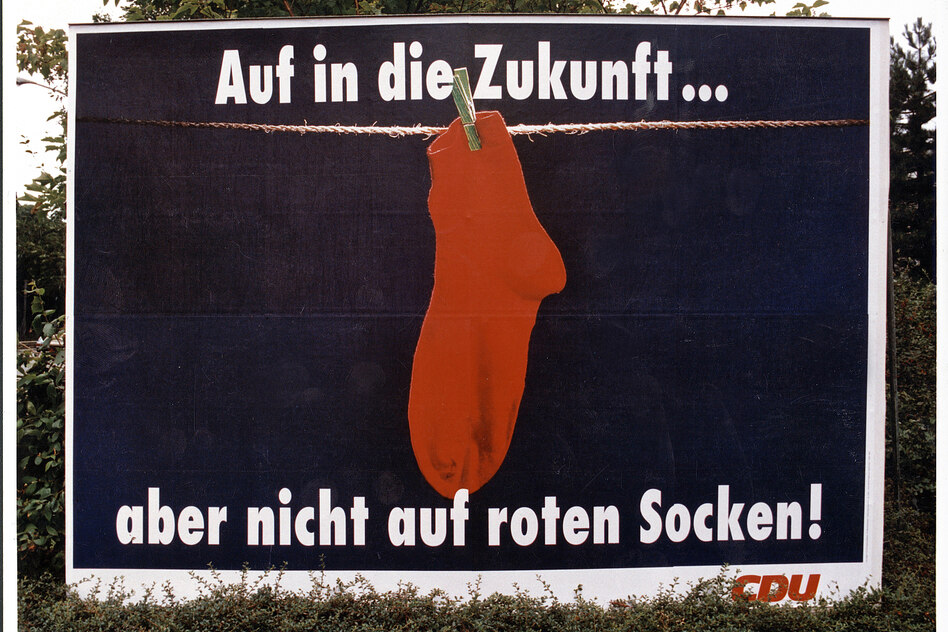
The most famous example of such panic against the left is the CDU's red sock campaign before the federal election in October 1994: "Off to the future, but not in red socks," the CDU had printed on posters at the time. The message: If the SPD wins the election, there is a risk that the SED successor party will tolerate a red-green minority government or a red-green-red alliance.
The background was that Helmut Kohl's federal government (CDU) feared that it would be re-elected; after all, the SPD was ahead of the CDU in the polls at the beginning of the year. When the SPD allowed itself to be tolerated by the PDS in a minority government in Saxony-Anhalt in the summer - the “Magdeburg model” that worked until 2002 - the CDU launched its campaign. With success: the SPD lost the election, and the Red Socks campaign was considered a decisive factor.
Even when the black-red coalition collapsed in Berlin in the summer of 2001 after the banking scandal and tolerating a red-green Senate was discussed for the first time at the Berlin state level, the CDU was up in arms. At the time, the Konrad Adenauer Foundation spoke of a “breaking of a taboo” - and accused the SPD and the Greens of abandoning an “anti-totalitarian consensus between the major popular parties” that “excluded participation in government by right-wing and left-wing extremist parties.”
The red-red Senate under Klaus Wowereit as head of government did come about in 2002 - if only against the violent protests in parts of the SPD. “Historically conscious Social Democrats must raise their voices against any pact with the successors of the SED,” said former police chief Klaus Hübner at the time and resigned. The left-wing Gregor Gysi became the Senator for Economic Affairs, later the previous long-time left-wing parliamentary group leader Harald Wolf. And he was then praised by business associations such as the IHK and the Chamber of Crafts as a pragmatic, thoughtful and non-ideological conversation partner.
Red-Red ruled until 2011. In 2016 there was another outcry when the Left was expected to participate in government again, now as part of a red-red-green coalition. This time the occasion: The left-wing urban sociologist Andrej Holm was to become state secretary. But as soon as the left had named the person, a week-long storm of media excitement broke out.
According to research, Holm denied being a Stasi member when he was hired as a research assistant at the Humboldt University (HU). In fact, when he was 18, he completed five months of training with the Stasi. In the end, Holm resigned. Tenant initiatives assumed that the drastic nature of the debate also had something to do with Holm's left-wing ideas about urban politics. He had already been arrested in 2007 on suspicion of terrorism after using terms such as “gentrification” in his writings – the charge was ultimately dropped.
But the excitement now erupting against the Left Party goes beyond the old fear of the “wall shooter party”. A new addition is a debate about anti-Semitism and Palestinian solidarity, in which - sometimes more openly, sometimes more covertly - the left is also accused of being close to Islamism. A chat between the Bundestag member Ferat Koçak and the son of the Berlin clan boss Issa Remmo, which became known on Monday, provides an example that seems to confirm all prejudices (see text below).
The excitement is almost exemplary and reminiscent of the right-wing agitation against the great New York role model of Elif Eralp's Berlin election campaign: Zohran Mamdani. For months, right-wing commentators accused him of being either a communist or a jihadist. Employees of his opponent Andrew Cuomo distributed manipulated videos in which Mamdani's beard was artificially lengthened and his skin tone darkened. And now, after the election of Elif Eralp in Berlin, Thorsten Alsleben from the New Social Market Economy Institute declared that the “young Berlin women” had “voted for the caliphate”.
It remains to be seen whether the current debate actually has the potential to prevent a Berlin government under a left-wing mayor Elif Eralp. The Left has initially invited people to exploratory talks next week. At the state level, the Greens have so far stuck to their line that a red-green-red coalition should not be dependent on votes from the Neukölln left. That wouldn't be a mathematical problem, after all, the coalition would have a majority of a whopping 15 seats in the House of Representatives.
Read the full story at the source
Source: taz