
World · taz · · 2h
Trump and Xi in Washington: Sparkling wine, an eagle and Sparta's fear
Deutsch (original) · Auto-translated to English
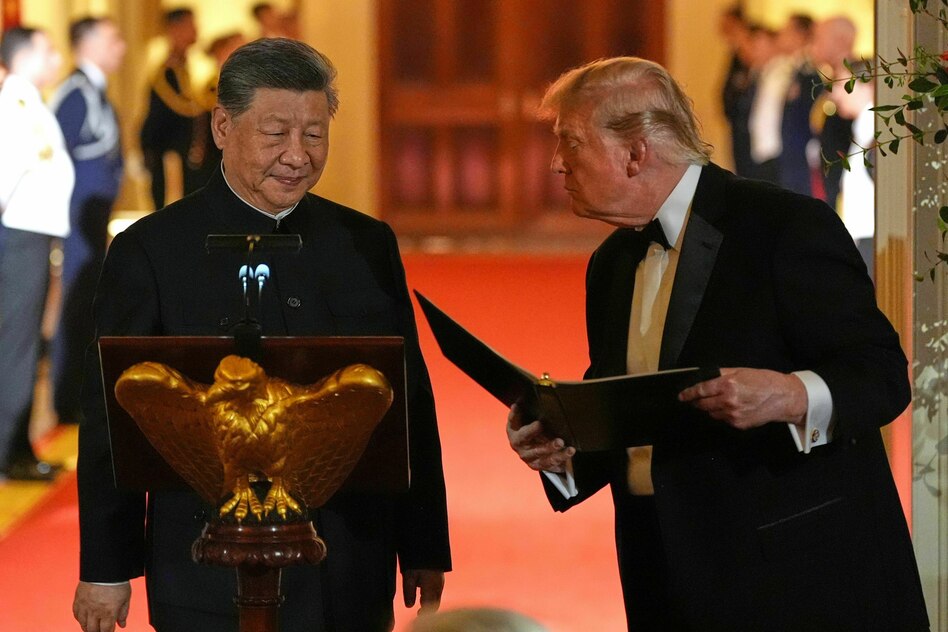
After a long day full of pomp and staging, Donald Trump steps up to the lectern in the packed East Room in the White House. He looks towards Xi Jinping and his wife, takes a meaningful pause and finally says: “You are really great people.” As the Chinese head of state raises his glass of Californian sparkling wine and clinks glasses with his neighbors Elon Musk and Jensen Huang, the US President continues: “We have never gotten along so well before.” Finally, he has a 90 centimeter tall eagle statue unveiled - as a special gift for the guest who has traveled from far away.
It was already clear in the run-up to what was perhaps the most important summit of the year that Donald Trump would put on a particularly pompous show. But the extent of the production surprised many Chinese observers. “Trump is undoubtedly welcoming Xi this time with the highest protocol honors ever,” comments Wang Zhian, a former journalist with state television CCTV who now lives in exile in Japan.
On the other hand, the results are pretty weak if you only look at the concrete results. “So far the summit has not even met the already low expectations,” writes Scott Kennedy of the Washington Center for Strategic and International Studies on X.
In view of the statements published by both sides so far, it is difficult to contradict this. At least one concrete result stands out: The USA and China have agreed on a two-month extension of the agreement reached a year ago in Busan, South Korea. The deal, which is now valid until next January, states, among other things, that Trump will not impose any further tariffs, while Xi will grant US companies access to rare earths from China. However, it was expected that the agreement would continue for much longer than just two months.
And on virtually every other issue – such as China’s support of Iran and Russia – there are no discernible breakthroughs. When it comes to dealing with AI, Washington and Beijing have at least announced regular exchanges. On the Taiwan question, the central concern for China's leaders, Xi Jinping has increased the rhetorical pressure as he urged the US to stick to the "correct position" and reject Taiwan independence. It is not known whether Trump made certain concessions, such as further delaying the $14 billion arms package to Taiwan.
Given the many challenges between the two world powers, the results have been lukewarm. "From my perspective, the most extraordinary thing is the level of staging and the symbolism that President Trump is using for President Xi. Frankly, that seemed to be the core of this visit," said Julian Gewirtz, former China adviser under Joe Biden, to the television station CNBC. Beijing is more than willing to play along with this scenario because it helps the Chinese side gain time, says Gewirtz.
In fact, Trump demonstratively took a lot of time to show his guest the new helipad in front of the White House and to present the presidential portraits along the colonnade. Apparently his aim was to establish a personal connection with the Chinese party leader. "Xi talks about state-to-state relations and power. Trump talks about personal chemistry. The contrast couldn't be clearer," says Ryan Hass of the Brookings Institute.
In his speeches, Xi Jinping outlined how he looks at the decisive system competition of today. "China and the United States can both benefit from cooperation and will both lose in a confrontation," Xi said. "Our competition should be a healthy competition and stay within certain limits. It should be a race in which each tries to catch up with the other, not a wrestling match in which one wins and the other loses." And then the 73-year-old brought out his favorite metaphor: “The Thucydides Trap can be overcome.”
The linguistic image was first popularized by the US political scientist Graham Allison. It describes the war between the emerging Athens and the established Sparta almost 2,500 years ago. According to the Greek military historian Thucydides, Sparta's fear of Athens' growing power triggered the open escalation. Now this constellation can be transferred to Washington and Beijing.
At the summit it also became clear that the two heads of state only have similarities in their strong desire for power. In terms of mentality, they work completely differently. While Donald Trump cannot be denied a certain entertainment factor, Xi appeared stiff and awkward throughout the entire state visit. During his monotonously delivered speeches, Xi's eyes were slavishly glued to the script, and his pronunciation also caused unintentional comedy on several occasions. For example, when the Chinese party leader spoke of the historic “ping-pong diplomacy” under Nixon and Mao, he accidentally said in Chinese: “popsicle diplomacy.”
What was interesting was what happened on the sidelines of the official ceremony. When Xi's wife Peng Liyuan stepped out of the Smithsonian American Art Museum after her visit, Chinese exile activists loudly shouted protest slogans at her: "Down with Xi Jinping!" Security forces wearing khaki caps and face masks immediately rushed in to attack the Beijing critics with pepper spray - before the police present intervened. Human rights organizations suspect that the attackers were Chinese agents.
Read the full story at the source
Source: taz