
Germany · taz · · 1h
Lack of drinking water: empty glasses without glaciers
Deutsch (original) · Auto-translated to English
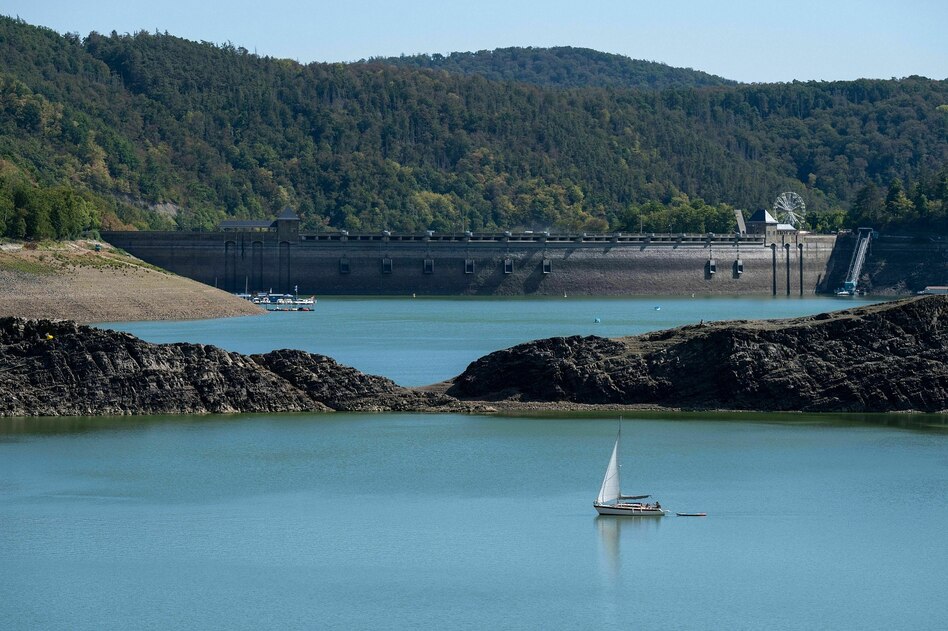
The Hessian Edersee is the second largest reservoir in Germany in terms of area. Behind the 48 meter high dam wall, a historic viaduct, the four-arched Aseler Bridge, was once flooded southwest of Kassel. The building, which was completed in 1890, cannot normally be seen but is completely submerged under water. But in the winter of 2025, the reservoir was so empty that walkers could cross the viaduct with dry feet.
There are regions in Germany where there is no usable groundwater; dams, lakes and rivers have to step in there; around 30 percent of Germany's water supply is based on this - in the Ruhr area, for example, in the Thuringian Basin, on the Swabian Alb, in Saxony or in Saarland. Water from the Harz dams is delivered via long-distance pipelines to northern Lower Saxony and Bremen. And these dams are increasingly making the drama visible: Germany is running out of water.
A study by the “Boston Consulting Group” and the “Naturschutzbund Deutschland” came to the conclusion that Germany is losing more water than its natural systems can replenish in the area. Since 2000, the Federal Republic has lost around 60 billion cubic meters of water from its surface reservoirs and aquifers - which corresponds to the amount of water that was once contained in Lake Constance. This emphasis on “earlier” is important: the level of Lake Constance reached a new minimum this summer.
Now the World Meteorological Organization (WMO) is also warning of a dramatic loss of fresh water: 2025 will be the fourth year in a row in which the glacier masses have shrunk significantly in all regions of the world, according to its report presented on Thursday.
Water with a mass of 1,400 gigatons was lost worldwide - roughly as much as would be needed to fill 560 million Olympic-sized swimming pools. At the same time, according to the report, global groundwater stocks have been shrinking in many parts of the world for years.
WMO Secretary General Celeste Saulo describes these bodies of water as the “savings account of the planet.” “We are emptying this savings account,” warns the Argentine meteorologist. The report lists Central and Eastern Europe as an example: In the period from 2014 to 2024, the deficit in groundwater reserves here is greater than almost anywhere else in the world.
Of course, the water shortage is acute in other places. “In the last five years, Asia and Africa accounted for at least half of all reported extreme hydrological events and more than 80 percent of associated deaths,” says Saulo. In addition, rivers worldwide experienced one of the three driest years in 35 years in 2025.
Climate change itself is now contributing to water scarcity. “Global warming is also increasing evaporation,” explains climate researcher Mojib Latif. "This means that the soils dry out more quickly. Conversely, there is more heavy rain, but the dried out soils can no longer absorb this water," said the President of the Academy of Sciences in Hamburg.
The UN is now talking about a water bankruptcy, which Latif thinks is correct: "While other terms like 'water crisis' suggest that the problem is reversible, the term water bankruptcy underlines that this is not the case." The glaciers are the best example of this: “When they are gone, then they are gone – and with them their fresh water.”
A study from South Korea shows how much of an impact the unrestrained use of groundwater has on the earth: In order to be able to grow potatoes in the Sahara, deep groundwater like petroleum is extracted from the ground. Egypt is now Germany's third largest potato exporter.
This means that water that is scarce in the Sahara “flows” directly to Germany, where farmers are left with their potatoes. Not only that: According to the study, this export led to a shift in mass on the earth's surface - and thus to a shift in the earth's rotation.
For its report, the WMO used data from 68 countries from over 3,000 stations and also from satellites. Events such as the low water levels on the Elbe and Rhine this year were not yet included in the investigation. Nevertheless, Celeste Saulo gave a forecast at the presentation in Geneva this Thursday: “The strengthening El Niño will intensify extreme events – drought in some countries and floods in others.”
Read the full story at the source
Source: taz