
World · taz · · 2h
Tour de France in East Germany?: Worn roads
Deutsch (original) · Auto-translated to English
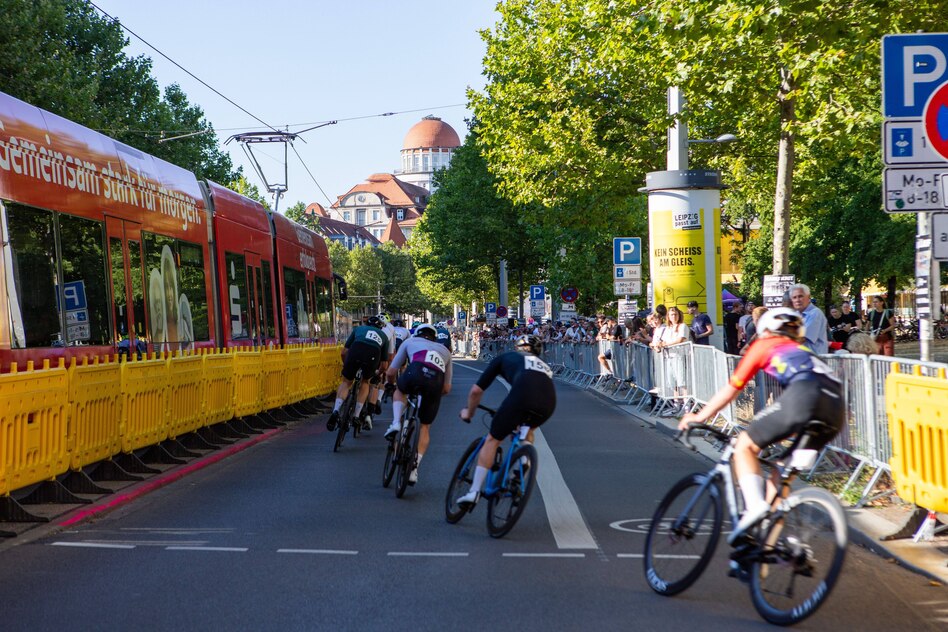
Tour de France boss Christian Prudhomme likes to move the Grand Départ, the start of the tour, to countries where he can tell good stories," says Isabell Gall, who is responsible for cycling in rural areas at the ADFC Saxony. Since 1954, the Tour de France has been started more and more often in other European countries, in 1998 even in Dublin on the Irish island. In 1987, for example, the first stage started near the Reichstag on the West Berlin side, right next to the wall.
The tour will now commemorate their case in 1989 again in three years, 2029, if the federal government and the three central German states have their way. This would “bring guests from all over the world together and at the same time remember the courageous people who took to the streets for freedom and democracy in 1989,” said Saxony’s Prime Minister Michael Kretschmer (CDU) at the end of July. At the end of July, he, his counterparts from Berlin, Thuringia and Saxony-Anhalt and the leading association German Cycling, the former Association of German Cyclists, handed over the East German application for the start of the tour in 2029 to the tour organizer Amaury Sport Organization A.S.O. Director Prudhomme then raved about “extraordinary historical and symbolic significance.
Such political loading of sporting events is usually blamed on the former GDR. “Of course this is also a political issue and you can’t ignore it,” admits Thomas Hofmann, President of the Saxon Cyclists’ Association (SRB). The interested cycling associations initially did not aim for the 40-year-old awakening in the GDR, but instead aimed for the year 2030 for the start of the tour.
Today, stages in “revolutionary territory” also offer the opportunity, according to the Saxon Green Alliance, to show “what has developed in Saxony and East Germany since 1989”. Isabell Gall from the ADFC cycling club has a lot to gain from cultivating the European idea and is thinking about state elections that tend to be anti-European. This can also be predicted for 2029, when the tour should lead through the similarly heated election campaign areas of Saxony and Thuringia.
Which streets in Central Germany do you actually want to send the world elite along without embarrassing themselves? For example, which descent into the Dresden basin should be acceptable for a peloton? As a recreational athlete, you should always keep both hands on the racing handlebars and grit your teeth tightly. When the popular Heidenau tour had to be abandoned a few years ago, liability issues in the event of accidents were also cited as a reason. However, you can protect yourself against this with cheap pedal bike insurance from the cyclists' association, as President Thomas Hofmann offers. SRB project manager Lukas Kraft points out that there are deliberately chosen cobblestone routes on the tour - and by no means only on the classic Paris-Roubaix. “The ASO chooses the route primarily based on images and dramaturgy, not based on surface classes,” says the planner.
The ADFC cycling club is more bothered by the disparity between spending on roads and those on cycle paths in the Free State of Saxony. In the draft of the 2027/28 crisis budget, road construction will not be cut, but money for cycle paths will be cut by 85 percent. And with the 450 million euros for the expansion and renovation of the state parliament, more than a thousand kilometers of cycle paths could be built, ADFC managing director Konrad Krause calculates.
The Saxon State Ministry for Infrastructure and Regional Development cannot yet comment on the suitability of roads and any construction work that may be necessary. There is no general classification as “suitable for touring”. First, the organizer must submit a concrete route proposal before a host of traffic and safety tests can begin.
The SRB is enthusiastically committed to the Grand Départ, the “big descent”. But like the ADFC, he also sees a mismatch between such a showcase event and the deficits in popular sport and talent development. “If a lot of money is invested in such a major event, there must also be something for popular sports and the clubs,” demands Isabell Gall. She primarily has an eye on the rural areas she looks after. Where else can children learn to ride their bikes to school safely, she asks, and where can they join sports clubs?
ADFC and SRB confirm the subjective experience that cycle tourism trips and everyone's races organized by member clubs of the Association of German Cyclists are becoming increasingly rare. In Saxony the number has roughly halved. For a long time, for example, you could compete with amateur competitors at the “Race Day” in Saxon Switzerland and the Eastern Ore Mountains for an entry fee of 30 euros using a transponder. What's left is the Velorace, where for 90 euros you can drive along those Dresden streets that people complain about all year anyway.
It's not just the Saxons and not just the lovers who complain. Last year, the only professional stage race for women in Germany, the Lotto Thüringen Ladies Tour, had to be canceled in Thuringia. The bicycle podcast “Antritt” asked long-time organizer Vera Hohlfeld for reasons. She cited a general lack of appreciation and political will. Specifically, a full 200,000 euros are missing, which the state of Thuringia has previously contributed, but has no longer had left since the “blackberry” government under Prime Minister Mario Voigt (CDU). For comparison: The costs for the big tour opening spectacle in 2029 are estimated to be in the region of 30 million euros. So far, only private funds have been used for this; decisions on how the states will share the costs are still pending.
SRB President Hofmann even finds the decline in popular sports “terrible”. It is not due to clubs and their great voluntary commitment, but above all due to increasing bureaucracy and rising costs. The deficits affected young talent and talent development. “If we can’t hold any races, we won’t have any top athletes!” Coach pay is also lagging behind. After all, the mountain bike and gravel sections are increasingly in demand, but are reaching their limits because there are numerous bans on their practice in the forest, for example.
But racing cycling is actually more popular than ever, as you can easily see from the street scene. Community-building cycling tours are not only held less frequently, but are also less in demand among young people. Social sporting encounters are increasingly being organized in private groups via social media or by bike shops. “The general trend is that less and less is being done in clubs,” states Thomas Hofmann. “It's like everywhere else, more fragmented, more fragmented, less binding,” agrees Isabell Gall.
And yet both have great hopes for the Grand Départ in the East German states. The ideal aspect is important to the ADFC representative. “It remains good for everyone if Saxony is promoted as a cycling destination!” SRB President Thomas Hofmann also speaks of a “huge enthusiasm” that will give impetus to young cyclists. Project manager Lukas Kraft backs this up with high mobilization figures, for example in Utrecht in 2015. Several hundred volunteers have already signed up in Saxony and its neighboring countries.
The cyclists’ association is the main driver of the application, but for the president “what happens around the professional sporting event is actually the decisive factor”. Such hoped-for secondary effects ultimately aim to compensate for the East German second-class status that is still felt even after 40 years. Hofmann speaks of an “opportunity to broadcast central German countries to the world public for four days”. The start of the tour will be broadcast in 190 countries, and according to ASO, the entire tour will be seen by 3.5 billion TV viewers worldwide. All expenses would be recouped many times over; sales of more than 200 million euros are expected as a result of the Grand Départ.
Politics comes into play again. Interest in the Tour de France is increasing. Some Saxon families also base their summer vacation planning on their stage plan. But for a celebration of the Peaceful Revolution in 1989, the tour doesn't necessarily have to stop at home. A growing majority is now skeptical about the consequences of the German-German unification process. They would probably still succumb to the fascination of the “giants of the country road”, as they were called during the peace journey in the GDR and neighboring countries, speeding past at more than 50 kilometers per hour.
Until the ASO's decision on the competing starting regions for 2029, which should also include the Czech Republic, is expected at the beginning of next year, there will not be much time for fundraising and contract negotiations. Difficult formation of governments does not make this any easier.
Read the full story at the source
Source: taz