
Germany · taz · · 2h
A thousand years after his death: Tsar Samuil gets a new resting place in Sofia
Deutsch (original) · Auto-translated to English
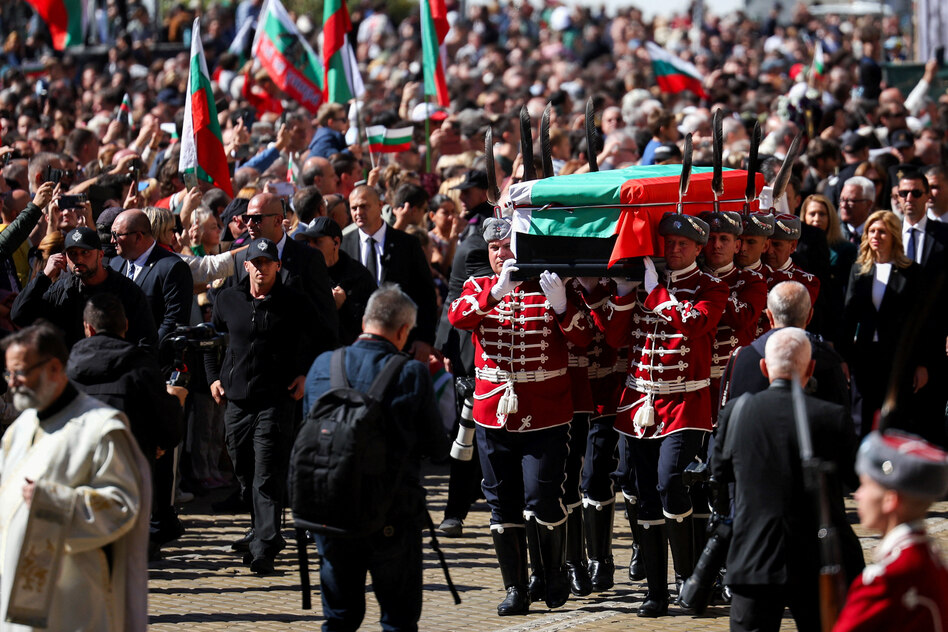
afp | More than a thousand years after his death, Tsar Samuil's presumed remains have returned to Bulgaria. After being handed over in the northern Greek city of Thessaloniki, the coffin arrived in the capital Sofia on Saturday and, covered with the Bulgarian flag, was carried through the capital by a guard of honor. Numerous people cheered the event, fighter jets flew over the city and 21 gun salutes were fired.
Prime Minister Rumen Radev thanked his Greek counterpart Kyriakos Mitsotakis for the “wisdom and courage” that made the “historic agreement” possible. The agreement strengthens “the strategic partnership, friendship and trust between our two countries,” Radev said. In return, Greece will receive back 48 objects that Bulgarian troops looted from churches and monasteries in northern Greece during the First World War.
750 police officers were deployed in the center of Sofia. The railway offered free trips to the capital. The remains were laid out in St. Sophia's Church - the sixth-century Orthodox basilica that gave Sofia its name.
Samuil ruled the Bulgarian Empire from 997 to 1014 and led several campaigns against Byzantium with his brothers. He expanded his power over large parts of the Balkans and made the region around Lake Prespa and Lake Ohrid, now largely part of North Macedonia, the center of his rule.
In 1014 the Bulgarian army was defeated by Byzantium. According to tradition, Samuil died of shock shortly after seeing thousands of his soldiers return who had been blinded at the behest of the Byzantine Emperor Basil II. Four years later his empire fell to Byzantium.
Samuil's suspected remains were discovered in the 1960s by Greek archaeologist Nikolaos Moutsopoulos on the island of Agios Achillios in Lake Prespa. In a grave, his team found the skeleton of a man, approximately 1.60 meters tall, as well as the remains of a silk fabric interwoven with gold thread. The location, clothing, age of the deceased and an old bone injury support the attribution to Samuil. However, the remains were never positively identified.
Bulgaria officially began negotiations for their return in 2007. Some Bulgarian historians questioned the exchange because, unlike the bones attributed to Samuil, the origin of the items reclaimed by Greece is certain.
At the same time, Bulgaria is not the only country that lays claim to Samuel's legacy. There is a huge statue of the ruler in the North Macedonian capital Skopje; many people in the country see him as “their” tsar. The Albanian-language newspaper Koha wrote: "The bones return, the conflict remains! Samuil is once again disputed between Skopje and Sofia."
In 2022, a bilateral commission recommended that Samuil be designated as ruler of a state “which most contemporary historians consider to be the Bulgarian Empire,” whose center of power was in what is now North Macedonia. Carnegie Europe political scientist Dimitar Bechev told AFP the initiative was also intended to underline the Bulgarian character of Macedonia's Slavic population.
The agreement also sparked a dispute in Bulgaria about who should take credit for the success. The repatriation comes in the middle of the presidential election campaign. Incumbent Iliana Iotova, who is supported by Radev, is focusing on patriotic themes and began her campaign in Veliki Preslav, a former capital of the First Bulgarian Empire.
Radev, who supports Bulgaria's place in the EU and NATO and at the same time supports dialogue with Moscow, wanted to appeal to patriotic voters, said political scientist Betschev. The message is that, unlike more radical forces, he achieves concrete results. Samuil's remains will find their final resting place in a white marble sarcophagus in St. Sophia's Church, according to state broadcaster BNT.
Read the full story at the source
Source: taz