
War & Militarism taz
Dispute among Republicans after midterms: Vance declares war...
... the main cause of the Republicans' election defeat. A sign that the party is preparing for a post-Trump era? more...
Deutsch (original) ·Auto-translated to English
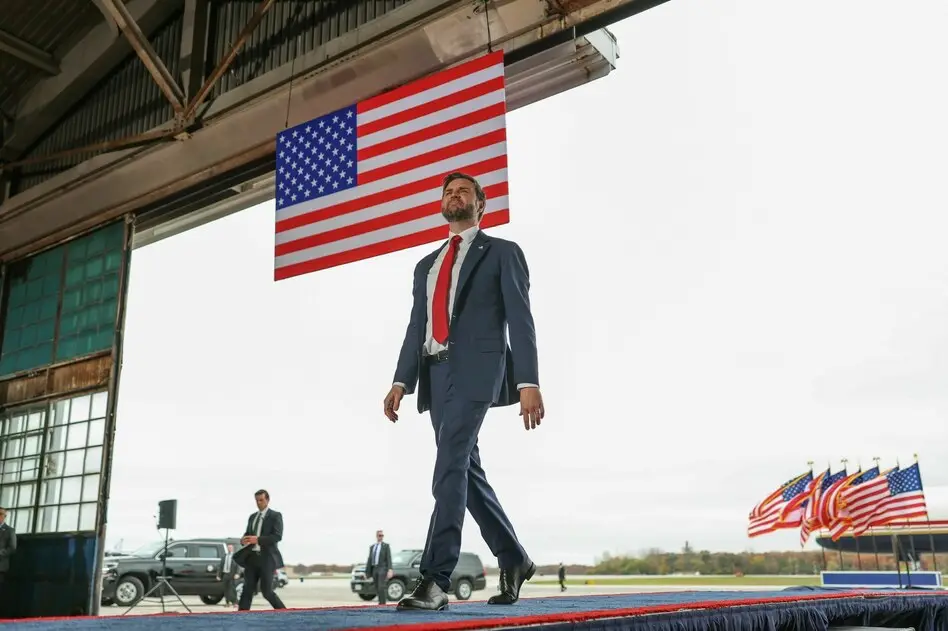
Of all people, US Vice President J. D. Vance was the first to publicly point out blame the day after the Republicans' crushing election defeat in the US midterms. “The reason we lost is the war,” Vance, who is running for president in 2028 and initially warned Trump about attacking Iran, wrote on X on Wednesday. “Everyone knows why we lost,” he added. Any “honest conversation about what happens from here” must start there.
This is the loudest deposition of a leading Republican politician from Donald Trump to date.
Even before the election, there was quiet criticism of the US President among Republicans. John Sununu, who lost the Senate race in New Hampshire, tried in vain to distance himself from Trump in an advertising clip. In it he literally said: “I haven’t even met the man yet.”
Ron DeSantis, the governor of Florida, who did not run again in the midterms, accused Trump after the election that high gasoline prices as a result of the Iran war had contributed to the Republican defeat. The conservative hardliner, who is said to have ambitions to run for president in 2028, also criticized the government's lax attitude towards AI data centers and the handling of the Epstein files. Nebraska Congressman Don Bacon told the New York Times, “It was all on him,” and he, too, meant Trump.
We analyze the US midterm elections on November 3rd: What does the result mean for US politics, the Democrats, Donald Trump and the 2028 presidential election?
Register here or watch live in the stream.
And yet it could happen that the first victim of this increasing criticism is not the US President, but his Defense Secretary Pete Hegseth, who calls himself “Secretary of War.” Back in September, Republican Representative Thomas Massie from Kentucky introduced eight articles of impeachment against Hegseth and requested that impeachment proceedings be opened. If the indictment and conviction in the Senate is successful, such proceedings end in impeachment.
Specifically, Massie accuses the Secretary of Defense of waging war with Iran without authorization from Congress and of being responsible for attacks on speedboats off Venezuela and crimes against civilians in the Yemen war in connection with the Iran War.
While in September there was no willingness on the part of Speaker Mike Johnson to bring the proposal from the notorious intra-party Trump opponent Massie to a vote, that may have changed now. US media speculate that it could be voted on in the House of Representatives as early as next week.
The Iran war itself - in fact neither the core of the MAGA ideology nor of Project 2025, i.e. the government's plan for authoritarian state restructuring - could possibly simply be admitted as a mistake; one could agree that Hegseth pushed Trump into the war, so get rid of him and then hope that the lost electorate will somehow swallow it. But then the war still has to end and the Strait of Hormuz reopens, and Trump still has no plan for either.
There's big trouble ahead. And yet the basic idea, at least in the first step, not to distance oneself from Trump, but from the Iran war, may initially be a viable option in order not to immediately risk an intra-party bloodbath. And apparently at least J. D. Vance, who along with Secretary of State Marco Rubio is currently considered one of the two front runners for the 2028 candidacy, has already decided on this path.
But in the medium term there is hardly any way around breaking away from Trump. And the more confused Trump takes refuge in his architectural plans and ballroom marble, the more urgent this becomes - but also easier.
For a long time, no one among the Republicans could get past Donald Trump. He had his supporters under control and those who rebelled against him were dealt a career-ending primary election defeat. The MAGA movement allowed itself to be directed as a political tool like a group of thugs in organized crime.
Trump used this power extensively in the midterm primaries. He actively pushed through loyal but unpopular candidates in the respective states, against the advice of his party colleagues. In South Carolina, he supported the candidacy of the completely unqualified Darlene Graham, sister of the state's late former senator, Lindsey Graham. She clearly lost the seat. In Texas, Trump nominated Ken Paxton, who had been badly hit by allegations of abuse, for the Senate seat instead of the incumbent John Cornyn. Paxton lost badly by more than ten points to the Democratic shooting star James Talarico.
Trump's core supporter is not enough to win elections. But there are still too many to miss out on. The question remains how the Republican Party will deal with this. Is MAGA possible without Trump?
The former MP and QAnon conspiracy believer Marjorie Taylor Greene, who has since left Congress, and the former Fox presenter Tucker Carlson are currently particularly advocating such a path. For both of them, at least publicly, the Iran war was the last straw that alienated them from Trump, who had always defined his “America First” mantra as not starting new wars. And at least that actually now enjoys bipartisan approval in the war-weary USA.
Figures from the neoconservative Republican past who are now also speaking out, such as Ari Fleischer, President George W. Bush's former national security adviser, are now also speaking out: The mistake, Fleischer said after Election Day, was not the Iran war itself, but the ceasefire without having achieved anything. It is unlikely that such positions will play a major role in the Republican Party.
It can be assumed that the actual government policy will be determined until the end of Trump's presidency by the strategic masterminds who are keen to implement the missing second half of Project 2025. People like Deputy Chief of Staff Stephen Miller or Project author Russ Vought, now head of the influential Office of Management in Budget. In the long term, getting rid of such people will probably be even more difficult for the party than saying a friendly farewell to Donald Trump.