
Germany taz
Stumbling blocks for Nazi victims: Commemoration in Heidenau moves to the cemetery
With votes from right-wing extremists, the city council decided not to approve any new stumbling blocks. A warning tour shows that there is a need. more...
Deutsch (original) ·Auto-translated to English
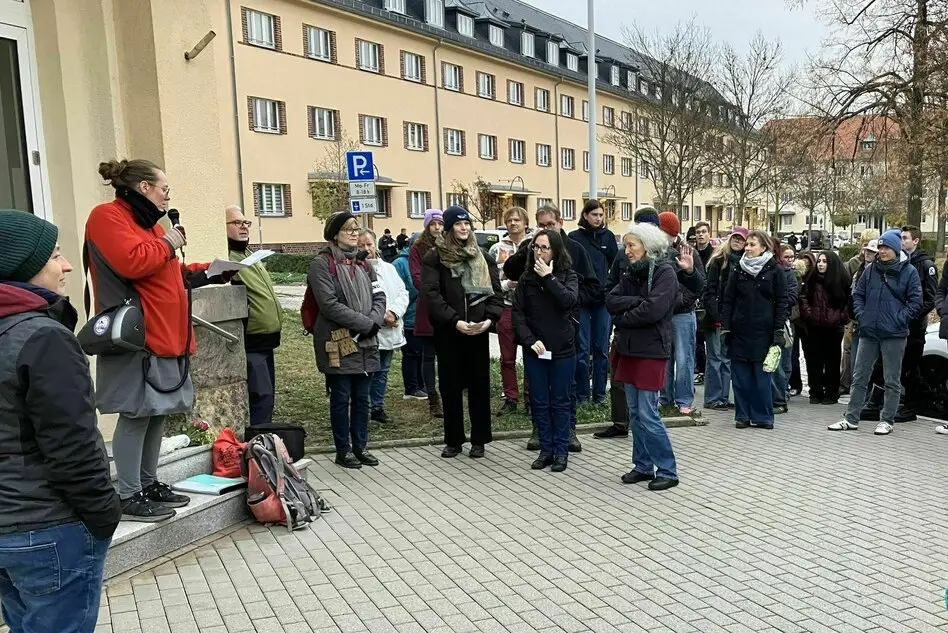
When Anne Nitschke switches on her microphone, around 70 people stand in front of her on Freedom Square in Heidenau to commemorate those persecuted by the Nazi regime. The occasion is the anniversary of the November pogroms of 1938, in which synagogues throughout Germany were desecrated, Jewish shops were looted and thousands of Jews were deported or murdered - including in Heidenau. The memorial walk, which Nitschke helped organize, will go past places where victims of the Nazi regime in Heidenau lived this Sunday afternoon. Short speeches are about the life that people led in the small Saxon town almost a hundred years ago.
There was Bernhard Berger, whom the Nazis arrested on November 9, 1938 during the November pogroms in Heidenau and took him to the Buchenwald concentration camp. He survived the Shoah and emigrated to Australia with his wife. There was Aloisia Braune, who, according to research by the Akubiz association, was persecuted as a Jew and communist in Heidenau. There was the Weiner family: Rosalie, Herrmann and their child Edith, born in 1933. They fled Heidenau in 1938 and were probably murdered in a massacre in Transnistria in 1942 because they were Jewish.
The Alternative Culture and Education Center (Akubiz), where Anne Nitschke from Heidenau sits on the board, would like to commemorate these people with stumbling blocks. These are small brass plaques with the names of victims embossed on them. Akubiz has already applied for the relocation of twelve of these stones. But laying them on public sidewalks will no longer work.
The Heidenau city council decided in September to reject all applications for new stumbling blocks without consideration. Even applications that have already been submitted are included. The initiative was supported by CDU and AfD members. Mayor Conny Oertel (independent) also spoke out against decentralized commemoration. According to Nitschke, the association also invited Oertel to the memorial on Sunday at short notice. But she canceled due to scheduling reasons. The speeches are always about the stumbling blocks.
The city councilors justified their decision by saying that people ignore the stumbling blocks and thus the names of the Nazi victims. This is not “dignified remembering”. Instead, a “memorial area” should be created in the northern cemetery, dedicated to the victims of “war, terror, dictators, expulsion and especially National Socialism in Heidenau”.
Shortly after the decision there was a lot of criticism. Charlotte Knobloch, President of the Jewish Community of Munich and Upper Bavaria, explained in response to a taz query that it was a completely wrong message to remove places of remembrance from the cityscape. She was horrified that the CDU supported “such a transparent maneuver by the extremists from the AfD”.
Despite the criticism, the city council is not moving away from the ban on stumbling blocks. At the end of October, the city council members discussed five petitions that called for the resolution against the stumbling blocks to be examined or revised immediately. But a majority of city council members rejected all applications.
Shortly afterwards, Oertel explained that “the victims of National Socialism were being intensively remembered” in Heidenau. There are already several monuments, and last year the city named a street after Paul Gröger (SPD), who died while resisting the NSDAP in 1933. For Gröger there is a stumbling block in front of the town hall.
In addition to this, there are four other stumbling blocks in Heidenau for the Reiner family. They are located near the train station, in front of the building built in 1913 in which the Reiners ran a department store. Anne Nitschke from the Akubiz association is standing right there on Sunday afternoon, leaning slightly forward and looking at the four tarnished brass plates. The mayor or the CDU faction in the city council never approached her club, she says. After the city council rejected the petitions, some people contacted Akubiz and asked what could be done for the Stolperstein commemoration in Heidenau. The club wants to invite people to a meeting this year, says Nitschke. “There are ideas for alternative options.”
One of the ideas is to ask the private property owners in the locations where the stumbling blocks will be located if the stones could be laid at their location. If they agreed, the city couldn't do anything about it. If not? Then it will take a while, says Nitschke. "But actually it's okay that it's still taking time. The process is part of it."