
Germany · taz · · 3h
Stockhausen's opera “Wednesday” in Berlin: the only solution is the use of helicopters
Deutsch (original) · Auto-translated to English
You shall be seven operas. The composer Karlheinz Stockhausen chose the seven days of the week as a model for his cycle “Light”. From 1977 to 2003 he worked on this work that makes the “Ring of the Nibelung” look almost like a musical miniature. Stockhausen, who liked to think big picture, had a preference for structures that created order. Before “Light” he wrote “Tierkreis” with twelve melodies about the twelve signs of the zodiac, his musical theater “Sirius” revolves around the four seasons and the four cardinal points.
The individual operas from “Light” take some time from the audience and some effort from the performers. “Wednesday” is a highlight in itself, as the four-hour opera contains one of Stockhausen's most spectacular compositions: the “Helicopter String Quartet,” for which the four musicians are placed individually in helicopters and play together via radio. The result is then transmitted, including the roar of the aircraft.
It was no small effort with which Aviel Cahn started his directorship at the Deutsche Oper on Saturday. And you have to be grateful to him for bringing this work, which for the reasons mentioned is not part of the standard repertoire, to the stage this season. It also sets an example as a political message, as for Stockhausen, Wednesday was considered a “day of unification, cooperation and understanding”.
The collaboration is presented in the first “scene” in the form of the “World Parliament”. The choir of the German Opera sings about things like love, not using any words themselves, but rather sounds that, for Stockhausen, should have a meaningful meaning. To improve understanding for the audience, individual singers provide normal language translation assistance with sentences such as “Love is loyalty”. Otherwise, the singing flows tightly, its dynamics seem as if they were placed inside the choral movement.
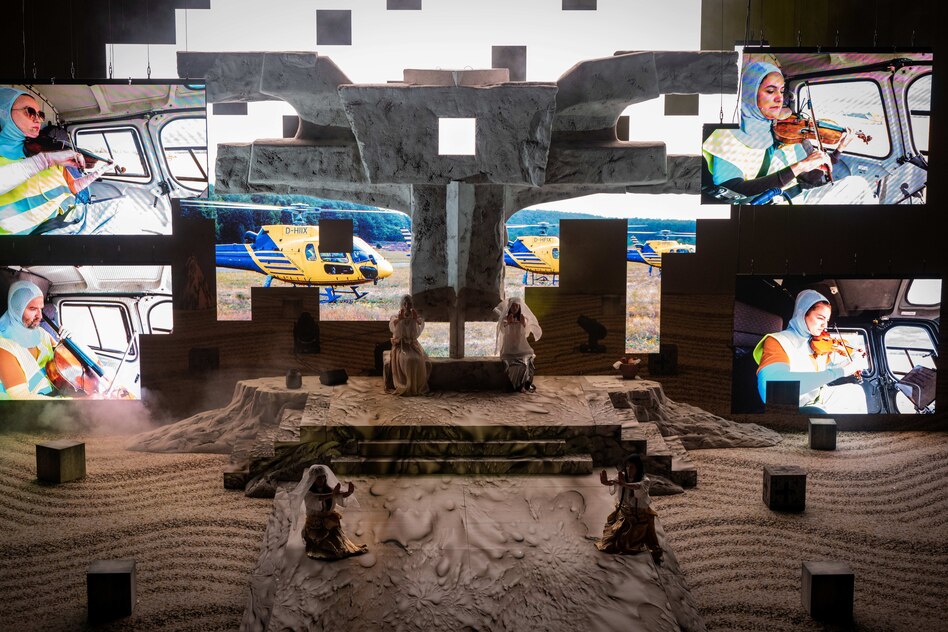
The stage design is open and closed at the same time. The orchestra pit has disappeared, filled with sand. At least figuratively, because slabs were laid above the sinking on which huge, enlarged patterns of raked sand can be seen, just like in a Japanese garden.
This sand is also shown on a large screen suspended in the middle of the stage. Not just a simple rectangle, but its shape is reminiscent of an incomplete puzzle, with occasional cutouts in the picture surface. On it you can see the sand, which seems to constantly flow away thanks to the help of the computer, only to immediately reappear in a pattern. What this doubling through projection is about is not really clear. There probably just needs to be more going on on stage. Because there is no such thing as stage action in the narrower sense.
Even in the second scene there isn't much happening that's particularly pleasing to the eye. The “orchestra finalists” appear one by one, eleven instrumental soloists on wind and string instruments who contribute their parts. As a transition, the entire ensemble plays in between; instead of dramatic gestures, the music moves calmly here too. However, the musicians are not “alone” because the associated electronic music is paralleled by environmental noises, from birds and bees to train noises and children’s voices. Meanwhile, a lot of things are going on on the screen, for example a flock of birds in which flying drones keep mingling, which suggests that the images come from AI. Aesthetically redundant, the images are becoming increasingly questionable.
The purpose of the monitor is only revealed in the third scene, in which the “helicopter string quartet” is finally allowed to start. You can see the four musicians getting into the helicopters waiting for them at Schönhagen Airport, how the rotor blades start to turn faster and faster and how the bows are grabbed inside. Not a live recording, the recordings are from September 5th.
Four individual smaller screens show the quartet in action, while the large monitor follows the flight from outside. Meanwhile, the frequencies of the string tremolos correspond to the hum of the rotors. A different kind of drone music. However, more musically productive results could be achieved with simpler means.
The fourth scene, the “Michaelion”, finally takes off cosmically. The archangel Michael and Eve join forces and ultimately even bring Lucifer to their side. Definitely the scene with the most action and plenty of Stockhausen goofball. A “Luzikamel” appears, which as a “kakamel” drops colorful balls from aft. From there it goes almost seamlessly into praise of God. Stockhausen was very Catholic. And had a sense of humor. As a singer asks in between singing: “Is this all nonsense?” Big applause at the end, especially for the conductor Maxime Pascal, boos for Susanne Kennedy's direction.
Read the full story at the source
Source: taz