
Germany · taz · 2h
“Star Trek” anniversary: never-ending expanses
Deutsch (original) · Auto-translated to English
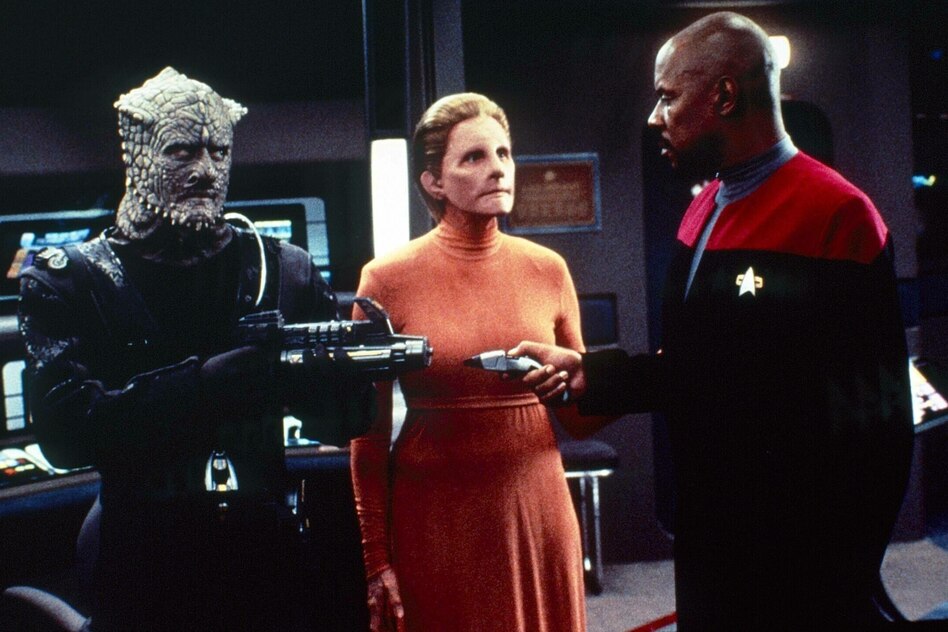
Assuming you wanted to watch all of the “Star Trek” series and films in a row, how long do you think you would be occupied with the infinite expanses of space? 50,000 minutes. So over 833 hours, almost 35 days without a break. This is how much moving images have been created in the 60 years of “Star Trek”. But no one could bear to take it all away. After all, people in 2026 will still have to work, sleep and eat.
In the Star Trek universe, people also need to eat, but conveniently the sci-fi future has done away with cooking. Food comes out of the replicator. All it takes is a call to the computer and a hot cup of tea appears in the machine out of nowhere. Hot drinks play a fascinatingly prominent role in “Star Trek”. First and foremost: Earl Grey. Captain Jean-Luc Picard (Patrick Stewart) prefers to drink this black tea, and the numerous tea drinking scenes in the series “Star Trek: The Next Generation” almost have meme qualities.
Picard and Stewart are among the many legends that “Star Trek” catapulted into the collective memory of pop culture. Above all, James T. Kirk, Spock, Pille, Scotty, Uhura, Sulu and Chekov.
The first “Star Trek” series almost failed. All major TV networks rejected former pilot and police officer Gene Roddenberry with his idea for “Star Trek”. It wasn't until he offered his material to the studio Desilu Productions, owned by actress Lucille Ball, that things turned. Lucille Ball, one of the most powerful women in Hollywood at the time, believed in Roddenberry's idea and pushed through the production of pilot episodes despite the resistance of her all-male studio board.
Kirk's Enterprise still didn't fly for long. The broadcasting company NBC, which then released the series, was not satisfied with the ratings and wanted to cancel the series soon. But it was only the first of many fan protests in 60 years of endless space that saved “Star Trek” from an early end. In 1969, after just three seasons, NBC finally canceled the show.
The first “Star Trek” series became a legend thanks to a peculiarity of the US television market. In addition to the big national networks like NBC, there were also countless local third-party programs that mixed local news with used entertainment formats that they bought from the big networks. The “rerun”, the constant repetition of this third party, made Kirk's troupe a pop culture hit that was finally shown in cinemas from 1979. This includes the acclaimed 1986 film “Star Trek IV: Back to the Present.”
The film, which celebrates its 40th anniversary in 2026, takes Kirk, Spock and crew back in time to Earth in 1986. Their goal: kidnap humpback whales who are supposed to save the Earth of the 23rd century, where humpback whales have long been extinct. Rarely has an environmental activist finger been so entertainingly packaged.
But “Star Trek” also works differently. William Shattner is said to have acted like an asshole to his colleagues on set. And Kate Mulgrew, as Kathryn Janeway in 1995, the first woman in the captain's chair, was subject to constant suspicion from studio bosses about her appeal to (male) audiences. This went so far that "Star Trek: Voyager" (1995-2001) even included an additional female character from season four onwards, whose actress Jeri Ryan explicitly had to wear figure-hugging catsuits. The working conditions in the series, which today had an unthinkable 26 or more episodes per season, each lasting at least 45 minutes, were hard enough even without sexism and resembled heavy assembly line work.
But the great serial “Star Trek” narrative now seems to be dying out at the franchise’s owner, Paramount Studios. None of the series reboots of the last 10 years have been able to build on the previous successes. And there are currently no plans for new series. Discussions about new “Star Trek” films should be ongoing.
So probably no chance left for series masterpieces like the story of “Star Trek: Deep Space Nine” (DS9, 1993-1999). For the first time, the series is not set in a spaceship, but on a space station, or more precisely, the legacy of an occupying army. Commander Benjamin Sisko, who loses his wife right at the start of a devastating attack on the Federation, now comes to this station, which was previously a forced labor camp, as a single father and new boss.
DS9 is probably the darkest and boldest of the many Star Trek stories, with the global upheavals, wars and conflicts of the 1990s leaving deep marks on the series' stories. To get to the heart of their story, however, DS9's showrunners only had to step out into the reality of 1990s America: racial discrimination. In no other “Star Trek” edition is Gene Roddenberry’s idea of a multi-ethnic, diverse and (not always) peaceful coexistence in all its complexity as credibly staged as in DS9, this melting pot of intergalactic peoples. Even though death or worse may be lurking out in space, utopia lives on this tin can with a view.
And it is an explicitly unadorned utopia that knows a lot of racism. For example, in the episode “Far Beyond the Stars”, where Commander Sisko, played outstandingly by Avery Brooks, the first black actor at the head of a “Star Trek” franchise, and his crew end up in the USA in the 1950s through a mysterious vision, where they make a living as authors of a fantasy magazine. Sisko has a hard time with the magazine's white editor because he strictly refuses to print his author's latest piece: the story of a space station under the command of a black captain and his multi-ethnic crew. But let's be honest: Even on the Earth of 2026, this material would no longer easily pass. Not even with “Star Trek”.
Read the full story at the source →
Source: taz