Germany · taz · 58m
From 2006 to 2026 in a few days: Twenty Chicken McNuggets for the price of four
Deutsch (original) · Auto-translated to English
As we enter the gate, a time hole opens. You briefly want to defend yourself against it, but you look back over your shoulder again. Behind the closing gap, the city is drizzling. The door closes, it's 2006. L. and I walk through the Schöneweider industrial architecture. Concrete dust, cigarette smoke, a Mercedes on a crane covered in disco ball mirror shards, a dimly lit blackboard. Art waits at the edges, some still wrapped.
A rotating sculpture with colorful lights, plastic torsos, tubes, and in my memory also gas masks, but maybe that's just the brain adding up. The list of artists on the wall with the production notes includes names from the everything-was-so-cheap-the-city-was-so-cool years, including Martin Eder, Lars Eidinger, Frank Küster. “Unruhe” is the name of the exhibition that is now scheduled to open at Art Week and was curated by the artist Anna Borowy.
But first we eat. The dinner speech will be given by filmmaker Ralf Schmerberg, who came across the space a few years ago while looking for a studio and quickly rented it. It is now called “MaHalla”: a “family” project that is gradually opening up to the outside world. There is also an impression of Schmerberg's own work: Before dessert, he serves the trailer for his feature film "Inderella" - a visually stunning epic about his love for the Asian subcontinent.
The vibrant colors undoubtedly suit the hall well. You're just about to think about the director's perspective when you remember: We've traveled back in time. Later we will go on a tour of the basement. L. and I are tired, we feel like getting going, we've already seen enough ground in our lives. “Are you afraid?” one of the exhibition participants asks L. She just remains silent, dryly irritated, her eyebrows twitching. Two colleagues join us for the long journey to the city center. The disco Mercedes winks glittering in the rainy backlight of the street lamps.
Back in 2026, Art Week is already pushing from behind before it even begins. Too much at once. It's good that some people start beforehand. The Louche Ops project space, for example, which opens with the painter and author Arnold Kemp. Later, literature pushes forward. At Writer’s Thursday in the schnitzel-golden Borchardt we read. The program is surprisingly flexible. Maxim Biller begins the reading marathon line-up as a kind of secret track, Henrik Bolz is pushed to the front: after a charming lecture in the literally boiling hall, he casually shoulders the sports bag and trudges off towards Friedrichstrasse. Later he will sit with Maybrit Illner and talk about the East before the election. The near future can no longer be ignored.
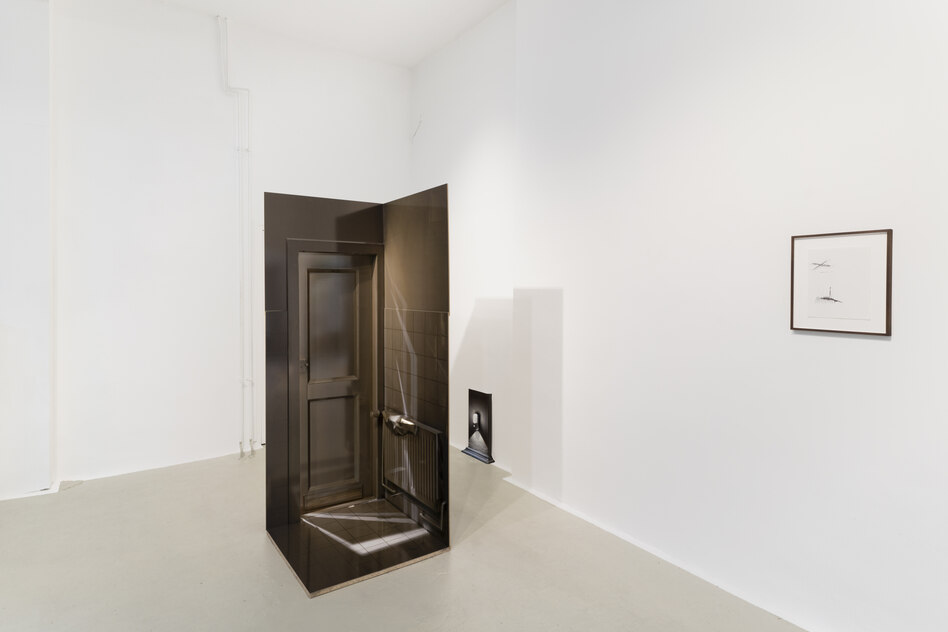
The next evening, at the Projektraum-turns-Gallery shop Paintshop on Hasenheide, there is a hint of future tense in the air. Here the Pernice student Lasse Müller recreated reality. A hard-working nerd must be someone who, like Müller, meticulously depicts what is there on paper with hundreds of photos of an object (road bollards, birch trunks, bathroom doors, surveillance cameras) and then recreates it mounted on wood. Only sometimes a polygonal glitch flashes out of the material. The heating in the bathroom backdrop of a contemporary Bundeswehr advertisement suddenly folds into non-Euclidean structures. The extent to which the image becomes an image here, including deceptively real inclusions of light, is worth taking a second look at what at first glance could be understood as a one-line, elaborate joke.
Aesthetically, the works seek proximity to potentially violent computer games, including the inherent idea of a future that has long since become a thing of the past. A bit like the McDonalds app with which F. and L. later try to get 20 Chicken McNuggets for the price of four at Hermannplatz. Or like the drunken Irish people in the same location cursing loudly about the fact that the promise of clubs and drugs in this city doesn't seem to be coming true that night. Or like the state elections the following evening, after the first projections of which one immediately longs for a time gap. However, you have to formulate this with a specific decade. Otherwise you might unfortunately get what you want.
Read the full story at the source →
Source: taz