
Germany · taz · · 2h
Season opening at the Volksbühne: Is yogurt the panacea?
Deutsch (original) · Auto-translated to English
Water shoots up from two fountains on the left and right of the Volksbad. A third beam joins them from the roof of the theater. Also on the roof: a large, inflatable body with no arms, legs or head, just a hairy vulva and breasts, just like in Gustave Courbet's famous painting "L'Origine du monde". Ten naked performers get ready up there; Five of them will immediately abseil down the facade and clean it with white rags, then rub themselves against it with rhythmic hip movements. The other five make atmospheric live music, somewhere between epic rock and pounding techno.
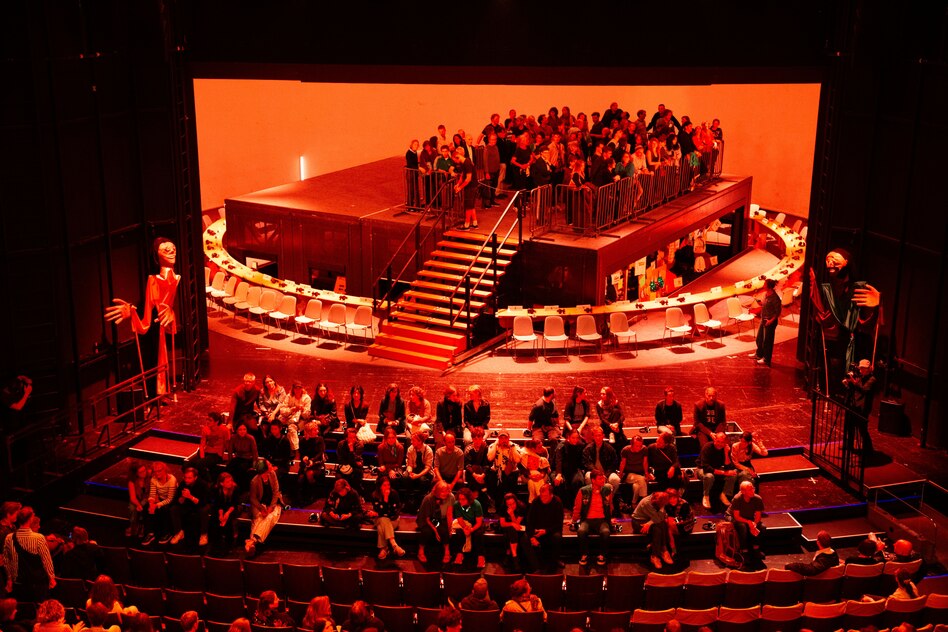
Florentina Holzinger and ensemble ring in the new season with “House Wash”. The ritual washing means a new beginning, but before things can move forward at the Volksbühne, under the new directorship of Matthias Lilienthal, we first have to look back at “House of Hopes”, at the time of the fall of the Berlin Wall. For this purpose, Rimini Protocol has set up ten stations throughout the house. Instead of just taking a seat in the large hall, the audience is chased through various locations on the Volksbühne.
At individual stations, performers present their own lives; they are people from different countries, all connected in one way or another to the fall of the Berlin Wall. Her stories exploit the possibilities of the theater, taking them on stage, behind the stage, into foyers and back rooms. They all deal with moments of hope for the situation in their country when the Berlin Wall fell.
The stations last approximately twelve minutes and all take place at the same time. This simultaneity also extends throughout the evening. Through headphones, the audience not only learns about the Herero and Nama, against whom the Germans committed genocide during colonial times, or the Islamic Revolution in Iran, but also receives instructions. Middle fingers should be extended to a passing group, which in the story represents soldiers. Later, now a soldier himself, you run through the star foyer, where the Romanian revolution is being talked about. All stations are coordinated with each other, in precise minute and step intervals.
Rimini Protocol works historiographically and relies on the effect of repetition. Each station suggests that history can also repeat itself. Anyone who dreams of democracy and gets it can also lose it again. Dance and music also play a role; Songs of resistance from China or Chile are sung, Hawaiian hula and a Bollywood film dance are performed. What is repeated and similar creates community. Of ten stations, only seven can be visited. At the end the hall fills up for the final applause – with a standing ovation. Some of the audience is still on stage. The final applause also signals: We belong together, no matter where. Ann Toma Toader
Immaculate and bright: When you look at the newly opened Prater on Kastanienallee, a well-known East Berlin facade graffiti comes to mind: “This house once stood in another country.” After ten years of renovation, the historic Prater ensemble is complete again - beer garden, communal gallery and the Volksbühne venue, which was shaped by René Pollesch in the noughties. On Friday evening, many of those who had made a pilgrimage to the dilapidated hall to watch post-dramatic pieces clogged up the Kastanienallee, which had been narrowed due to the construction site, with their premiere beer - across the stream of tourist groups.
The opening piece “Perfections”, based on a novel by the Italian author and translator Vicenzo Latronico, about an expat couple in Berlin, also begins outside. A male couple with rolling suitcases and white oversized shirts with the inscription “International Nobody” make their way through the crowd, nagging, and the audience follows into the theater hall, which is decorated in red and green tones. There the couple's argument picks up steam: Why does the apartment look so different than in the pictures? Why is the local service staff (Prater regular actress Inga Busch in the “National Nobody” shirt) no help?
The expat evening, staged by Anta Recke, who already worked with Volksbühne director Matthias Lilienthal in Munich, is consistently bilingual in German and English, with sprinkles of French, Italian and Spanish. Word uncertainties and strong accents included. This seems fitting, given the bubble of creatives described by Latronico, which moves smoothly but smoothly through a city in which it is primarily interested in the emptiness. Recke's idea of distributing the novel's already quite generic protagonist couple Tom and Anna among six actors in alternating message shirts also underlines the superficiality of this volatile social structure.
The audience, spread all around the hall, watches the “Bodies”/“Nobodies” as they have breakfast in huge, meticulously furnished old apartments, have sex and design websites, and attend openings in the evenings and collect ideas for the next project (“Anywhere”). Tom and Anna, who have settled into the flood of images on the Internet, feel “enviable” and privileged. But imperceptibly, the rush of possibilities gives way to routine. Berlin is changing, rents are becoming more expensive, art spaces are closing, and there is debate about the future of Tempelhofer Feld. Tom and Anna say goodbye to friends more and more often. They feel threatened by the new young professionals streaming into the city. In 2015, refugee solidarity gave rise to the possibility of establishing new, more meaningful social relationships. But Tom and Anna don't gain a foothold here either.
Director Recke largely succeeds in making one forget the basic dilemma of her production: How do you bring a novel to the stage that does without dialogue? To the bubbling techno beats of Ted Gaier ("Golden Lemons"), who also embodies one of the "Bodies", the actors wrestle silently with each other or suddenly mingle with the audience (particularly charming: Benjamin Radjaipour as a frivolous whisperer of sexual practices for couples). The a capella interludes also seem confident - only the multilingual text passages require the prompter to play several times. For the Volksbühne crew, who are used to huge amounts of text, this is a bit surprising. As a “small, super-specific form of historiography,” as it says in the accompanying booklet, this opening evening nevertheless fits easily into the larger Berlin narrative framework, which has been expanded again with the new Prater. Nina Apin
“People need stories,” it says towards the end. Up until then, many stories had been told, metaphysical, unredeemable and dissolving ones. And perhaps that is the core of the confusion that arises on this last opening evening of the Berliner Volksbühne. It is titled “Mononoke” and was written and directed by Satoko Ichihara. At the center is Tatako (Rosa Lembeck), an “ordinary woman”. She seeks advice from the fortune teller Princess Monoprix in order to remove an iron egg that she had pushed into her vagina in an excited moment.
Princess Monoprix is a small, enterprising woman, actually a Bunraku doll, who is moved by three players (Gwentsche Kollewijn, Akira Schroth, Maria Vittoria-Zinoni). She floats through the room with glowing red eyes, soon begins a high-priced consultation, talks about karma and the guilt of her absent father, and sells Tatako expensive miracle water. In between, Yaku (Gro Swantje Kohlhof), an intrusive Döderlein bacteria, speaks up, which lives in Tatako's vagina and tries to keep the PH value under control. At the recommended clinic, Tatako then meets the futuristic-looking doctor Hoshino (River Roux), who uses her iron finger to suddenly establish a connection with Takako's supposed father Sato (Julia Riedler) and soon wants to initiate artificial father-daughter iron egg insemination.
After a short time, a confusing web emerged that evening, consisting of sex, iron and Japan as one of the world's most important crude steel producers, and the question of images of women and the roles of fathers and mothers. From ideals of beauty and yogurt as a panacea, vaginal thrush and deadly curses. In scenes arranged rather sparsely on the forestage, the four players talk their way through these story(s), wearing white socks, sandals and disgusting green-yellow wigs (costumes and puppet design: Belle Santos).
Later, as water drips and mist rises, an alien-like fallopian tube-womb object made of loops and tubes by visual artist Mire Lee will fill the stage. A resistant structure that “cannot produce life and makes the impossible act of allowing life to arise from it itself a work of art,” says the text. The doctor Hoshino has long since come out as an artist, curses and ghosts have been forgotten and Tatako realizes: "It's all a lie. Then I'm not cursed. Everything's okay."
It's not that easy for the audience. Although the evening is captivating with its idiosyncratic stories, whose narratives are repeatedly undermined, the overall taste remains very unwieldy and special. Moments of acting happiness are missing, as is a dramaturgical or atmospheric pull that unites all the stories - be it in raw, archaic chaos. Katrin Ullmann
Read the full story at the source
Source: taz