
Politics taz
Social protest in France: Diagonal of frustration
The unrest and violence in France has a history of disrespect. The Republic must respect its own values again. more...
Deutsch (original) ·Auto-translated to English
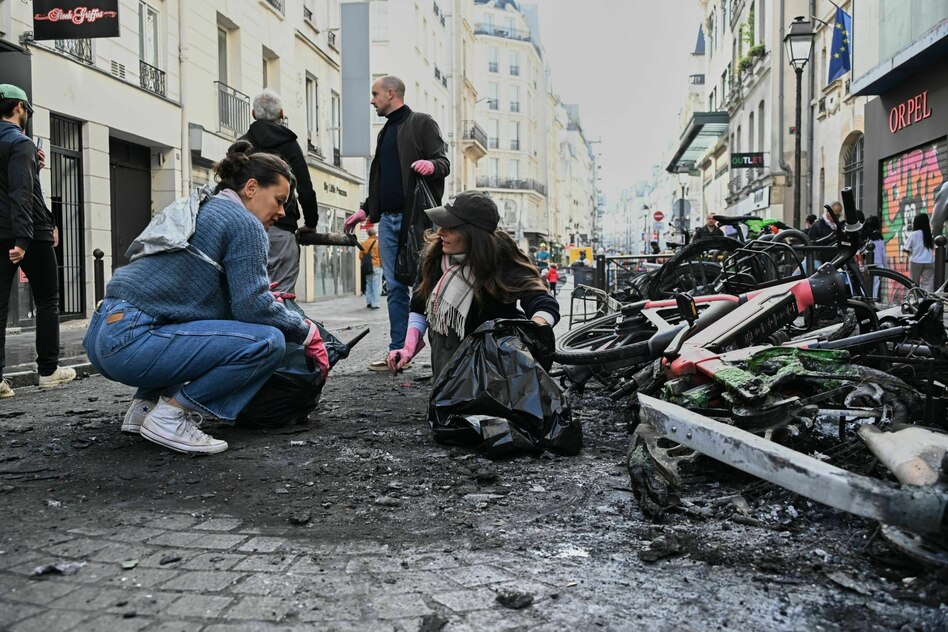
Their names are Arthur, Joseph or Soukeyna. They study mathematics, politics or go to high school. All three were on the streets last weekend. Not to riot. But to demonstrate for better conditions at their schools and universities. They reject the violence that overshadowed the rallies in many places. But they still want to continue with their protests. And that's a good thing.
The young people's uprising is not only directed against broken toilets and the lack of teachers. Behind him is the question of what the republic actually has to offer its young people. Whether the promise of equality still applies. “Liberté, Égalité, Fraternité” are written above every school gate in France. But these values can hardly be found anymore, especially in the education sector. Anyone who looks around the banlieues can see that. The high-rise housing estates that have been built on the outskirts of large cities resemble ghettos. The plaster is crumbling in the classrooms.
Studies show that applications with non-French sounding names or addresses in problem suburbs are rejected much more often. Discrimination is particularly noticeable during police checks: According to the French civil rights commissioner, black or Arab-looking young men are four times as likely to be stopped within five years as white men. The risk of being searched or taken to the police station is twelve times higher.
The taz is an independent, left-wing and opinionated daily newspaper. We have been arguing in our comments, essays and debate texts since the taz was founded in 1979. We often cannot and do not want to agree on an opinion. That's why you'll find some completely opposing positions here - all part of the very broad left-wing spectrum of opinions.
Anyone who speaks of equality cannot accept that skin color determines how young people are treated. The young people from the suburbs have mostly been French for three generations. But to this day they are not accepted as such.
The outrage over the death of 17-year-old Nahel, who was shot by a police officer during a traffic stop in 2023, should also be understood in this context. Back then, too, young people rioted all night long, looting shops and destroying public facilities. The images of burning cars were reminiscent of the suburban riots of 2005.
Even then, President Jacques Chirac had denounced discrimination against suburban youth. “We will not achieve anything lasting if we do not fight this poison of discrimination,” he warned in a speech that has lost none of its relevance. Especially because Chirac saw the rioters as French, without any reservations. “I would like to tell the children of the problem areas that, regardless of their background, they are sons and daughters of the Republic.”
Such a commitment is urgently needed today. Instead, right-wing extremists like Éric Zemmour blame “hordes of barbarians from the Maghreb and Africa” for the riots. Marine Le Pen, who is currently leading all polls for next year's presidential election, castigates “anarchic immigration”. The first rapid procedures show that the picture is mixed. The Minister of Justice himself now said: “There is everything... people with a migration background, foreigners, but also people who are completely integrated, who are French.”
The students from the banlieue have now been joined by many peers from the better districts of the big cities. This solidarity is new. It shows that a general discontent affects 18 to 25 year olds. No matter whether in Neuilly or Saint-Denis: They can't find affordable apartments, get by on temporary contracts and worry about the climate. Together they are against “La France à Macron”, as their posters say. So a France in which politics is made from above and people's concerns count for little.
is a freelance journalist in Paris and has also been writing for the taz for many years.
The president's condescending advice to just cross the street to get a job stuck with many young people. Anyone who governs like this should not be surprised if a generation loses trust.
Young people are currently experiencing first-hand how far the disregard goes: The government is accusing the left-wing far-left party La France insoumise of controlling the protests. Such an attribution is easier than dealing with the problems of young people. The Prime Minister has not yet received the representatives of the student unions. No wonder that many young people have the feeling that they will only be taken seriously when they use violence.
According to a survey by the Ipsos Institute in the summer, only a quarter of 18 to 29 year olds believe that politicians understand their concerns. Four fifths are of the opinion that those responsible for politics are preparing poorly for their future. “These young people no longer recognize themselves in our institutions, in the elites that they are supposed to represent,” says sociologist Michel Maffesoli to the newspaper Opinion.
When the yellow vests protested in 2018, the whole of France looked at the diagonal du vide - the diagonal of emptiness. What was meant was a 1,500 kilometer long strip between Lorraine and the Pyrenees, where there is hardly any infrastructure. The doctors' offices and schools are closing, and the village bistro is also closing. The residents feel left behind. When the government increased the gasoline tax, the gilets jaunes took to the barricades in their yellow high-visibility vests.
This time it is not a diagonal of the void that is rebelling. It's a diagonal line of frustration that stretches from the suburbs to middle-class neighborhoods. The fact that parents are now taking to the streets with their children shows how deep their concern for the future runs. France's problem is not just anger on the streets. It is a republic that must respect its own values again - especially towards young people.