
Germany taz
Rare Kennedy Disease: You Bittersweet Life
The painter and theater man Klaus Fermor has the rare Kennedy's disease, which causes his muscles to atrophy. He doesn't let it get him down. On the contrary. more...
Deutsch (original) ·Auto-translated to English
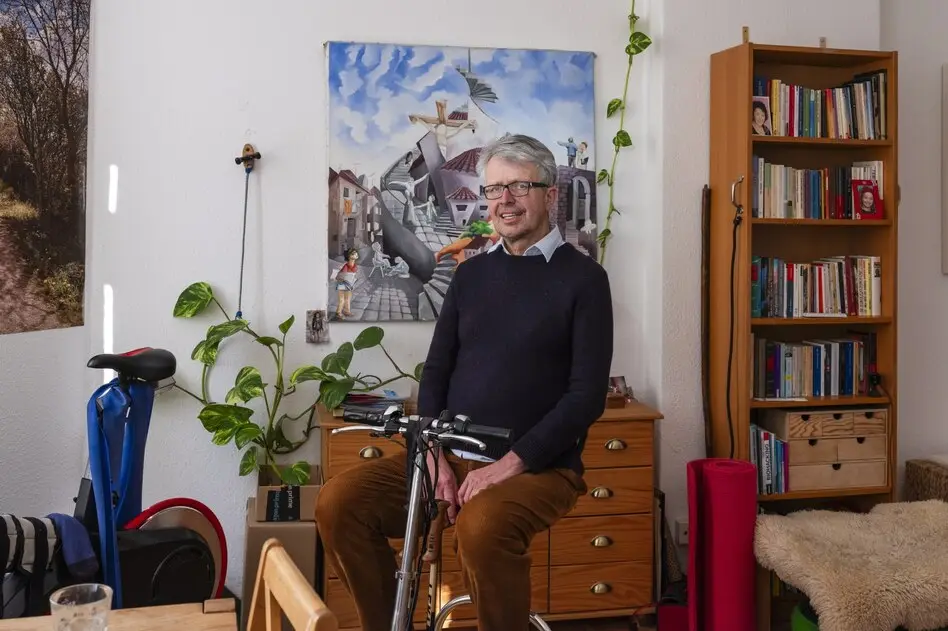
Klaus Fermor relies on community. Because he knows that she carries him. Even when he can no longer do everything.
Outside: On Wartburgplatz in Berlin-Schöneberg, people are sitting in the sun, others are cycling past. Children scream in the playground. A few steps further you go through a front building into a leafy backyard. Colorful pennants are stretched between chairs, benches and a long table. Klaus Fermor lives in one of the apartments facing the courtyard.
Inside: Fermor sits at the dining table in the living room and sips his tea. The 64-year-old has lived in the 42 square meter old apartment since 2014. Lots of wood, fresh flowers on the table, postcards, drawings and oil paintings everywhere. A plant climbs the entire living room wall. A small angel figure hangs on the window. A guitar, his oldest possession, leans next to a shelf. He likes things that have a soul. Even if he doesn't actually care about things. His illness teaches him this.
This text first appeared in wochentaz, our weekly newspaper from the left!
Every week, wochentaz is about the world as it is – and as it could be. A left-wing weekly newspaper with a voice, attitude and the special taz view of the world. New every Saturday at the kiosk and of course by subscription.
The diagnosis: Fermor has spinal muscular atrophy type Kennedy, a progressive disease that increasingly limits his mobility and independence. He was diagnosed in 2006 when he was in his early 40s. It was a shock for him, who loved to travel and take things into his own hands. "This is how I will end up. As a disabled person. As a need for care," he thought at the time.
The descent: At some point during a hike, his legs completely gave out while his friends continued walking. He caught up with her again. But during the painful descent it became clear to him: it was his last hike. He had to say goodbye to the need to keep up with the others.
Ways: Fermor dreamed of running, swimming, traveling again. He said he struggled and was angry. But at least: The disease progressed so slowly that he was able to gradually rebuild his life. “If I want to do something, I always find a way,” he says today. "I can't walk, but I can do other things. Painting allowed me to develop thoughts into positive images."
Perspectives: His brother, who was two years older, had the same illness and took a different path. That of assisted suicide. He withdrew, seeing himself as a "cripple," as Fermor says: "He died of inner emptiness and meaninglessness. I see possibilities, he saw the disability." Klaus Fermor did not know that his brother became a member of the German Society for Humane Dying. He didn't leave a suicide note. Fermor says he understands that his brother no longer saw any point. However, it hurt that he left without saying goodbye.
Precaution: Fermor, who describes himself as fundamentally positive, is now a member of a euthanasia association. He knows how and where he wants to die one day, he says: in the bedroom of his apartment. But it's not that far yet. He still wants to make the most of the liveliness he feels within himself. Enjoy people and culture. Participate. However, before complete dependence sets in and he is at the mercy of institutions, he wants to leave. The knowledge of self-determination calms him. "I want to say just like my brother: Now it's good. I want to leave with dignity and with a smile," he explains, biting into a cookie.
Soul home: Fermor grew up in Lindau on Lake Constance, in a family of dentists. As a “good sandwich child,” he often put his own needs aside. “I always felt like it was my job to mediate between everyone.” Family remains an anchor for him to this day. He calls the depth and breadth of Lake Constance “the home of the soul”. But at some point Lindau became too stuffy for him. After graduating from high school, he did community service in a hospital far from Lindau and moved to Berlin in 1984.
Stage: As a young person, Fermor swore with his best friend: “We will become artists, nothing else.” But art academies rejected him. He didn't want to become a dentist like his father. He then worked in a daycare center and painted a lot. “Through painting I was able to connect with the world and deal with fears.” In the end he didn't become a visual artist, but rather a theater man, traveling around the country with the Rote Grütze theater and working with "little Turkish bullies" in Berlin-Schöneberg, some of whom he still maintains contact with today. He also worked in Brazilian favelas and as a self-employed person in the event sector. Today he works in the Atze music theater. “I always wanted to be on stage, then ended up backstage and was happy there.”
Unfinished: One of his pictures hangs on the wall above a wooden chest of drawers. A surreal, religious-looking network of houses, stairs and figures under a wide cloudy sky that depicts street children in Portugal. It's not finished yet. Fermor wants to continue working on it. There are still a lot of pictures to finish and a lot of old letters to read, he says. The will to live is the will to act.
The crack: But many things that used to be taken for granted are no longer possible today. At least not that easy. What Fermor clings to: That he did the things he wanted to do. “I won’t leave as a grumpy moron, but as a person with a wealth of experience.” Still, he says, he sometimes gets angry and frustrated and becomes impatient with himself when his body goes on strike. He then quotes Leonard Cohen: "There is a crack in everything. That's how the light gets in." – There is a crack in everything. But that's where the light comes from. This is also how he sees his illness.
Faith: Fermor prays morning and evening. For his family, his neighbors, sometimes for the whole world. His father was pragmatic about praying: Maybe it was better to pray, then at least you would have fulfilled your duty. Fermor, however, is concerned with something different. “Giving my life into the hands of something higher gives me strength.” He enjoys spirituality and the idea of previous and future lives. He sees gratitude as an active decision - although he himself cannot say which came first, the positive attitude or the gratitude.
Give and take: With assistance, Fermor's everyday life works well. He receives support with his journey to work, around the house and with personal care. His daily companion: a motorized tricycle that enables him mobility. For this purpose, neighbors built him a ramp to his apartment. Having long preferred to organize everything himself, he first had to learn to accept help. Today Fermor says: “I don’t feel like I need help, but rather that I often make people happy if they can help me.” His friends describe him as caring and humorous. As someone who goes out a lot and likes to laugh. “If you give something, you get something in return,” says Klaus Fermor.
The little thing: There are flowers on the windowsill that he slowly waters. It is rituals like these that give Fermor stability - just like cooking, lighting candles and singing. Then there are the people around him. He especially needs this, he says, because calm doesn't come easy to him in the face of greed for power, the loss of humanity and growing autocracies. What holds him together is community.