
Germany taz
Novel “The Ticking Heart”: In a strangely irradiated world
In “The Ticking Heart,” Lutz Seiler takes creative risks and makes the magical appear realistic. The plot stretches from Berlin to Semipalatinsk. more...
Deutsch (original) ·Auto-translated to English
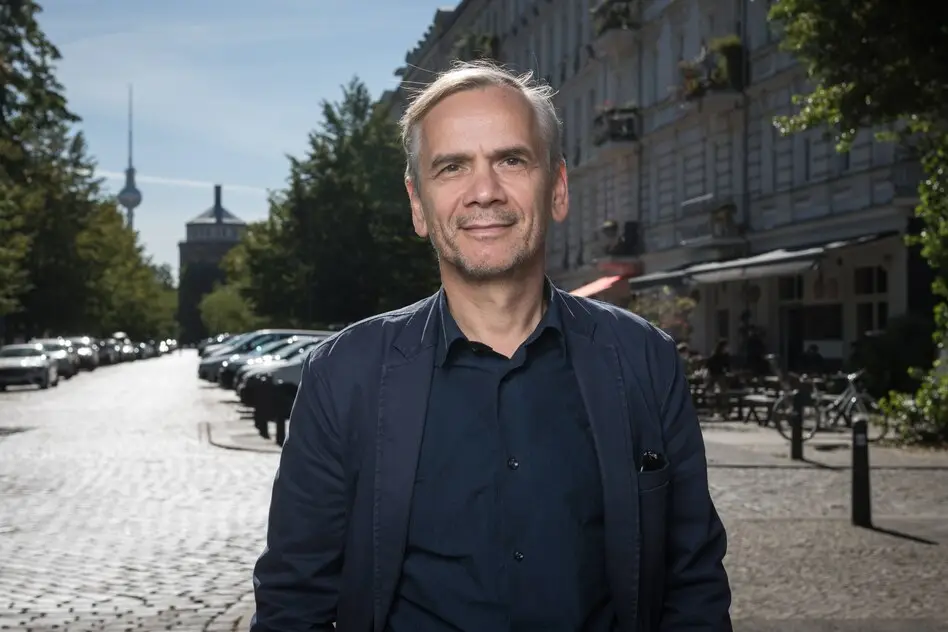
Only two writers have won all four of Germany's most important literary prizes in their careers. In addition to Terézia Mora, Lutz Seiler has this grand slam of the Büchner Prize, Bachmann Prize, Book Prize and the Leipzig Book Fair Prize to show for it. Now his new novel “The Ticking Heart” has been published – can he fulfill the promise of this award-winning career?
In this novel, the 63-year-old builds on something familiar. As in its predecessor, “Stern 111,” the focus is on the poet and bricklayer Carl Bischoff. As a reminder: Immediately after reunification, Carl moved from the Thuringian province to the wild east of reunified Berlin in search of love and artistic self-realization.
The action picks up again about ten years later; we are in Prenzlauer Berg shortly after the turn of the millennium. Actually everything is the same, Carl is still an unsuccessful poet with great romantic ambitions. His residence alone has moved 100 meters further east to the other side of Prenzlauer Allee.
Lutz Seiler: “The Ticking Heart”. Suhrkamp, Berlin 2026, 464 pages, 28 euros
The fact that he had a relationship between “Stern 111” and “The Ticking Heart” and moved to the country doesn’t matter. With a separation, which takes place shortly before the action begins, and the return to the capital, Seiler restores the familiar initial state. The historical context has changed; While in Berlin in the early 1990s, Carl only needed a chisel and a new lock to move into an already empty apartment in an old building, he is now dependent on the favor of real estate agents.
“The Ticking Heart” stretches from west to east between Amsterdam, Berlin, Vilnius and Semipalatinsk. The events are driven forward by the mysterious Aysha, who contacts Carl on behalf of an international poetry society. Finally someone seems to have discovered his genius, he appears at international festivals and - how could it be otherwise - falls in love with Aysha.
In short, you feel like you're reading a classic artist's novel: Carl, like his creator Seiler, was just working as a bricklayer before someone finally became aware of his literary talent. But that is only a tiny part of this novel, which is difficult to describe in classic genre terms. Once you think you've got hold of him, he'll quickly escape.
The individual stops on Carl's journey on the way east are treated with such seriousness that each time you think that Carl has arrived and that this is where he will stay.
Seiler understands the phenomena in literary terms, for example when Carl's work as a bricklayer is captured in the image of the "lime thumb": "When the lime made the skin dry and brittle, the hands shrank. A tension arose that pulled the bricklayer's thumb onto the palm of his hand, first the thumb and then the other fingers, little by little, the hand closed into a fist. A phenomenon that construction people called the lime thumb."
The next stage of Carl's discovery at poetry festivals is also approached very seriously, a microcosm of artists of the word floating above things is opened, but then the journey goes again in a completely unexpected direction. This uncertainty is masterful because it creates uncertainty about the progression of the plot, in which no reliance can be placed on common narrative patterns. In a world in which a lot has already been told, Seiler has the gift of creating something fundamentally new.
At the same time, he doesn't get lost in postmodern gimmicks; the plot has a core that is revealed over the course of the novel. In reality, Carl is discovered not because of his lyrical talent (none of his poems can be read in the novel), but because of his experience with radioactive radiation; As a child he was the victim of an accident in the uranium mining industry in the GDR.
Aysha, on the other hand, is a shaman from a nomadic “clan” that lives on the USSR’s nuclear test site in what is now Semipalatinsk, Kazakhstan, and struggles with the long-term consequences of the contamination. They hope to get expertise from Carl about relieving their pain.
These seemingly loose ends are connected by magical motifs. During Carl's first encounter with shaman Aysha, a bud is implanted in his hand. It will blossom until the end of his journey in Semipalatinsk. These shamanic abilities do not appear to be mumbo jumbo. In the world of the ticking heart, they are a plausible effect of radioactive radiation. Seiler's unique shape makes the magical appear realistic.
When it comes to negotiating a romantic relationship alone, Seilers go through the motions. As in the previous novels, men are dreamy enthusiasts who, in their search for love, only meet unfathomable, nymph-like sexual creatures. In the book prize winner "Kruso" such a creature suddenly appears in the protagonist's bed; in "Stern 111" the young Carl meets his school crush, who gives in to him in no time at all.
Seiler and Carl, who has now aged ten years, remained true to each other in “The Ticking Heart”. The Kazakh shaman appears incredibly desirable, Carl falls for her at first, but for reasons he cannot understand, she remains completely unreceptive to his love. Okay, they sleep together, but this female creature seems removed from such earthly interests, her inner life remains a mystery.
This fetishization is irritating because it is strangely flat compared to Seiler's great originality. Everything about this book is new, only this relationship to women is old.
Given the creative risk that his new novel represents, this can be forgiven. In terms of form and content, the balance between innovation and comprehensibility is finely balanced. It is this relationship between artistic ambition and accessibility that makes Seiler so worthy of the award.
His novels are enjoyed by both literary critics and the general public. With “The Ticking Heart” Seiler also proves his versatility. After his first two novels, he could perhaps have been described solely as a turning point author, but here he proves that he can open up completely new worlds.