
Anti-fascism taz
Self-exposure of the NSU 15 years ago: Questions still remain
People in Zwickau Cathedral devoutly remember the victims of the NSU. The core trio didn't commit murders in the city, but felt at home. more...
Deutsch (original) ·Auto-translated to English
Mandy Boulgarides pauses for a moment, sobs quietly, takes a breath and then continues. On this Wednesday afternoon, her voice echoes from the high stone walls of the cool cathedral in Zwickau. It is the city's official commemoration event, exactly 15 years after the “National Socialist Underground” (NSU) exposed itself. Boulgarides stands at the front of the lectern and talks about her father, Theodoros Boulgarides, the retailer in Munich. And she talks about the irreplaceable loss when the NSU murdered him in 2005.
In Zwickau, the not-so-small town in Saxony, the core trio of the NSU lived undisturbed in different apartments for years. From there they planned attacks, murders and robberies, supported by a still unknown number of people who knew.
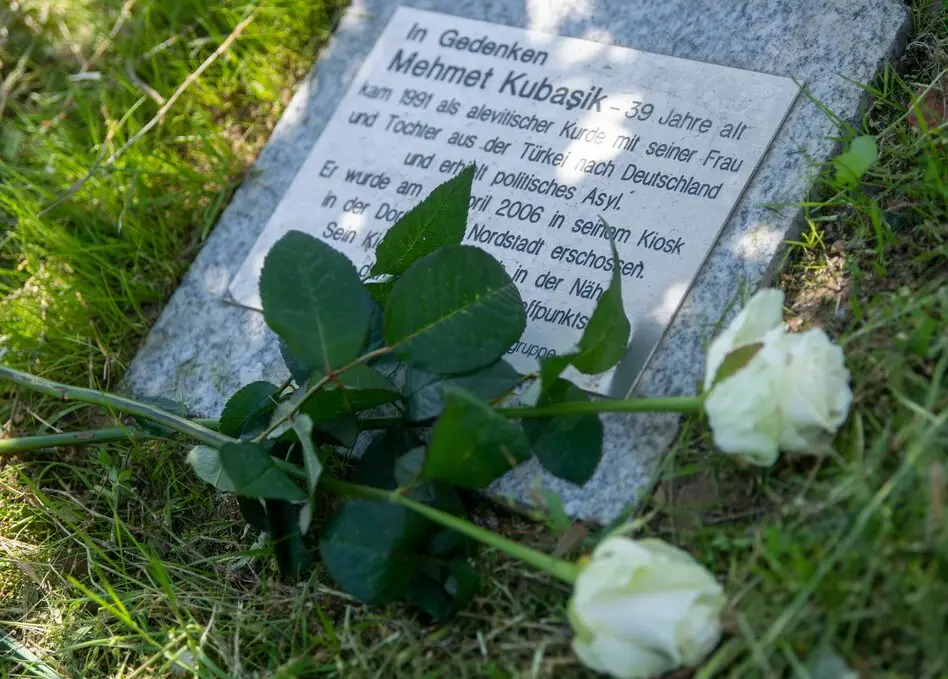
But at the commemoration in Zwickau Cathedral on Wednesday, the focus will be on the ten murdered people and their relatives. In addition to Theodoros Boulgarides, the terrorist group killed Enver Şimşek, Abdurrahim Özüdoğru, Süleyman Taşköprü, Habil Kılıç, Mehmet Turgut, İsmail Yaşar, Mehmet Kubaşık, Halit Yozgat and Michèle Kiesewetter.
After Mandy Boulgarides' speech, several representatives of the federal government and the Saxon government took the podium. Ministers or ministers of state are not there. Sebastian Wüste, State Secretary in the Federal Ministry of the Interior, among others, admits that the police made mistakes. “The security authorities have investigated in many directions, but not in the right one.” Instead of the right-wing extremists, the focus was on the relatives - until the self-exposure 15 years ago.
But questions remain unanswered to this day. This is emphasized by those affected and relatives of the victims of the NSU terror. There are eight demands on flyers that are displayed on the wooden benches in the cathedral. “We demand sustainable psychological and unbureaucratic support for those affected,” it says. Or: “We demand the investigation and prosecution of all NSU supporters.”
Some of these supporters also lived in Zwickau. Probably on Polenzstrasse, one kilometer from the cathedral. This is exactly where the core trio, Beate Zschäpe, Uwe Mundlos and Uwe Böhnhardt, lived from 2001 to 2008. A few hours before the official commemoration, around 40 people crowd onto the narrow sidewalk. You listen to a person from the Open Trial Documentation Center talk about how comfortable the three perpetrators felt in the city.
Contrary to what the word “underground” in their self-chosen name suggests, the core trio did not live isolated from society, says the person from the documentation center, who only introduces himself with the first name Momo. Instead, they maintained contact with neighbors and holiday acquaintances under a false name. Polenzstrasse is the second stop on a tour that the Open Process Documentation Center is offering for the first time this Wednesday, 15 years after the self-disclosure.
However, the tour skips the last place of residence in the spring district of the NSU core trio. Unlike Polenzstrasse, it is largely known, explains Momo. After Mundlos and Böhnhardt shot each other after a failed bank robbery in Eisenach, 150 kilometers away, Zschäpe set fire to the apartment on Frühlingsstrasse exactly 15 years ago, blowing it up to destroy evidence.
Instead of on Frühlingsstrasse, the tour ends in the memorial grove at the Swan Pond in Zwickau. Ten trees there not only remind us of the NSU murder victims. They also remind us that commemoration in Zwickau was a difficult topic for a long time.
When citizens initially commemorated the victims with memorial benches on the 5th anniversary in 2016, within a few days some of them were sawn, sprayed with paint and stolen. Unknown people also sawed down a memorial tree planted in 2019 for Enver Şimşek, who was the first to be murdered by the NSU, after a few weeks.
Only a little later did the city plant the ten trees in the memorial grove for the murder victims. But she did not include the victims' surviving relatives. Several names on the memorial plaques were misspelled. Then the AfD laid a memorial wreath and caused a commotion.
The names on the boards have now been corrected. The fact that the ten memorial trees are still standing may be because the police were guarding them, Momo suspects, shortly before the tour ends. The leaves of the ten still young trees have already turned autumnal. Next to them there are wooden benches again, brightly painted, on which the names of the murder victims are also written.
A few hours later, the participants in the memorial service move from the cathedral to the grove. It has now become dark. At the end, the hundred or so people form a semicircle, say the names of the murder victims together again and finally remain silent for a minute.