
Politics · taz · · 2h
Schwesig's SPD election campaign in Meck-Pomm: With the electorate she can
Deutsch (original) · Auto-translated to English
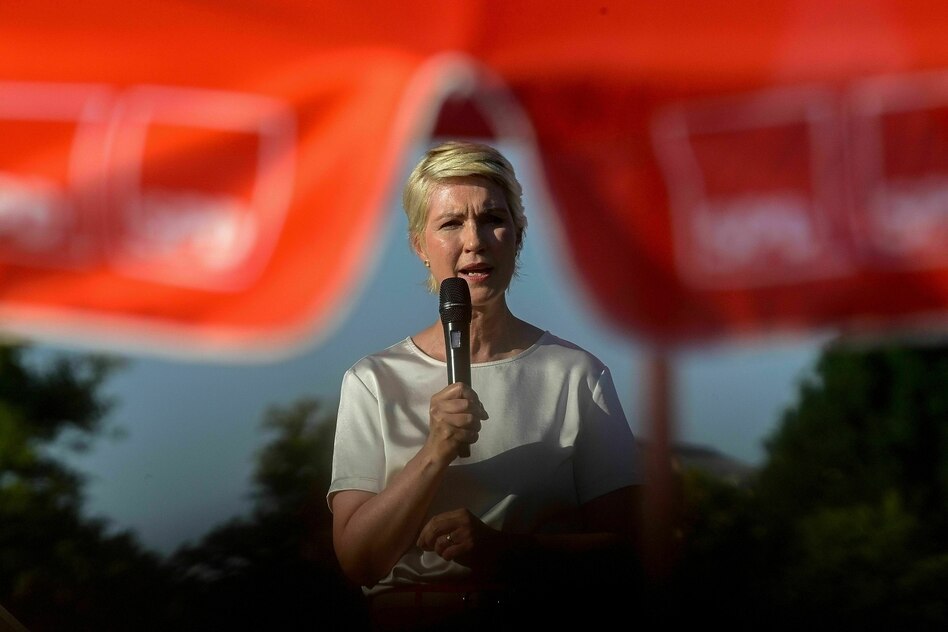
Two dozen people came to the public discussion with Manuela Schwesig. Including a man in a denim jacket from Bad Doberan. "First of all, a huge compliment for your great work. You could be Chancellor." The Prime Minister said with a smile: “Thank you.” Then she continued: "We already have a chancellor. My place is in Mecklenburg-Western Pomerania."
That was two years ago. At that time, Schwesig supported the Brandenburg party friends in the election campaign. The Chancellor came from the SPD. Today Schwesig is fighting for her position as Prime Minister – and against the decline of her party.
There are good reasons to believe she will win this election. Point by point, the SPD is creeping closer to the AfD. Some hope that Schwesig will then also save the SPD. And maybe lead her back to the Chancellery? There are also good reasons against it. The AfD has been ahead in surveys in Mecklenburg-Western Pomerania for months. The SPD has slipped to 12 percent in the federal government. The SPD can hardly afford an election loser as its candidate for chancellor.
This text first appeared in wochentaz, our weekly newspaper from the left!
Every week, wochentaz is about the world as it is – and as it could be. A left-wing weekly newspaper with a voice, attitude and the special taz view of the world. New every Saturday at the kiosk and of course by subscription.
Manuela Schwesig brushes aside personnel debates like annoying flies: “Anyone who knows me knows that I concentrate on what I’m doing at the moment.” Her goal is to make the SPD the strongest force and remain Prime Minister for the next five years.
The conversation with her takes place five weeks before the election in a former manor house in Lübtheen. Around 150 people want to discuss things with her in the garden. The taz has 25 minutes before Till Backhaus, constituency candidate and agriculture minister, picks you up for the preliminary meeting. “Looking a little pale, girl,” he says. – “Do you think so? Should I put on a little make-up again?” Schwesig turns to her campaign manager. She reassures: "No, you look like you always do. Enough color."
She looks a little tired. The election campaign is like a bike ride in a constant headwind with heavy luggage. Traditionally, state politics dominate state elections. But the bad reputation of the federal government and its unpopular reforms weigh on local election campaigners. The Prime Minister of Saxony-Anhalt, Sven Schulze, was thrown out of his seat a week earlier.
Schwesig tries to throw off ballast in time. She has been railing against the federal government's policies for weeks. "Mr. Merz wants to abolish the tax-free pension after 45 years. If you don't want that, then support me," she posts. Since the AfD's victory in Magdeburg, it has sharpened its strategy. “I am your woman against blue.” Schwesig puts everything on one card – hers. Tours through all 36 constituencies, looking for a conversation.
“I like to fight,” she tells the taz. Unlike Schulze, who drove slalom, Schwesig and the SPD charted the course early on and set three guard rails: economy, family and cohesion. “People don’t look at big headlines, but rather whether things will improve for them in everyday life,” she says, biting into a waffle. She doesn't promise anything she can't keep.
“As a mother, I think the referendum to halve the group size in daycare centers is great, but it is not affordable.” That's why she and the initiative agreed on a realistic plan for how the groups could be halved over the next few years. She wants to remain credible. This also includes: “Here in MV, party and government work are not so far apart.”
Clear focus, clear role, clear color choice. As Prime Minister, Schwesig likes to appear in a blue pants suit. In Lübtheen, the top candidate appears all in red, as she did at the coronation party conference in Wismar in June. There she entered the stage wearing white sneakers with red lettering: “SPD”. A custom-made product. She and her team leave nothing to chance. Schwesig swayed to the Baltic Sea wave song, and the party celebrities swayed along. "Where is my mayor from Wismar? Hop, hop onto the stage!" she shouted. Schwesig once wanted to be a teacher, you can imagine that.
With one vote against, the delegates elected Schwesig as the top candidate. The debate about the government program flowed as smoothly as a herring in the Baltic Sea. “A little bit of democracy within the party,” some people murmured behind closed doors.
Schwesig has its regional association with 3,000 members firmly under control. The list was drawn up late. Anyone who expressed criticism in advance ended up at the back. “In Mecklenburg-Western Pomerania she enjoys the status of a queen,” says the left-wing Bundestag member Dietmar Bartsch, who comes from Mecklenburg-Western Pomerania. “The SPD and the country also live from the fact that Schwesig is so strong.” The SPD and the Left have been governing together for five years, and the distribution of roles is clear. “She’s the cook.”
Schwesig grew up in Seelow, Brandenburg. At the turn of the millennium she moved to Schwerin with her husband, where she worked as a tax investigator. She only joined the SPD when she was 29. At that time, Thomas Haack was a member of the SPD parliamentary group in the city council of Schwerin. An SPD employee came into his lawyer's office one afternoon and said: "There's a couple waiting there who are interested in the SPD. Can someone talk to them?" He did.
Schwesig appeared self-confident, says Haack. “As a newcomer, she explained to the old hands what the SPD wanted.” Just a year after joining the party, Schwesig became a member of the Schwerin city parliament. Haack became parliamentary group leader and she became his deputy. “Their demands on our joint work were very high,” he remembers. “She was an incredible telephone operator, she talked to people until she got what she wanted,” Haack reports on the phone. She paid attention to every detail. Haack talks about a course for local representatives. In the evening, a “fireside chat” with a district administrator was on the agenda. Schwesig got a small fireplace lit with a candle that flickered cozy.
If you talk to people around you, they say that Schwesig is disciplined, assertive, ambitious and a “tough” negotiator. “All good attributes,” Schwesig tells the taz. “I don’t see anything wrong with it.” She is a tough negotiator, yes. "But I care about the cause. I want to make a difference." Is she a power politician? She takes a breath. “If you mean that I use the opportunities I have to get something done, that���s right.”
Free childcare, a growing economy, a dial-a-bus system – Schwesig lists her successes in Lübtheen. “We have implemented everything we promised.” The on-call buses are so busy that not a single one can be booked that evening.
When it starts to rain in Lübtheen, she slips under a woman's umbrella. “I can?” – “Get over it,” she says and laughs. Schwesig can with the electorate. While she sometimes looks journalists in the eyes when they bring up a sensitive topic such as a canceled panel discussion, citizens are allowed to ask any question, no matter how controversial.
The word firewall bothers him, says a man in a flat cap. “They’re not all radicals.” He was once active for the CDU and is now considering whether he should vote for the Blues. Schwesig thinks it's really good that he brings this up. “Sure, we have to talk to AfD voters and take care of their issues.” But cooperation with the party that does not distance itself from radical forces? “You don’t give the key to someone who has been banned from entering the house.” The man thanks you for the open words. “I don’t regret coming here.”
Internally, Schwesig's sharpest sword is the telephone switch. “Your political successes are the result of a lot of communication,” says Julian Barlen. The SPD parliamentary group leader in the Schwerin state parliament is one of her close circle of highly loyal confidants. They are all ready to clear away problems day and night. They overcame two major crises together. In September 2019, Schwesig was diagnosed with breast cancer. She was Prime Minister for two years, which she had taken over from her predecessor, who was suffering from cancer. She stayed and organized government and everyday life around the chemo. She has now healed. “The illness has humbled me and strengthened me emotionally.”
After the personal crisis, the political one followed in 2022. Russia invaded Ukraine. Months earlier, Schwesig had co-founded a foundation that, under the guise of climate protection, obtained Russian money for the further construction of the Nord Stream 2 gas pipeline. For four years, an investigative committee in the state parliament focused on the foundation and Schwesig's role in it. The accusation that she acted in Russian interests could not be substantiated.
Many observers nevertheless agreed that the affair had damaged Schwesig so much that it would never play a role in Berlin. The opposite is the case.
She belongs to the SPD's inner circle of power and has a close relationship with party leader Lars Klingbeil. She has helped negotiate every coalition agreement since 2013, well prepared with figures and demand papers that she distributed in advance. No other Prime Minister is as present in Berlin as she is.
How would she answer the man from Bad Doberan today? “The same as back then: I’m concentrating on Mecklenburg-Western Pomerania.” But a party friend is convinced: “Schwesig will not be satisfied with just being Prime Minister.” The Chancellor can dress warmly.
Read the full story at the source →
Source: taz