
Germany · taz · · 58m
Sweden before the elections: Fighting for voters with cute bumblebees
Deutsch (original) · Auto-translated to English
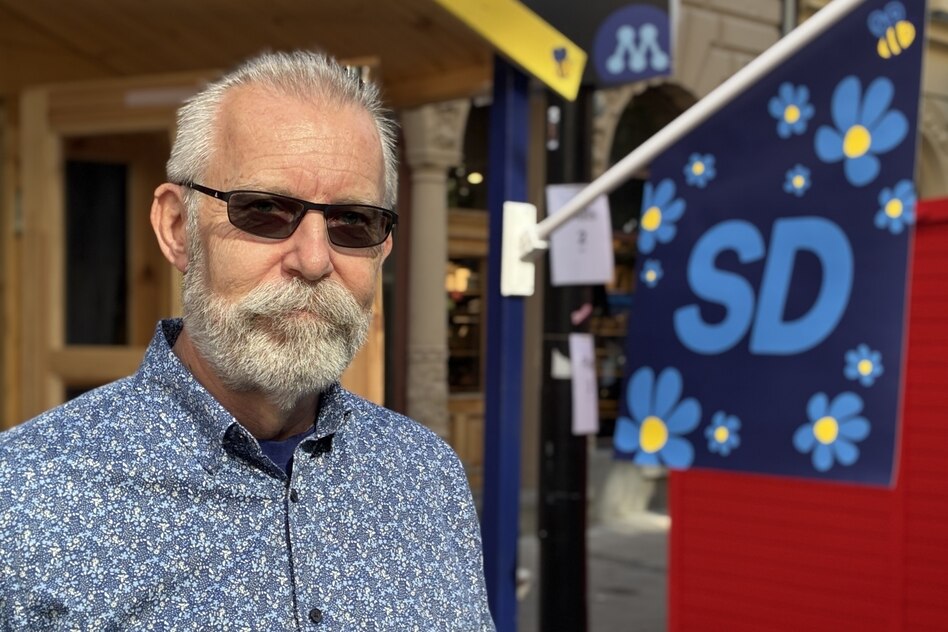
A woman asks whether she could have such a cute bumblebee, almost as she passes by. Of course she can. Next, a teenager wants to know if the tobacco tins cost anything, but no, he is welcome to take one. There is no talk about politics at the Sweden Democrats' election booth. No matter what - there were apparently no questions, and the merchandising will speak for itself in the new owners' everyday lives.
Sweden goes to the polls on September 13th. This is what it looks like here in Sundsvall, 400 kilometers north of Stockholm, in city centers large and small all over the country these days: an alley like at a fair, but instead of throwing cans there are political slogans. “At your side,” is the headline of the Left Party in the city of 100,000 inhabitants. “For your freedom, for our future” the liberals. “Less inequality creates more security,” say the Greens on a flyer.
Will Sweden's right-wing government - the first with direct influence from the Sweden Democrats - be voted out after four years? Is there some kind of shift to the left coming? For a long time it looked like this in surveys, but in recent weeks the large lead of the center-left party spectrum has begun to melt away. The Social Democrats in particular – still the country's largest party – are losing support. Critics demand that they should stop talking about ministerial posts and party incompatibilities and instead talk about their politics. There is a lack of clearly recognizable social democratic visions.
In any case, the vision of the Sweden Democrats is clearly visible in Sundsvall. Not only Hummel stickers and snuff boxes with the party logo are distributed at their stand. The whole appearance looks colorful and playful, as if designed for a picture book. Of course, there are also words between colors and images. Their election campaign motto: “We will make Sweden Sweden again.”
The success story of the Sweden Democrats, which calls itself a socially conservative nationalist party, is reflected in this alley with the voting booths. The role of outsider is long gone. The country's second-largest party according to poll numbers naturally stands next to the venerable Social Democrats. And their appearance in classic red seems almost staid next to that of the right-wing populists.
The Christian Democrats across the street give away mineral water, and party leader Ebba Busch smiles at the label on the bottles. She has now been part of this government structure for four years, which pro forma kept the far-right party out of ministries, but gave it great political influence as a majority creator. Cooperation with Sweden Democrats? Normalized.
At the local level, their politics are a little different, “a little softer, so to speak,” says Arne Engholm at the Liberal stand. He is running for the local elections that are taking place at the same time and believes that in local politics we have to make very concrete decisions together for the local people. That actually works well with the Sweden Democrats. Representatives who didn't know the rules of the game and shouted at meetings were somehow inconspicuously sorted out.
But at the national level he doesn't understand some things. For example, why the minimum wage required to obtain a work permit has been raised so much. One could get the impression that they wanted to get rid of the people who earn less.
His party is currently worried about returning to parliament. Engholm considers missing that to be a “catastrophe” also because of the Sweden Democrats: “Who is going to stop them then?” he says. That's what the liberals in this government were all about: acting as a brake on the worst ideas of right-wing populists. However, political observers fundamentally doubt that the Sweden Democrats can be stopped at all.
In terms of local politics, Engholm is well acquainted with Mats Hellhoff, the man at the Sweden Democrats stand who exudes the most authority there due to his age and appearance. He was a police officer, took part in UN missions and saw a lot: Engholm just likes him. He is also not one of those who want to chase all people with temporary residence status out of the country.
The respected Hellhof, in turn, later said: “We actually agree with the liberals on most things.” He is not only a local politician, but also a member of the Reichstag. It's going well, he says, with three days in Stockholm per week. He also thinks that we could work together with many parties at the local level. At the national level, however, there are a lot of ideological questions. He may not agree 100 percent with everything his party says and does. “But when I do our election compass, there is always at least 90 percent agreement,” says the 72-year-old.
He describes the fact that the Sweden Democrats, by pushing for an increasingly rigid migration policy, have ensured, among other things, that urgently needed nursing workers are expelled, as a myth: out of 200,000 nursing staff in Sweden, perhaps 200 risked expulsion. Almost negligible, that is. “We have only increased the demands on people who want to stay in Sweden”: He also makes what concerns so many people in the country sound normal.
A significant part of society does not want to accept this normality, and they are also represented in Sundsvall. Jan-Olof Strindlund is standing at the modest-looking Green Party booth, far away from that of the Sweden Democrats. The 89-year-old has been involved with the Greens for ten years - ever since he helped a grandchild with a school assignment about climate change and thus became aware of the issue.
He sees no reason to be calm about the rise of right-wing populists. “All they say is: drive as much as you want and we Swedes are so much better than everyone else,” he says. “In the long run, that means destroying civilization.”
Not only the political opposition, but also human rights organizations, legal experts and political commentators warn that the Sweden Democrats represent a threat to society. While, last but not least, the current government made up of Moderates, Christian Democrats and Liberals and their remaining voters remain committed to dealing with a largely normal party.
A group of eighth-graders on an election project trip suddenly populates the election campaign stands in Sundsvall - they want answers to the same questions from all party representatives. And lo and behold, there is agreement between the Sweden Democrats and the Greens: both of them like the ban on cell phones in schools. Perhaps more of a generational question than one of party politics.
Petter and Gustav, both 14 years old, say that all the boys at their school are right-wing. “It’s just a matter of how far to the right,” says Gustav. How do you explain that? “Especially with influencers on Tiktok.” And where do you see yourself? “I try to stay neutral,” says Petter, “and just listen to everyone.” What Sweden's political landscape will look like when he is allowed to vote for the first time: That too will probably be decided next Sunday.
Read the full story at the source →
Source: taz