
World · taz · · 55m
School in Ukraine: School start in Irpin with AI and shelter
Deutsch (original) · Auto-translated to English
The banister in the Lyceum is decorated with blue and white balloons. “The beginning of the school year should be a bit festive,” says Natalia Tit, head of the School for Innovative Technology in the Kyiv suburb of Irpin. The first day of school was a few days ago. But because not all students could come straight away due to the ongoing Russian air raids, the balloons were left hanging a little longer.
At the beginning of September, a school year during war began in Ukraine for the fifth time. On the night of September 1st, Russia fired ballistic missiles at Kyiv and its surroundings. The circumstances are also forcing the country to find creative solutions in school education. They are often digital, but that alone is not enough.
Around three million children and young people will attend Ukrainian schools in the 2026/2027 school year, including around 240,000 first graders, said MP Iryna Brozova from the Youth and Sports Committee. According to the information, around 2.2 million Ukrainian students are taking part in face-to-face classes, while another 700,000 to 800,000 are learning in a mixed model. Around 200,000 in areas close to the front can only be taught online. 400,000 take part from abroad.
Irpin has grown rapidly over the past two decades. The high-rise buildings have grown into the sky between the single-family homes in this once quiet suburb. Even in the midst of war, there is brisk construction activity. The mix of proximity to the metropolis and nature with the large pine forests and lakes attracts well-earning newcomers.
The Lyceum has stood for nine years on a street in the city center between a supermarket and a Soviet-era apartment block. Ukrainian lyceums are comparable to German high schools - secondary schools that are intended to prepare students for university studies. Many have specialized in their field.
The Lyceum in Irpin, as the name suggests, offers specialized classes in computer science and technology. And there is another one for English. The students then have more lessons in these subjects. In English, for example, there are five hours per week instead of three.
The orientation can also be seen in the schoolyard: on the outside wall of the neighboring house there is a picture of Martin Cooper, who developed the cell phone for the US company Motorola in 1973. “His parents came here from Irpin,” explains Ivan Nechiporuk. We have already been in contact with the inventor several times and have had video chats with the students.
Netschiporuk teaches computer science and astronomy at the Lyceum and is enthusiastic about the digital, state learning environment Mriia. “This is my account,” he says, pointing to his smartphone. “The same thing works for teachers in the web browser.” His timetable is laid out there. For each lesson he can prepare the content he wants to present and then release it to the students. “I can give them homework and create tests.” The lessons are streamed live via video chat. Chatting takes place via the messenger Signal.
Artificial intelligence is integrated into the Mriia. “For example, if we need a test about the content of the previous school lesson, the AI creates the desired number of questions.” When the students then fill out the test, they receive a transparent result straight away. “This relieves us of many routine tasks and in the freed up time we can focus more intensively on the students,” says Netschiporuk.
The Lyceum in Irpin is one of the schools piloting the AI-powered version of Mriia. Mriia is the Ukrainian word for dream. Mriia is available to all schools on a voluntary basis and will later cover all levels of education: preschool, extracurricular activities, vocational and academic education as well as adult education. Mriia was implemented by the East Europe Foundation. The development was largely financed with funding from Switzerland. The donors also include the German Foreign Office and GIZ.
Natalia Tit heads the lyceum. She takes time for a tour. There's no alarm right now, she says, so you can attend classes in the normal rooms.
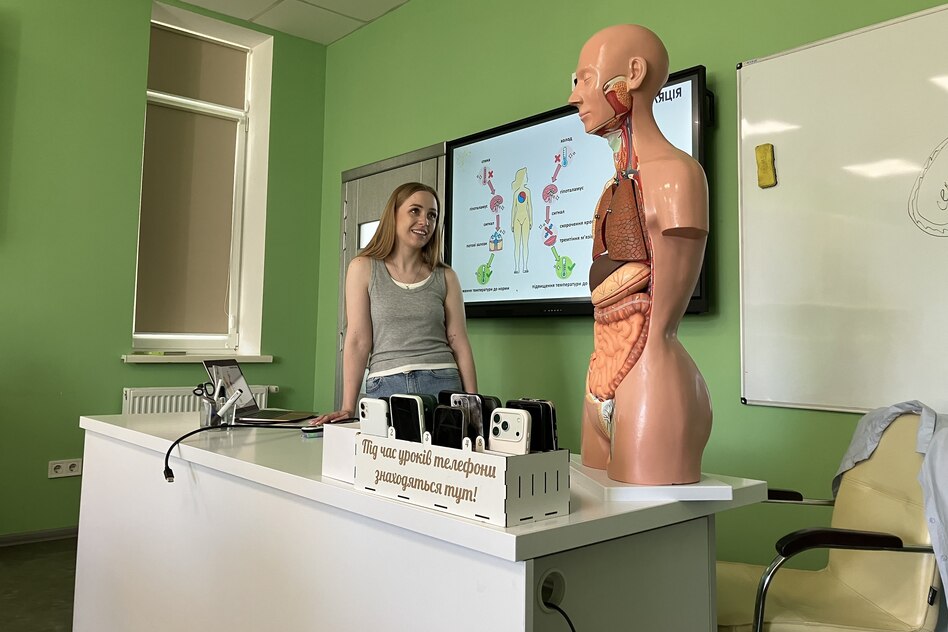
On the third floor, one of the eighth graders is having a biology lesson. The students' smartphones are kept in a box on the teaching desk for the duration of the lesson. Teacher Marina Sokur explains a presentation about the human circulation on a large monitor. Students in the room can follow the same content on tablets on their desks, just like students attending remotely. The lessons are filmed on the laptop on the desk in front of Sokur and streamed via the Mriia platform.
Shortly before noon, Britney Spears plays from the loudspeakers for a few seconds. “You drive me crazy!” Instead of a bell, the break in the Lyceum is rung in with canned world hits.
With currently 237 students, the Lyceum is a comparatively small school. In view of the Russian air raids, the small size has an important advantage: all students fit into the shelter in the basement at the same time. According to the safety regulations, only as many students can be taught in person at the same time as there is space in the safe room. Other schools therefore work in shifts.
The regulation has a serious reason. Schools are repeatedly the target of Russian attacks. According to Unicef, more than 1,600 of a total of around 12,000 schools in the country were damaged or completely destroyed by last winter.
Of course, there is not as much space in the basement as on the three floors above ground. However, each class has its own seating area with tables and chairs. There are blackboards, whiteboards and even a 3D printer as well as a wall bars, a floor exercise mat and table tennis tables for physical education lessons.
Classes continue in the basement when the alarm is raised. “But we are adapting the content,” says English teacher Olya Huschchina. Because of the cramped conditions, you can't speak loudly in the basement without disturbing others. So she is still preparing a second version of the lesson in which the students read or write.
The concept seems to resonate with the students. In the first week after the holidays, no classes were canceled, says Dima. One of his friends goes to the big neighboring school around the corner. "He only had two hours of lessons the whole week. They go into the basement and just wait. How are you supposed to learn something like that?" The 17-year-old will graduate next summer and then wants to study in Kyiv.
13-year-old Mariia is in the 8th grade and is happy with her choice of school. Her teachers praise her for her good English, and that's true. She likes that a lot of teaching is possible in person, it is more efficient. “Direct exchange is particularly important when it comes to languages,” she says. There are also many options outside of the actual lessons in the afternoon. On a wall in the hallway, a dozen working groups advertise for participants. This school year, for example, you can learn German and Polish, there is a design group and one for programming languages, chess and theater.
Despite all the digitalization, schoolchildren have recently shown more interest in printed books, says school principal Tit. She can see this in the usage figures for the school library. In a meeting room on the ground floor, an entire side of the wall is lined with bookshelves. Students can borrow the books using a QR code and return them when they are finished.
Read the full story at the source
Source: taz