
Germany · taz · · 2h
Saxony-Anhalt after the elections: Oh, if only it were an it-could-be country
Deutsch (original) · Auto-translated to English
A ljoscha Begrich now has to sort out the bike thing. He has an appointment with two artists who will be exhibiting here from Saturday, but they have both lost their bikes. Parked in the train, stepped out briefly, the train set off, with wheels, without artists. And without a bike you are lost here in the Wittenberg district.
“We can do it,” Begrich says into the phone. After all, there are enough bikes on the festival grounds. Everyone here is on folding bikes, some of them original Mifa, the good GDR model.
The festival site is located in Zschornewitz, 2,400 inhabitants, a district of Gräfenhainichen, East Saxony-Anhalt, just before Bitterfeld. To get here you need a car or a bike. It's five kilometers from the nearest train station: first onto Rosa-Luxemburg-Strasse, then into Leninstrasse, Street of Peace, past the AI-generated protest poster against the “noise pollution from the wind industrial plants”. And that makes it clear where we are here. Then you stand in front of the iron gates of what was once the most powerful brown coal power plant in the world: Zschornewitz power plant.
After the elections in Saxony-Anhalt and Mecklenburg-Western Pomerania, there is a threat of an AfD government for the first time. The taz reports what is at stake - and who is now defending democracy. All texts about the series can be found here.
The power plant has long since been shut down and large parts have been demolished. Where energy for half of the GDR used to be produced is now mainly meadow. The Festival East starts here on Saturday, subtitled: Festival for Art and Mutual Interest. 100 artists, theater, installations, films, readings, concerts, workshops, dance, conversations. The motto this year: “Power Plant of the Future”. But what future actually, when in this state just 44 percent voted for a party that wants to go back to the past?
“Look around,” says Aljoscha Begrich and spreads his arms. “There are blooming landscapes here.” It's Tuesday, day two after the state elections, and Begrich is walking across the festival grounds. He is serious about the blooming landscapes: "This region is a prime example of ecological transformation. Something has been achieved here that no one would have thought conceivable 30 years ago."
Bitterfeld was once the dirtiest city in Europe. First brown coal was mined, then one of the largest chemical sites in the GDR was built. After reunification, tens of thousands lost their jobs and factories rotted away on contaminated land. The renaturation began with the dismantling; today there are swimming lakes and the forests are green. Even the CDU local mayor proudly defends the wind turbines in the area. They bring money into communities and clean electricity.
And yet Bitterfeld is an AfD stronghold. Almost 50 percent voted for the party here.
Aljoscha Begrich is the curator of the festival, but prefers to call himself a dramaturg; he comes from the theater. He was born and raised near Magdeburg, today he lives in Berlin, but has an apartment and an office near Bitterfeld. He comes from a kind of East German civil society clan, his parents are theologians, his cousins work for the Magdeburg Democracy Association Miteinander e. V..
Begrich has worked at the Ruhrtriennale and at the Maxim Gorki Theater in Berlin. He thought up the festival with two colleagues six years ago. They presented it as the “Ruhrtriennale of the East” to the then CDU culture minister Rainer Robra, who was enthusiastic.
It has taken place twice since then. In the summer of 2024, around the European elections, Begrich and his team visited the city's former fire station and discovered that the political scope for art in Saxony-Anhalt was becoming narrower. A local AfD politician reported Begrich for a work of art, a citizens' association close to the AfD called for the festival to be canceled, a right-wing motorcade disrupted the festival, international artists felt unsafe, and in the end it became clear that the festival could not take place on city grounds again.
Begrich and his team have drawn conclusions: this year they are on private property, the festival will only open after the election, financed primarily by private foundations and EU money. The share that the country adds is small.
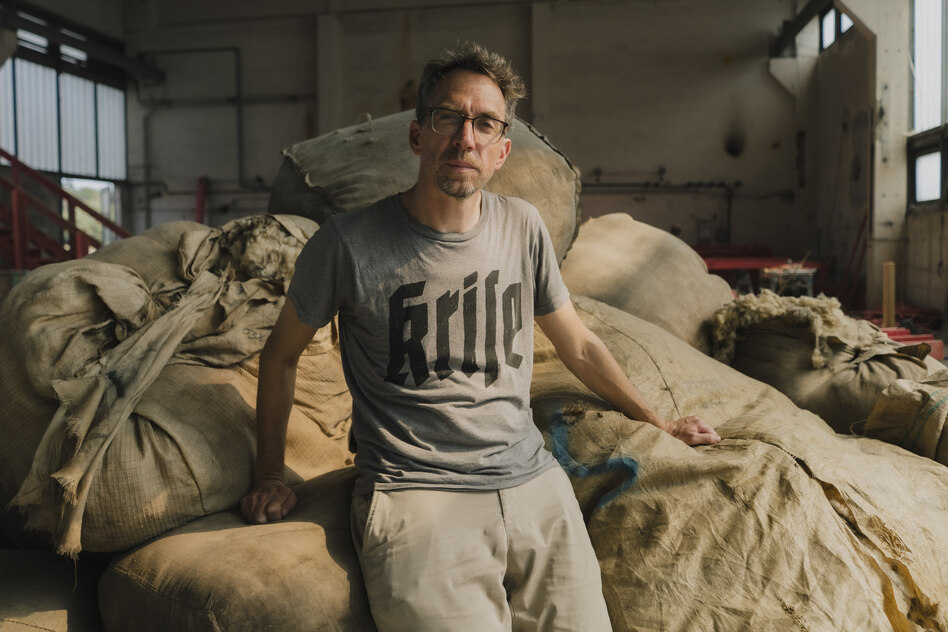
Begrich is now standing in a huge hall and has to scream. Behind him, construction workers are sawing wooden beams apart. They are building a huge ramp for a project called “Wool Employment.” Three tons of sheep's wool are lying around the hall in large sacks. The festival visitors should comb, felt, dye and process them into carpets. Doesn't sound like what a possible AfD culture minister would imagine art to be. “Yes, of course,” says Aljoscha Begrich and grins. “Sheep farming is German tradition, craft, patriotism.”
Fifteen kilometers further west: The youth club 83 is located in a prefabricated housing area in the north of Bitterfeld-Wolfen. It is one of several places here with which the festival cooperates. The walls are sprayed with graffiti, and on a door there is an overview of what the parties want to achieve for children and young people.
Together with the festival team, the youth club raised project funds. This finances an employee who goes on walks with the children. Together they look at what the children in their environment are missing and, if possible, build it themselves. They have built raised beds and a mobile bar out of pallets. It will also be used during the festival. “It was important to the children that the bar was accessible to disabled people,” says social worker Cornelia Geißler, so the bar was lowered. “The children learn: My wishes are important, we can all make them happen together.” This feeling will last forever.
Cornelia Geißler has been working with young people since 1989. She founded the club 21 years ago, which is now called Youth Club 83. She sits on the city's youth welfare committee and coordinated the “Schools without Racism” program, for which the AfD in Saxony-Anhalt now wants to withdraw support. She can talk about the 1990s, when left-wing kids organized punk concerts and right-wing martial arts events. Youth social work is Geißler's life's theme.
This text first appeared in wochentaz, our weekly newspaper from the left!
Every week, wochentaz is about the world as it is – and as it could be. A left-wing weekly newspaper with a voice, attitude and the special taz view of the world. New every Saturday at the kiosk and of course by subscription.
If you ask her what she thinks of the election results, tears well up in her eyes. “It makes me sad that we seem to have failed to convey how we want to live.” She no longer knows whether she and those around her who vote for the AfD still speak the same language. “So far for now,” says Geißler and swallows. “Anything else would just be crying.”
Many people who are committed to democratic coexistence in Saxony-Anhalt feel the same way. They are desperate and exhausted. They are disappointed that all their commitment could not stop the AfD and are afraid of the future. Many have long since learned how the party can control them, even without an AfD prime minister. Also Cornelia Geissler.
At the beginning of the year, the Bitterfeld AfD stirred up sentiment against the 83 youth club. With the votes of individual CDU members, the city council finally voted for a motion from the AfD that provides for less money for the federal program “Live Democracy!” to spend. The association that runs the Youth Club 83 had to cancel projects, including a dance course in the special school and the laying of stumbling blocks. The youth club itself was not affected.
But Geissler has no illusions. The youth club association is 90 percent financed from public money. “If the money goes away, then we’ll just have to get it from somewhere else,” says Geißler, now combative again. “Giving up is not an option.” That's why she is so happy about the cooperation with Festival Osten.
The next morning, Wednesday, day 3 after the state elections, an old woman gets on the S-Bahn behind Wittenberg. She walks with canes and, without being asked, tells her story of suffering: knee surgery, doctor's botch, heart surgery, now it's difficult for her to walk. What do you think about the election? “It was clear that the AfD would win, Merz shouldn’t be surprised, he’s just lying and cheating.” And the AfD doesn't cheat? “Oh well,” she huffs. She herself would have liked to vote for the AfD, but didn't make it to the polling station. "The knee. Unfortunately."
Meanwhile, in the festival office, Sara Dillgen is trying to find a fitness trainer. Dillgen is part of the festival team and lives near Bitterfeld-Wolfen. She needs the fitness trainer for an art event: the artist group Rimini Protocol is exhibiting fitness equipment in the machine hall. When you use them, they produce a sound. If several people use several devices, a live symphony is created. Sara Dillgen used her contacts and her email went to more than 30 fitness freaks in the region. But no one reported back. “I wonder whether people are now distancing themselves from us because we are somehow perceived as left-wing.”
It is important to Begrich and his team that the festival is docked to the region. That's why they also work with local initiatives beyond the festival. They founded a theater group called Diakonie, where people with disabilities perform puppet theater. During the festival, the association More Democracy e. V. moderate conversations with visitors in the power plant. The festival crew is currently developing a concept with local clubs to revive the disused cinema in Bitterfeld-Wolfen.
If you ask Aljoscha Begrich what the most future thing will be on show at the festival, he thinks about it for a long time. “The potato field,” he then says. The team planted potatoes between the prefabricated buildings in the north of Bitterfeld-Wolfen. They are supposed to be harvested during the festival, cooked into potato soup and eaten together.
"People from here often talk about it as if it were a country that used to be: there used to be industry, there used to be a lot of people. I'd rather think about the country that could have once existed," says Begrich. The population of Saxony-Anhalt is shrinking dramatically. So there could be a lot of space for ecological transformation, for utopias, hope and good social coexistence.
Read the full story at the source →
Source: taz