
Politics · taz · · 3h
Russia before the election: fill out the voting slip or invalidate it?
Deutsch (original) · Auto-translated to English
The taz panterstiftung presents a weekly selection of current reports from Russian critical media every Wednesday at taz.de/unserfenster. With this project, the taz panter foundation strengthens independent journalism and enables critical editorial teams to continue their work even under difficult conditions.
Novaya Gazeta Europe opens a window to Russia with the following article. You can read the entire text here in Russian.
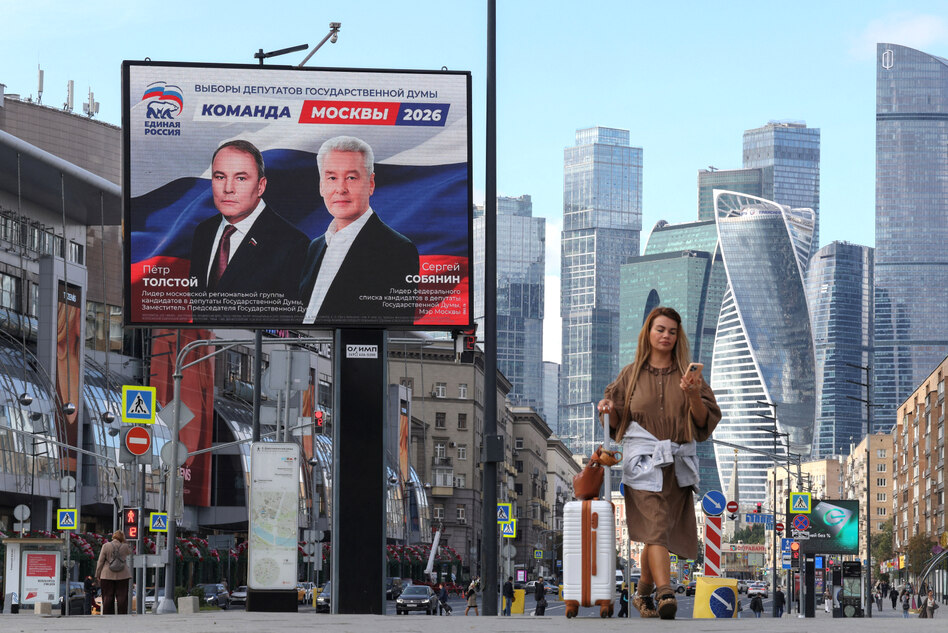
From September 18 to 20, 2026, Russia will elect a new State Duma. It is a difficult time for war opponents. The victory of the Kremlin party is already certain, and the federal list of the Yabloko party was excluded from the election. It was the only party that spoke out against the war of aggression in Ukraine. It is the first election since the beginning of Russia's major invasion of Ukraine.
All other parties admitted to the election are in favor of a continuation of the so-called “special military operation”. The parties already represented in parliament are almost unanimous in their support of the Kremlin course. The few anti-war candidates running in individual constituencies are under constant pressure across the country.
Voters who oppose the war are in a bind. Should they fill out the ballot paper or stay away from the Duma election, which is already completely controlled by the Kremlin? Novaya Gazeta Europe has compiled the most important strategies.
Option 1: Vote for Yabloko and invalidate the party list ballot
Yabloko is calling on his supporters to vote in person and with a paper ballot on the last day of voting, September 20th. Where Yabloko candidates are still running in direct constituencies, they should be supported. However, the party recommends invalidating the ballot paper for the party list by ticking several parties.
Yabloko justifies the move by saying that parliamentary parties have unanimously supported key Kremlin decisions, including war, repressive laws and restrictions on civil rights. At the same time, pressure on Yabloko candidates is growing: so far, 19 direct candidates have already been excluded from the Duma election. 118 candidates are still running in 47 regions of Russia.
Option 2: Vote for any party except United Russia
Initially, Yulia Navalnaya and the Anti-Corruption Fund supported Yabloko as the only party with a publicly declared peace position. After the exclusion of the Yabloko list, they changed their strategy: in the direct constituencies they recommended following the “Smart Voting” suggestions. When voting on a list, however, they advise voting for any party except United Russia. It is the state party and has an absolute majority in the State Duma.
According to Navalnaya, Jabloko's exclusion was also intended to demotivate voters and discourage them from going to the polls. However, that is exactly what one should not get involved in, says Navalnaya.
Opposition politician Maxim Katz also believes a boycott would be a mistake, as low voter turnout benefits the authorities. Depending on the constituency, he recommends either the strongest opponent of the United Russia candidate or the most politically acceptable candidate - and Yabloko where his candidates are still running. Journalist Dmitri Kolesev also argues that the Kremlin has an interest in keeping as many opposition-minded voters as possible away from the election.
The political scientist Yekaterina Schulmann sees the election less as a competition for Duma mandates and more as a test of loyalty to the state leadership. For the organizers, United Russia's share of the vote is crucial. Every vote for another party therefore reduces the demonstrated support for the government.
The Free Russia Forum, co-founded by Garry Kasparov, describes the vote as a “farce” intended to simulate political competition and legitimize existing governance, including the vote in Russian-occupied areas of Ukraine.
The forum argues that participation strengthens the regime rather than weakening it. The Russian opposition should instead concentrate on supporting Ukraine and defeating the Putin regime.
Russia is voting, but what is really on the ballot? In the “Free Speech” podcast, Arnold Khachaturov, editor at Novaya Gazeta Europe, explains why the Duma election is more than just a political production for the Kremlin. Above all, it serves as a test of how much power Putin still has.
With your donation to the taz Panter Foundation, you help to strengthen critical journalism and make it possible even under difficult conditions.
Read the full story at the source
Source: taz