
Politics taz
Raw material mining in Armenia: A gold mine is quickly opened
Armenia's government put a controversial gold mine into operation shortly before the UN Nature Conference. Critics hope for international attention. more...
Deutsch (original) ·Auto-translated to English
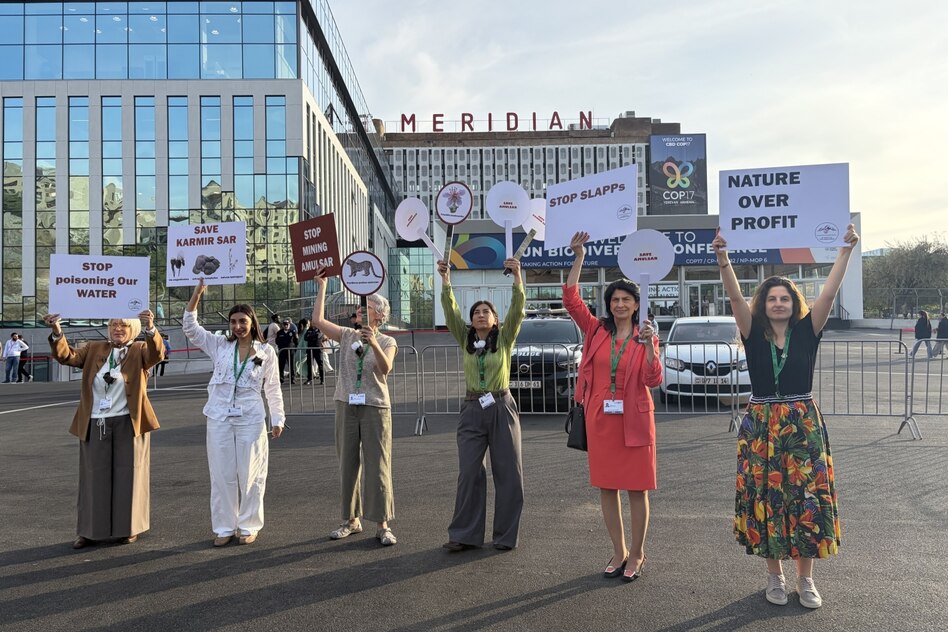
First a car with an Argentine flag pulls up, then one with a Canadian one. People in suits come out of an exhibition center, waiting for the green buses that will take them back to downtown Yerevan. Six women appear. They are calm, they smile and hold up signs: “Stop Mining Amulsar” is written on one. Or: “Stop poisoning our water”.
The women are protesting against the construction of a gold mine in Armenia, right in front of the sports and concert complex where the UN World Nature Conference is meeting. The demonstration remains peaceful; a conference visitor from Spain comes to them and wants to know more. The police watch the women from a distance. Unlike two days before, she doesn't intervene.
The Amulsar gold mine in the southeast of the country has been controversial in Armenia for years. Construction began in 2016 in the Jermuk region, a health resort. Activists had stopped the opening several times, most recently in 2018. But the environmental activists' blockade ended with the second Nagorno-Karabakh war in 2020, says Nazeli Vardanyan from the NGO “Armenian Forests”. Environmental lawyer Vardanyan comes from Jermuk, where the gold mine is to be built, and says: “We had strong fighters who spent the night in the mountains in front of the mine.” But in 2020 the men had to go to war against Azerbaijan, and most didn't come back, says Vardanyan.
Vardanyan has been campaigning against the construction of the gold mine since 2006. The first excavations began 13 kilometers outside the health resort. Opponents of the mine fear severe pollution of the environment, especially from the water discharges that would occur when the gold was washed. Vardanyan says that this water would be diverted into rivers and thereby end up in Lake Sevan, the largest freshwater lake in the Caucasus, more than twice the size of Lake Constance.
Nazeli Vardanyan doubts whether the mine in Jermuk even offers enough gold. Investigations did not provide clear results. She fears that the company Lydian Armenia, which is responsible for the gold mine, actually wants to extract other resources, such as uranium. The company, whose parent company Lydian is registered in the British tax haven of Jersey, does not respond to inquiries.
Economics professor and mining expert Suren Parsyan believes that the Armenian economy could benefit from the gold mine in Amulsar. He assumes annual sales of $930 million, which would increase Armenia's GDP by around 1.5 percent. In addition, 900 direct jobs and around 3,600 indirect jobs would be created, said Parsyan. He argues that the gold price is stable globally, so there is economic potential. Parsyan cannot assess whether the company will adhere to ecological standards.
At the beginning of October, just a few days before the start of the nature conference, Armenian Prime Minister Nikol Pashinyan unexpectedly opened the mine. Since 2025, the Armenian government has held a 12.5 percent stake in Lydian Armenia. It had previously made financing packages possible with banks so that the company could continue work on the mine, Armenian media reported.
Activist and lawyer Nazeli Vardanyan says that several politicians who have publicly opposed the gold mine in the past have now changed their minds. A politician contacted did not respond to the email. Human rights activist Oleg Dugaryan, also an opponent of the gold mine, deals with slap lawsuits. These legal proceedings against activists lead to high costs and are intended to stop their criticism.
The Armenian company Lydian Armenia is said to have filed similar lawsuits against activists several times. Dugaryan and his NGO are currently taking legal action against the Armenian government. And everyone who is fighting against the further expansion of the Amulsar gold mine is hoping for international attention through the World Nature Summit.