
War & Militarism taz
Retrospective on Rammellzee: His resistance was unbroken throughout his life
Rammellzee shaped modern American pop culture, but he is still hardly known to the general public. The Museion in Bolzano is now devoting a large retrospective to him. more...
Deutsch (original) ·Auto-translated to English
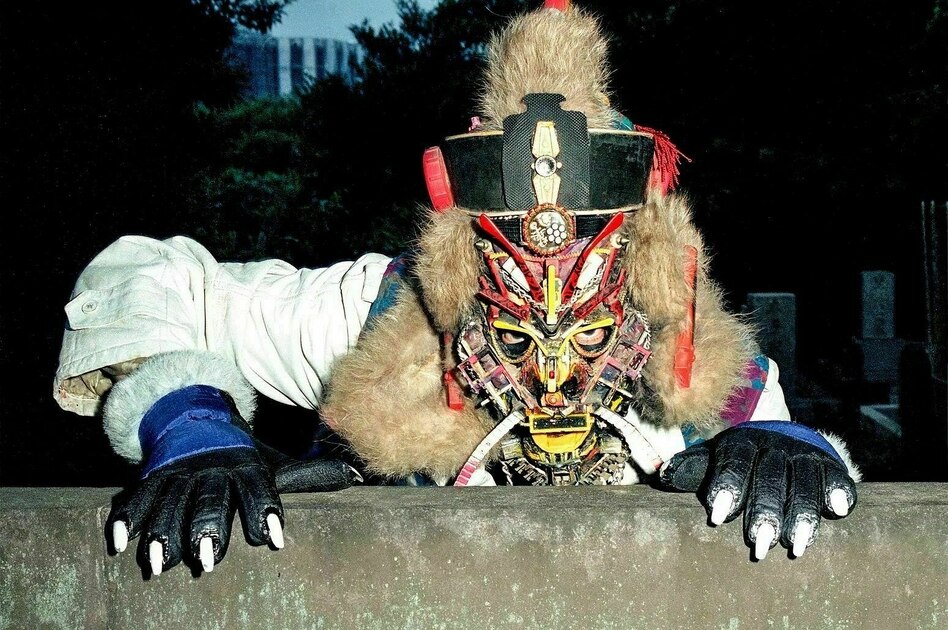
"It cost $80,000 and four years of life to produce the part here, it weighs twice as much as me and it takes 15 people to put it on me," a boyish-looking man grins into the camera. The short video shows the American artist Rammellzee in early 1991, shortly before an exhibition opening in the Netherlands. The "part" is an exoskeleton made of kilos of plastic, hot glue and epoxy. If you fill it with dry ice, it can emit smoke at the push of a button, explains Ramm, as his friends and admirers call him, and the whole thing looks like every Lego technology fan's boyhood dream. At least one with proper street cred.
A few exhibits further on, it rotates in all its glory on a tiny stage in infrared light: “Gasholear,” as the portable sculpture is called, a bulletproof construction equipped with flame and rocket launchers, four loudspeakers, a vocoder and strobe lights. According to the video recording described, the New York artist continued to build on it for seven more years, continually expanding, repairing and optimizing it.
Now this mountain of petroleum and synthetic resin that has become neon plastic weapons has been visible for a week in, of all places, the Tyrolean Alps. There, the Bolzano Museion is showing the exhibition “Rammellzee Time:line” – the first major retrospective in Italy of the New York graffiti and hip-hop icon of the same name, an artist’s artist: one of the most important and at the same time less well-known artists of recent American pop culture.
Born in 1960, Rammellzee grew up in Far Rockaway, Queens, near the terminus of the A-Train subway line, to an African-American mother and an Italian father. In the 1970s, the first graffiti of Rammellzee, who gave up his birth name and officially renamed himself in 1979, appeared on the subway trains on line A, still under changing pseudonyms. The young artist quickly made a name for himself in the still small scene. Today's cult film "Wild Style" by Charlie Ahearn made him known to a wider public in 1982. But the young artist's career had long since begun.
The exhibition at the Museion traces this in an almost annoyingly precise timeline. With the show, the house delves into an individual position after showing a large institutional graffiti exhibition last year: Both were and are part and result of an internal museum research project that examines non-violent forms of resistance and art as a social and urban practice.
Rammellzee's resistance was unbroken throughout his life. As a young man, he declared the alphabet to be a weapon itself, painted the trains with his suburban friends, who then spread their names and messages in the inner city, which was still inaccessible to them, and made them, the unwanted poor teenagers, heroes there - Keith Haring wasn't the only one who was inspired by them. A few early works on roller blinds and from sketchbooks in the exhibition bear witness to these beginnings. In addition, the curators Hugo Vitrani and Cédric Fauq, who have already shown parts of the retrospective at the Paris Palais de Tokyo and the Capc Musée d'art contemporain de Bordeaux, are presenting works by friends and companions. And those are some.
In 1979 Rammellzee moved to Manhattan. Here he meets Fab 5 Freddy, who introduces him to the downtown scene. The young artist gets around quickly and a lot: he meets Francesco Clemente, becomes friends with Martin Wong and Jean-Michel Basquiat (works of both of them hang in the Museion), appears as a cameo in the Jim Jarmusch film “Stranger than paradise”, influences musicians like the Beastie Boys and Cypress Hill with his band Gettovetts, and records with William S. Burroughs. His influence is so diverse, ranging from designing the backgrounds in Madonna's "Hip Hop" performance to collaborations with streetwear brand Supreme. He writes theoretical manifestos, uses ideas from the Italian Futurists, thinks in the spirit of the times about Afrofuturism and the possibility of an equal humanity in space, and coins and invents terms such as iconoclast tankism and gothic futurism.
Soon after his arrival in Manhattan, Rammellzee devoted himself to large-scale, layered epoxy works and costumes. He works with fluorescent neon colors, found objects and plastic jewelry, pouring layers upon layers on top of each other - and refusing to comply with any occupational safety regulations.
When the American gallery owner Jeffrey Deitch wanted to win Rammellzee over for a collaboration, it didn't happen: Ramm insisted on producing his synthetic resin works directly in the exhibition space, but Deitch didn't want to expose his employees to the highly toxic fumes.
Rammellzee died in 2010 at the age of 49 as a result of years of self-inflicted poisoning through work. His ashes are kept to this day in a pyramid-shaped, mirrored urn designed by Ramm himself, along with the solution to the formula of his mysterious name. This is also an exhibit in the exhibition.
“Ramm:Ell:Zee Time:Line”. Museion Bolzano, Italy, until March 14, 2027
Perhaps it was the early painting on trains and subway shafts that forever linked Rammellzee's work to the extreme of near death, even for himself. "Graffiti was created in the dark, when you can't feel anything, can't touch anything. You can't concentrate on anything and can't manipulate anything." It says at one point as a quote from the artist on the timeline.
Bringing artistic works that, as a counterculture, were not designed for exhibition spaces into the museum, quickly runs the risk of a bourgeois archival debate. In the Museion, the curators slip past it by a whisker, despite or even partly kitschy exhibition architecture. The fact that this is successful is also due to the radical quality of the work shown - that cannot be manipulated either.