
Germany taz
Recycling business in Peru: Collecting self-esteem
In Peru, only three percent of waste is recycled. A women's collective in Arequipa is taking on the task. And it also helps the members. more...
Deutsch (original) ·Auto-translated to English
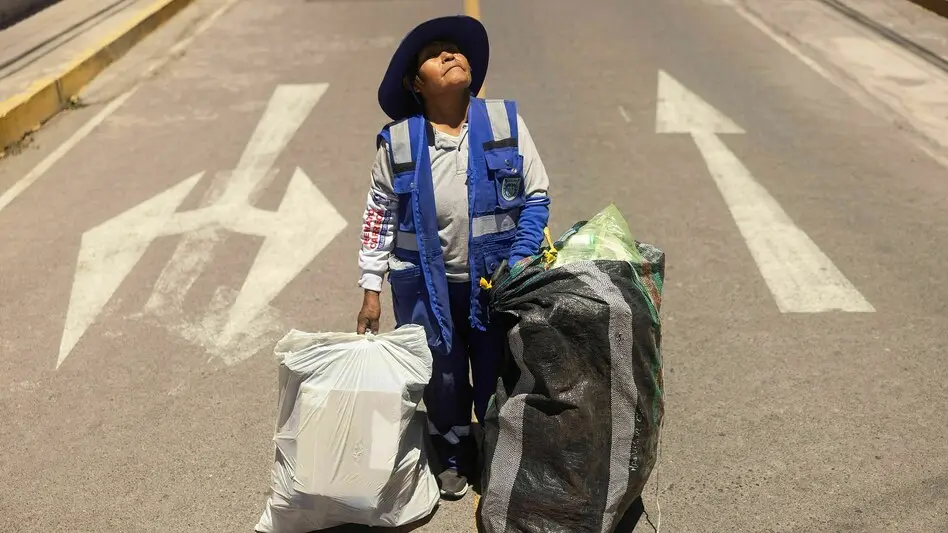
They are part of the street scene in Peru: people who move through the streets with carts, bicycles or huge sacks and collect plastic, cardboard or metal. The Environment Ministry estimates that around half a million people live off what others throw away. They fish out what can be sold from the garbage bags in front of the houses: cardboard, aluminum, plastic bottles. They work where the municipal waste disposal ends. This is also the case in Arequipa, the second largest city in the country, at the foot of the Misti volcano, nestled between the high Andes and the Pacific.
On this late October morning in the Bustamante district, Ricardina Labra is rummaging with her hands in the trash bags on the side of the road. Since seven o'clock, the 61-year-old has been sorting out everything that can no longer be recycled: diapers, plastic trays with gnawed chicken legs. She wears a wide bucket hat with a neckerchief. Passers-by protect themselves from the sun with an umbrella.
“Of course the work is tiring, all the walking, the heat,” says the mother of five. "But I like her. 'People come to me and say: Thank you, Mamita, thank you for taking care of us and the environment.'"
Ricardina Labra has been collecting recyclables for 14 years. She belongs to the Mujeres Ecosolidarias, the eco-solidarity women, an association of professional recyclers with a fixed salary and regular working hours. As the name suggests, only women work there, on average over 50 years old.
They ended up collecting trash after escaping men who had beaten or betrayed them. In Peru's cities, including Arequipa, the majority of family income usually comes from men. The women raise the children and run the household, unpaid. Some contribute with odd jobs, selling lunch or perfume at front doors, cleaning for families who are financially better off. That's rarely enough for a life with children. With the separation, the man's main income usually disappears, and from one day to the next the women are solely responsible for their families.
With Ricardina Labra it's the other way around. Her husband doesn't have a permanent job; he occasionally takes odd jobs, if at all. “We both used to work together in a quarry,” she says. "Then there were no more materials there. But we still had to pay for school supplies for our children." On the street she met women collecting garbage. They asked if she wanted to join in.
She receives around 350 euros a month from Mujeres Ecosolidarias as a recycler, roughly the same as the Peruvian minimum wage. The women recycle up to 45 tons of garbage every month. They sell most of it, especially paper, cardboard and plastic, to large waste disposal companies. Plus what they make themselves: flower pots, table tops, coasters and shelves made from melted plastic waste.
They also run a thrift store on the premises. They pull whatever is still useful out of the trash and put it up for sale: Bibles, stuffed animals, high heels, wine glasses. A teenager looks sheepishly at the jackets on the rack, a gray-haired man in work clothes tries on a dark blue fleece sweater. “I come by once a week and see what’s new,” he says. "The store is a godsend for the people in the area. They don't have a lot of money and everything is affordable here."
Women don't get rich from it. According to the association, the income fluctuates depending on how much recycled goods they are currently selling. The club's reserves amount to just under 2,500 euros. Labra and her two dozen colleagues are making a contribution that the city urgently needs.
Arequipa dumps the waste of its more than 1.2 million residents into a single open landfill on the outskirts of the city, in the Quebrada Honda ravine. Around a thousand tons of garbage end up there every day. Although waste separation is required by law in Peru, only around three percent of waste is recycled nationwide. In Germany it is 68 percent.
In Quebrada Honda, on the edge of a poor neighborhood, garbage bags arrive filled with preserving jars, leftover food, batteries, used ear buds or broken plates. The Peruvian environmental regulator classifies the landfill as heavily polluted. The waste is only inadequately covered. Stinks, insects and stray dogs spread. Environmental organizations and local activists warn of the consequences for rivers and agriculture in the area.
Cecilia Pérez, who is responsible for municipal waste disposal in the Mariano Melgar district, also considers the landfill to be a health risk for the residents of Arequipa. “The dump is already collapsing and contaminating its surroundings with pollutants that are seeping into the soil and groundwater,” she says. This is precisely why the work of the Mujeres Ecosolidarias is so important: so that the poisonous mountain in Quebrada Honda grows a little slower.
After four hours in the sun hauling and sorting garbage bags, the second part of the working day begins for Ricardina Labra. With a dozen other women, she stands on a conveyor belt in the covered backyard of the recycling plant, wearing a mask over her face and gloves on her hands. Everything that Labra and her colleagues collected in three parts of the city that morning is now passing them by, and it's not just plastic.
Shards keep wandering down the assembly line, including electrical devices that leak toxic liquid. Anyone who misses will injure themselves. There is no talking during this time. Chicha, Peruvian cumbia with congas and electric guitars, is playing on the radio. In time, Labra uses a cutter knife to poke holes in the plastic bottles that slide past. Once the air is out, the bottle goes into a bag provided for this purpose.
The women not only sort what others throw away, they explain to the residents of Arequipa what recycling actually is. Thanks to Mujeres Ecosolidarias, almost 8,000 households in Arequipa now separate their waste and put it outside the door on agreed days, where the recyclers pick it up.
Lorena López lives in a small terraced house in Mariano Melgar, one of the three districts on this route. A few years ago, two women stood in front of the house for the first time and patiently explained to her what belongs in the recycling bag and what doesn't. Since then, there has been time for a few sentences every time they are picked up, and López has now become friends with some of the women. "In our neighborhood there are mainly women at home during the day. When a woman rings the doorbell, it creates more trust. You open the door quicker to another woman than to a man," she says.
The people of Arequipa appreciate the work of the Mujeres Ecosolidarias: the city's largest bank donates their waste paper to them, a disco gives them their empty plastic and glass bottles after party weekends. And yet the women talk about how ashamed they were of their work at first. Some collected for years with sunglasses and a cloth over their face, fearing that the neighbors would recognize them and insult them as basurera. A basurera is the garbage lady: she picks up what is thrown away and takes it to where it disappears. Into the landfill, with no second use, no thought for the environment.
The women of Mujeres Ecosolidarias have a different self-image. They also pick up what others throw away, but in order to save it: waste becomes raw materials, plastic waste becomes flower pots and shelves. Anyone who talks about garbage politely but firmly receives a short lesson in materials science: “It’s not garbage, it’s reciclaje (recyclable material).”
Ricardina Labra now ignores derogatory comments. But on the collection routes through Arequipa, it's not just words. Recently, one of the women was beaten by a man who had torn open recycling bags to get paper and cardboard. Labra and her colleagues report that confrontations with informal collectors are not uncommon.
In addition to the Mujeres Ecosolidarias, there are other associations in Arequipa in which around 120 recyclers have organized themselves. The US NGO TechnoServe, which offers training to the clubs, estimates that more than 80 percent of them are women. However, the majority of those who live off discarded recyclables are not organized. They roam the streets at night, tearing open garbage bags that are ready for the city's garbage collection and looking for something usable in them. They leave the rest scattered on the pavement. They fight alone for survival, without a job, without a fixed salary, without a club to back them up.
This is how Petronila Charca, now president of the collective, started. In 2008, the Mujeres Ecosolidarias were the first recyclers in Arequipa to organize together. This afternoon, Charca is standing next to Ricardina Labra on the assembly line. Chacra is a small woman with two long braids swirling down her back. Charca became involved in recycling after her husband fell from a roof in an accident at work and died. The 67-year-old smiles a lot. Then fine wrinkles gather under her eyes, row by row, and you can't tell whether the laughter has put them there or the years.
After her husband's death, she first cooked in a comedor popular, one of the many women-run community kitchens that exist in Peru. The income was just enough to feed herself and her five children. Together with other women, she decided to walk the streets, ring doorbells and ask for recyclable waste.
At first they were laughed at. “We were told that this could become a real career,” says Charca. Doors and windows were slammed in their faces. People didn't understand what the women were doing.
Men should also join the initiative; it was not intended as a purely women's organization, says Charca. "From the beginning we invited men, but they didn't want to. They didn't want to tell us why. Maybe they wanted to earn more or just didn't want to work with women." Today women don't miss their male colleagues. On the contrary: women, almost all mothers, are more understanding when a colleague spontaneously has to look after a sick child and therefore cannot come to work.
Wait, but there's a man in work clothes walking across the yard of the recycling plant? How did he get lost here? José Carrizales laughs. He's not an official recycler, but he's still part of it: He drives the truck that brings the collected garbage bags to the plant. And what's it like to be the only man among women? “Very difficult,” he says and grins. “No, seriously, it quickly became normal for me.” In Carrizales' opinion, pure men's groups can easily turn into something unpleasant. He talks about a pack in which everyone wants to outdo the other. He doesn't experience this with his colleagues.
The Mujeres Ecosolidarias bought the land for the recycling plant, to which Carrizales travels several times a week, with the support of a Belgian NGO. In workshops sponsored by Peruvian companies and NGOs, they learned how to protect themselves at work, run a business and assess the value of the materials they collected. They now pass on this knowledge and train companies in recycling. And the women work quite digitally: they use QR codes at the front doors to record where and when they have already picked up recycling bags.
Word of women's success has spread. Companies and organizations from home and abroad contact the Mujeres Ecosolidarias, they want to see the facility, offer help and, arm in arm with the women, laugh into the camera for press photos.
Support also came from Germany. The copper producer Aurubis supported the project in 2022 together with the German-Peruvian Chamber of Commerce and Industry. There are currently two complaints from Peru against Aurubis in Germany under the Supply Chain Act. In a report, environmental organizations accuse the company of not doing enough to combat human rights and environmental violations among its copper suppliers in the Andes. The companies mentioned there include Antamina and Anglo American - both of which also financed projects run by TechnoServe, the NGO that offers workshops and training to the Mujeres Ecosolidarias.
In 2020, the then Peruvian Environment Minister even visited the recycling plant. Meanwhile, collective president Petronila Charca no longer agrees to visits so quickly. More than once the women had the feeling that they had to be used for greenwashing by authorities and large corporations.
Despite the attention and international support, Charca doesn't know whether she will be able to continue paying most of her colleagues next year. Financially, the club's survival depends on a contract with the Mariano Melgar district, which would have expired at the beginning of November. The women are listed as municipal waste disposal service providers and are paid to pick up recycling bags in the district. Only a few days before the deadline came the news: the contract would be extended until the end of the year. What comes next is now open again.
The importance of their work for the city is also reflected in the recycling figures: In Arequipa, eight percent of waste is now recycled, almost three times as much as the Peruvian average. For the environmental scientist Diego López, this is also thanks to initiatives such as the Mujeres Ecosolidarias. López holds seminars on circular economy at universities and has long been active in the city's environmental management. The fact that Arequipa has reached this point today, he says, also has a lot to do with the years of work by aid organizations and international cooperation. They trained recyclers and sensitized the population about waste separation.
López also advised on a project whose consequences for the Mujeres Ecosolidarias business are still unclear. A few days ago, the Ministry of the Environment opened a new recycling plant near the overflowing landfill on the outskirts of Arequipa. Small initiatives could also benefit from this, says López. In the future, city trucks will collect the garbage bags and drive them directly there. The women were spared the long, strenuous tours in the morning. Instead, you could sort on site or hand over your collected material there. The Mujeres Ecosolidarias are still skeptical about the new building. It is up to two hours' drive from your company.
For years, hardly anyone in Arequipa was interested in what could be made from waste. The women turned it into a business in which they decide for themselves how they work. Now the state is building a facility on the outskirts of the city. And of all people, the authorities whose work the women have been doing for years are now determining what happens next for them.