
Politics · taz · · 2h
Right-wing extremist state parliament president: The Union prefers to look to the left
Deutsch (original) · Auto-translated to English
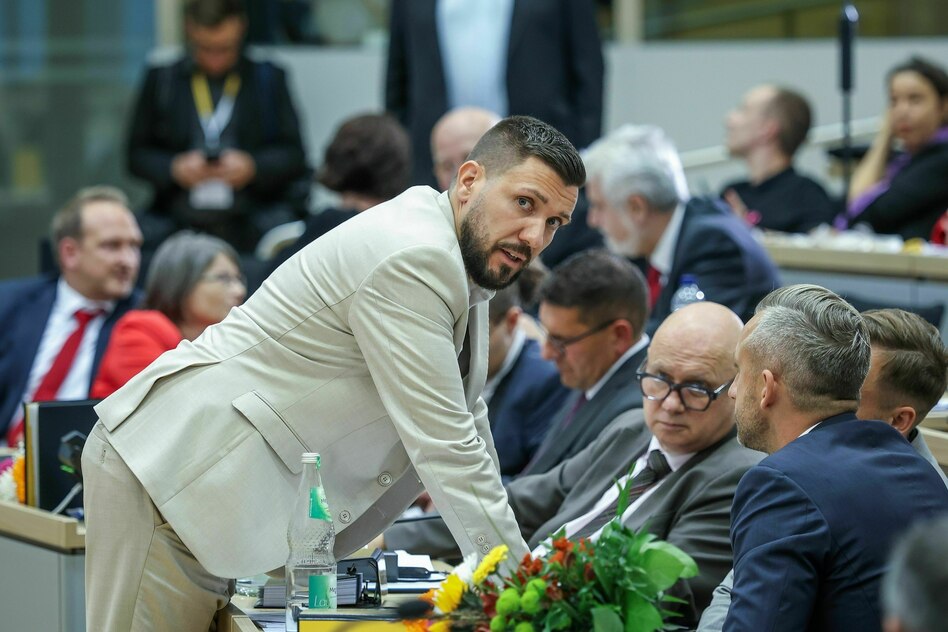
He couldn't find any words for more than 24 hours, but on Wednesday afternoon CDU leader and Chancellor Friedrich Merz finally commented on the election of the new AfD state parliament president in Saxony-Anhalt. At a Handelsblatt event, Merz said that anyone who votes for the AfD would destroy credibility. “This is not compatible with the values of my party, the CDU.”
At the same time, Merz emphasized that the election was secret and that it was not known who helped AfD candidate Tobias Rausch achieve an absolute majority. The assumption that the votes came from CDU representatives is an unsubstantiated assumption. And he played the ball to Magdeburg: the investigation should be carried out there.
When asked, Merz even ventured into conspiracy myths: False flag operations, i.e. covert maneuvers that are blamed on an opponent, do not only occur in the military sector. Merz spoke of “at least two factions” that undermined democracy – and tried to hold the Left Party responsible, which he accused of open anti-Semitism. The Chancellor called on the Greens and SPD to prevent a left-wing mayor in Berlin. A clear announcement that he avoided making to his own party in Saxony-Anhalt.
There is strong evidence that the AfD candidates in Magdeburg were also elected with votes from the CDU. Rausch received 48 votes in a secret ballot, four more than the AfD and BSW factions combined. The right-wing extremist ideologist Hans-Thomas Tillschneider, who was elected vice president, received 5 votes, which mathematically cannot come from his own group.
The BSW denies having elected him. In addition to Rausch and Tillschneider, only the CDU candidate Carsten Borchert received the necessary votes for the office of vice president. The SPD candidate Armin Willingmann failed. Borchert's election results only lead to the conclusion that he was supported by AfD politicians. Is one hand washing the other here? Die Zeit reports on agreements between the CDU and AfD MPs.
As designated chairman, Merz once announced that anyone in his party who worked with the AfD would have to expect an exclusion process. He did not repeat this threat - probably because he would hardly be able to follow through with it.
Merz's secret rival, North Rhine-Westphalia Prime Minister Hendrik Wüst, described the election of the AfD state parliament president as a deep turning point. It shows “that something has slipped in our country”. For the Christian Democrats, "clarity and unity are important. We oppose the AfD and its radical positions with all our might, but at the same time we do everything we can to win back their voters to the political center." The election in Saxony-Anhalt will not be the last test of tension in the parliamentary debate with the extreme fringes, said Wüst.
At the request of the taz, the deputy CDU federal chairwoman and education minister Karin Prien commented on this. “I would not have thought it possible for a long time that 85 years after the Babyn Yar massacre a member of a firmly right-wing extremist party would be elected president of a state parliament and, yes, it depresses me very much,” writes Prien on the journey back from Ukraine. “It is a further normalization of what should never be normal.” The fundamental values of our democratic society should never be questioned again.
Prien does not comment on the fact that these fundamental values are already being questioned and that the AfD in Saxony-Anhalt could also succeed in organizing majorities together with the CDU in the future. Schleswig-Holstein Prime Minister Daniel Günther is clearer. He wrote on Facebook that the election results left him “stunned.” “If anyone from the Union’s ranks was involved in this, he or she did not act according to the Union’s values.”
And what consequences would that have? Inquiries from the taz to the four Saxony-Anhalt CSU members of the Bundestag remained unanswered by the time of going to press. Like the Chancellor, CDU General Secretary Franziska Hoppermann referred to Magdeburg. The clarification must take place in the state parliamentary groups, said Hoppermann in a statement.
The SPD tried to put at least some pressure on its coalition partner. Party leader Lars Klingbeil demanded clarification from both the BSW and the CDU as to how so many votes for the AfD could have come about in Magdeburg.
The Social Democrats also made a symbolic statement. The parliamentary group vented their anger on Tuesday evening with a spontaneous walk to the square named after August Bebel not far from the Bundestag. Defense Minister Boris Pistorius complained about the “stirrup holders” in Magdeburg who had “offended the country” by electing the AfD parliamentary president. He did not mention Union and BSW by name.
The SPD parliamentary group leader Matthias Miersch told his MPs that after these events they should “never go back to the agenda”. The coalition committee was also scheduled to meet in the evening, in which leaders of the CDU/CSU and SPD wanted to discuss the contentious issues of the upcoming reform projects. The election of the AfD state parliament presidents is likely to put additional strain on the agenda.
Read the full story at the source
Source: taz