
Politics · taz · 43m
Reactions to the Saxony-Anhalt election in MV: Cycling for civil society
Deutsch (original) · Auto-translated to English
There is a lot of talk about shock, about disaster, but also about the will not to give up now: Civil society in Mecklenburg-Western Pomerania is even more alarmed than before since the AfD won almost 44 percent in the election in neighboring Saxony-Anhalt. There will be elections in Mecklenburg-Western Pomerania in just over two weeks. And here too, the AfD has been ahead in surveys for a long time.
“Of course, after Sunday, nervousness arose in civil society: What’s going to happen here now?” says Jessica Weiß from the One World State Network MV association to taz. But, says the Rostock resident: “We are in the middle of ensuring that this doesn’t happen again on September 20th.”
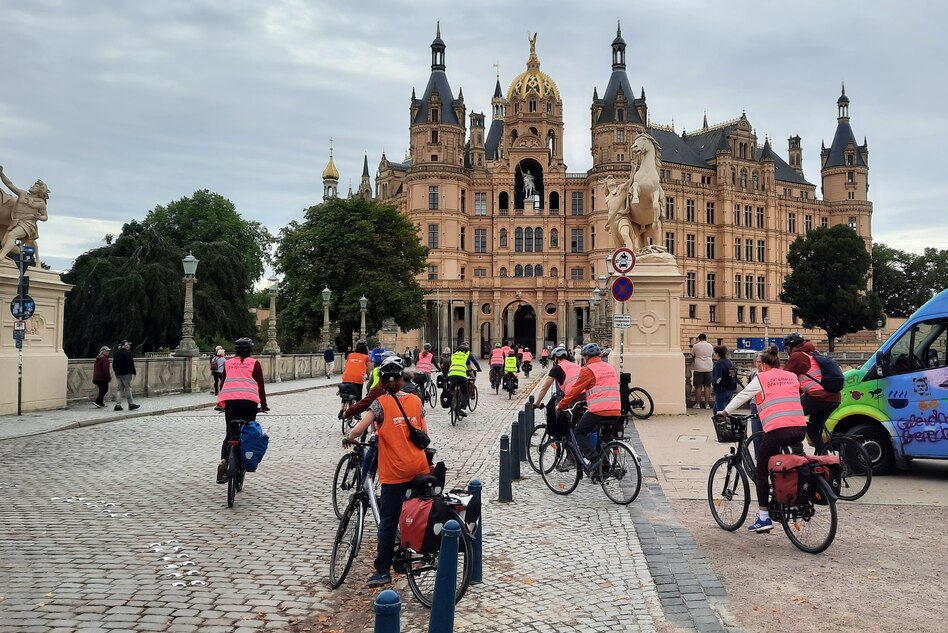
In the middle of the countless actions against the right in the northeast in the coming days there will also be a cross-country tour coordinated by Jessica Weiß, namely by bike across the country “for a cosmopolitan, diverse and democratic MV”. That's the motto. Schwerin, Parchim, Malchin, Demmin, Greifswald: Almost 200 kilometers lie ahead of the around 60 cyclists who gather in front of Schwerin Castle for the start on Tuesday morning by Friday.
The participants from all over East Germany want to meet mayors, a bishop, an eel fisherman, an ex-neo-Nazi. Above all, they want to “provide space to exchange ideas with the local people and perhaps also to make a difference in people’s minds,” says Weiß. Their expectation: that something can still be done with civil society actions like this bike tour between now and September 20th.
With exactly this claim, thousands of people took to the streets in numerous cities in Mecklenburg-Western Pomerania on Monday evening. The nationwide “Moving Together” alliance called for the protests against the AfD. In Rostock alone, the organizers counted around 3,000 participants.
At the rally in Schwerin, even SPD Prime Minister Manuela Schwesig finally spoke up. The situation is “very, very serious,” she said. But Mecklenburg-Western Pomerania is not Saxony-Anhalt: "We will stop the AfD's power fantasies together. The AfD won't get our home."
Schwesig used the day after Magdeburg to once again push her ongoing “Me or the AfD” campaign shortly before her own state elections. While the SPD top candidate previously campaigned on large posters across the country with the slogan “The woman for MV”, “The woman against blue” has now been added. Only with it can we prevent “the AfD from taking over power in MV,” said Schwesig.
In fact, the right-wing extremists are relying on a domino effect. “This fantastic success gives us in Mecklenburg-Western Pomerania a real tailwind for the last two weeks of the election campaign,” said the AfD candidate for prime minister, Leif-Erik Holm, on the evening of the election. He is sure that the “blue wave” will now sweep from Magdeburg to Schwerin.
The surveys so far say something different. The extreme right is still leading, but is stagnating at 35 percent. In contrast, Schwesig's SPD has recently caught up strongly and is currently at 32 percent. The CDU, which has already suffered a crushing defeat in Magdeburg, is threatened with an even greater disaster in Schwerin. The last survey puts it at only 8 percent.
The CDU state chairman and top candidate Daniel Peters also considers the SPD’s “Woman against Blue” campaign to be “extremely dangerous”. “Schwesig and others are continuing to fuel polarization,” Peters told taz on Tuesday. And: “It also strengthens the AfD.” He fears a “permanent social division” similar to that in the USA. “Nobody who means well for this country can seriously want this,” said Peters.
Jessica Weiß from the One World National Network, which is currently cycling, is hoping for the Schwesig effect. She would like to make it clear that her association is not tied to party politics. But the starting position in Mecklenburg-Western Pomerania is “significantly better” than in Saxony-Anhalt, not least because of the popular Prime Minister’s race to catch up.
Read the full story at the source →
Source: taz