
Germany · taz · · 2h
Punk bands German spawners and screamers: They have fun, anger and hope against hatred
Deutsch (original) · Auto-translated to English
Half a century of punk, and somehow its engine, driven by energetic amateurism and simple anger, just won't break. Which must also be due to the fact that “punk”, difficult enough to define, has continually invented new artistic expressions for itself. Only in its rigid musical formal language, when punk becomes punk rock, does a verbalization occur that strips the music of anything dazzling and interesting. Can be heard on the first farewell tour of the Toten Hosen, whose rock music, for all its merits, is truly numbingly boring.
Is there something like a core of punk that connects everything that was and is cool about it - from the beginning to the experiments of post-punk? And that contradicts what's shit about punk? Probably not. You shouldn't approach pop with essentialist ideas. Based on two recently released albums, one can sketch what punk was and is.
But first read it briefly: Greil Marcus begins one of the seven best books about punk, “Lipstick Traces”, with a description of the toothache voice of Sex Pistols singer John Lydon: “An organ that denied all social facts and thereby asserted that anything was possible”. A voice, moreover, that seemed “available to anyone who dared to use it.” “Denying the Facts” was in the original text of the Sex Pistols debut single “Anarchy in the U.K.” (1976), however, is not intended in an escapist manner, but is shouted into the world in the knowledge of the constraints that surround and await young people.
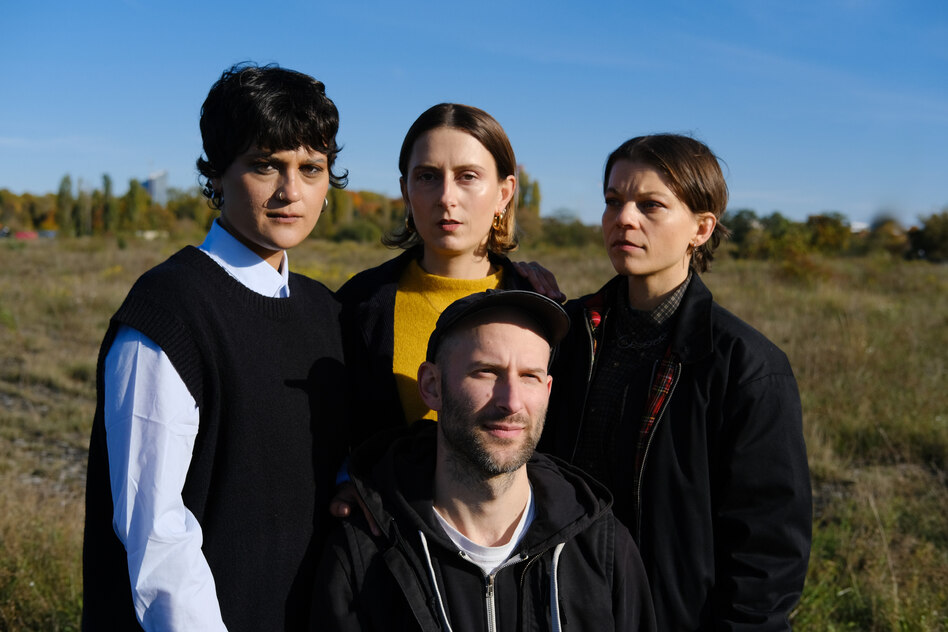
German spawn: “Punk is shit, punk is awesome” (Pretty on the Inside/Broken Silence); live on September 26, 2026 at Juzi Göttingen
Screamer: “The Lost Tape” (Die Alle Records/Broken Silence)
This describes a lot of what punk was and is: denying how things are usually solved and simply doing something different. What then resulted in an opening: anyone who wanted to could do punk. Marcus describes this impulse as a gesture of a radical no, which in “Lipstick Traces” he connects with other artistic avant-gardes, especially with Dada and Situationism.
But this is going too far. It's best to ask directly about the music. One of the best younger punk bands in this country are Deutsche Laichen and come from Göttingen. Their second album is called “Punk is shit, Punk is awesome,” and the urgency inherent in the genre is also conveyed here through the voice, which screams violence against the bad normality: “A crack rarely comes alone / Everything that stands / Let’s tear it down.” You can make anger sound different, auto-destructive, frustrated (then it quickly sounds depressive) or straight up hateful.
The anger of Deutsche Laichen is underpinned by queer-feminism, ultra-energetic, and listening to singer Krätze is fun. The song “Zelle,” the band tells taz in an interview, “for example, is a love song to friendships and our community, which is why we consciously wanted to give the sound a very positive musical vibe. “We need Hopecore to counter the hate.”
The political aspect of the Göttingen music has nothing like a slogan, but rather is thought and told from the perspective of one's own situation. “From a queer feminist perspective, there is a clear relationship between the two, the private is always political,” says the band. “Love songs are political because love is political.”
You can hear the self-taught nature of the music. There is nothing deficient in Deutsche Laichen's punk, but often leads to its own sound signature. "Our sound wasn't thought out from above, but has grown organically over the years. We know each other and, for example, our respective musical socializations very well, which is why our new album has so many cross-genre references."
The guitars of Deutsche Laichen sometimes sound like Sonic Youth, and the musicians didn't first listen to German political punk when they were young; role models were Courtney Love, Brody Dalle and singer Poly Styrene from the British band X-Ray Spex.
Back to the beginning. The rehearsal room recordings of the Hamburg original punk cell Screamer were released on the deserving label Sterbt Alle Records. Drummer and singer Stephan Mahler and guitarist Christian Mevs later played with Slime, and some of the Screamer songs from around 1979 and 1980 on the compilation “The Lost Tape” also appeared in new versions as songs from the first three Slime albums.
The big no that Greil Marcus describes as a core of punk is shown here in a politicized vocabulary. The music on “The Lost Tape” shines with the most beautiful rehearsal room noise and conveys a lot of excess energy and immediacy. Slime had that later too. But Slime as a band became very practiced very quickly, and because with Screamer you can hardly understand the lyrics in all the noise, Greil Marcus' Nein here again has something subliminally fundamental and comprehensive.
The sound of Screamer, made by young people who had just finished school at the time, still shoots out in all directions. The impulse to lock myself in the basement for six band rehearsals a week, as Mevs explains, was a little broader and not just "political": "Above all, it was about energy, about resistance, about being different. That was relatively easy to understand and also self-effective. It made me immediately feel at home because I wasn't alone." Stephan Mahler adds: "You can hear all of our youthful energy. And surprisingly, it sounds pretty good too. These tapes were still lying around somewhere. That's believable and completely genuine."
In the punk context, “believable and completely genuine” does not mean “authenticity” (which, as a suggestion and promise, belongs more to rock or punk rock), but stubbornness. Musically, for example in Mahler's playing, who plays the drums more like a guitar ("I sat in the back, but I saw myself as an equal part of the instrumentalization") and after Slime - like Christian Mevs - musically he went out into the open and makes very different music with a lot of projects. “Punk, our socialization, our personality, that will never go away in any way.”
If you no longer define punk as “three chords, played jaggedly, and someone screams at the front,” but as a certain attitude, which is also made up of the points outlined by Greil Marcus, then you can also hear punk in the later, more experimental projects of Mahler and Mevs: Belgrad, Mahler/Fondermann, Rossburger Report, Mastino. And in the classic form in the later bands of the screamer guitarist Martin Witte, who died in 2025, who, like Stephan Mahler, played in what feels like every second Hamburg punk band. For example Napalm, Punkenstein, Razors, Torpedo Moscow and Noise Annoys.
None of this changes anything, at least as Greil Marcus explains, measured “in terms of the absolute demands that were created by the Sex Pistols for such a short time” (the life-saving potential that punk had for many individually cannot be overestimated). Marcus continues: "Music strives to change life; life goes on, music stays behind; that's the only thing left to talk about."
There is a kind of traditional punk cleverness, a radiant intelligence at best, that you could learn in urban and provincial punk circles. A mixture of directness, pronounced stubbornness, fuck-you attitude and wit. Last but not least, punk was the promise of escaping “that’s just the way life is.” The work of Stephan Mahler and Christian Mevs shows that this can work, at least on a musical level.
When you get older you don't have to sound like Die Toten Hosen or like Kettcar. What is crucial is an unbreakable stubbornness. And Deutsche Laichen's songs also sound as if the people who play this music couldn't be made stupid so quickly.
Read the full story at the source
Source: taz