
Germany · taz · · 60m
Premiere 100 Years of Munich Kammerspiele: Confidently scratching off the scabs of the past
Deutsch (original) · Auto-translated to English
Among other things, the Kammerspiele was once called “To the Big Wurstl”, based on the Viennese Wurstlprater, before it moved to the theater on Maximilianstrasse built by Max Littmann in 1926. A name so provocative that in 1910 Heinrich Mann even took legal action against seeing his one-act play “Varieté” performed there, and an anecdote so juicy that Mayor Dominik Krause (Green Party) did not miss the opportunity to perform it in this, her hall, on the opening evening of the 100th season of the Munich Kammerspiele.
There is quite a bit of history that the Kammerspiele can look back on, and it is exactly this that will be twisted and turned throughout the evening - and not just in the celebratory speeches.
They are granted the opportunity to reassure themselves a bit: Theater of the Year! Production of the year! Actor of the Year! Dramaturg of the year! Three theater meetings! Just a few of the prizes and awards that Barbara Mundel can look back on since taking over as director. And just as Krause looks diligently into the future and addresses the Saxony-Anhalt AfD, Mundel looks back: on the silence and cruelty in the house under the National Socialists and the continuities after 1945. The Kammerspiele cannot and must not “leave yesterday alone”. Curtain up. The game time begins.
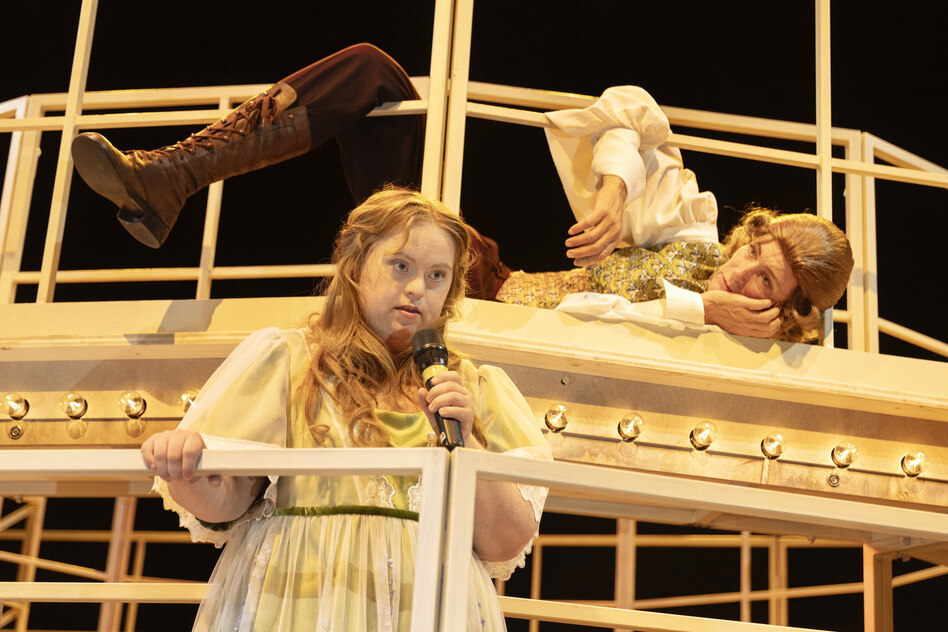
“Danton” is not Büchner’s “Danton’s Death,” which is placed here on the boards of this breathtakingly beautiful hall designed by Richard Riemerschmid à la “Rudolf Steiner meets Art Nouveau” (as it will be called later in the piece), as it happened at the opening of the Kammerspiele in 1926; At that time it was still with a partly Jewish ensemble. Instead, there is wild meta-theatre, led by director Lizzy Timmers from the Post Paradies collective.
The actors plow through three levels of time and fiction in the play (including the collective members Pina Bergemann, Henrike Commichau, Leon Pfannenmüller), which largely revolves around the rehearsals for “Danton's Death” at the Munich Kammerspiele in 1926, but at times falls into the present.
This leads to some double casting, such as the velvet-voiced Edmund Telgenkämper in the roles of Robespierre, Hans Schweikart (ensemble member under Falckenberg and Nazi profiteer) and Flora Fromm (one of the house's Jewish partners) and of course himself. Not only thematically but also structurally, memories of Peter Weiss' “persecution and murder of Jean Paul Marat are portrayed by the acting group of the Charenton hospice under the supervision of Mr. de Sade”.
"Then as now, we feel the plea in Büchner's text to endure the historical in the complexity of the details. Büchner's call against the tyrannical still resonates, his call to the dynamics of violence that, once unleashed, takes everything with it. Good and bad, uncontrollable." Leon Pfannenmüller, as himself or in the role of the Falckenberg dramaturge Wolfgang Petzet, warns right at the beginning and thus points to everything that is to come.
For example, when Christian Löber touches your chest with his words, when he, as the historical Cornelius Klämmerer, reports about cruising in the English Garden with an SA man, about fear and shame and lust. Or when Henrike Commichau reports on the unsuccessful student attempts to rename the Otto Falckenberg Drama School, where she trained more than ten years ago. Or when Telgenkämper shifts from the role of Flora Fromm and reflects on moments that are crucial to history, first remembering the murder of Walther Rathenau and then remembering all the murdered members of the Fromm family with Isar pebbles pulled out of his handbag.
It is precisely these tragic and responsible events that connect Georges Danton's French Revolution, the pre-March period during Büchner's lifetime, the pre-Nazi era and - according to the evening's thesis - today. The fact that the whole thing doesn't seem too didactic is also due to the great and constant music of the evening (composition by Kristina Koropecki, live music: Jakob Roters). Particularly worth mentioning here is the tragic solo singing by Luisa Wöllish as Julie, Danton's wife.
And some of the show moments that border on the strange, such as Pfannenmüller's clown performance at the end, when he tries to put the evening-defining number "100" on the top of the stage set that has been transformed into a cake, are probably perfectly measured for large parts of the audience to create a lively mixture of morality and metacollage (the evening is repeatedly punctuated with quotes from other plays such as "Hedda Gabler" and "Leonce and Lena"). to emerge - and the reassurance to do the right thing in the wrong times. As a house, but also as a cultural scene in the city of Munich.
The fact that people don't stand up during the thunderous final applause seems to be at least due more to the leaden weight of the world situation on the shoulders of the audience than to the production itself.
Read the full story at the source
Source: taz