
Politics · taz · · 1h
Political messages in US sports: Facing the protest
Deutsch (original) · Auto-translated to English
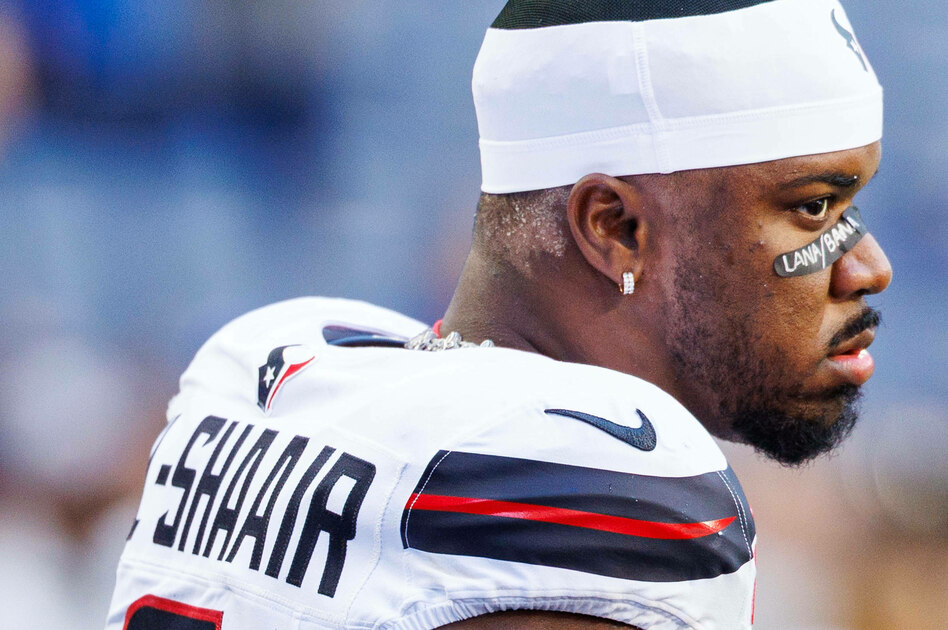
A zeez Al-Shaair is not one to be easily defeated, the Houston Texans linebacker is one of the most feared defensive players in the NFL. Among the most infamous moments of his career was a knockout of quarterback Trevor Lawrence in 2024 that resulted in a three-game suspension and a fine of more than $300,000. At the start of this season, Al-Shaair was not just athletically indomitable. In order to exercise his right to free speech, he appeared willing to take on league bosses and risk his career.
For the first game of the National Football League season, Al-Shaair had the name of the Palestinian girl Hind Rajab, who was killed in Gaza, painted under his eyes. “I wanted the world to know her name.” He was happy to accept the league's fine of $11,000 for the unauthorized appearance. “How much is a human life worth?” he asked provocatively after the penance. “For me the money is irrelevant.”
When Al-Shaair once again wrote the name of a dead Palestinian child, eight-year-old Wafaa Akila, on his face last Sunday at Paycor Stadium in Cincinnati, the league brought out the bigger guns. They threatened to take him out of the game, but the 110 kilo man gave in and washed his cheeks.
The protest by the practicing Muslim Al-Shaair was the clearest of the rather timid statements by US professionals about the violence in Gaza. As courageously as US sports spoke out about racially motivated police violence in their own country during the height of Black Lives Matter, they have so far remained silent when it comes to Israel's actions in Gaza. “The pressure on the players is enormous,” an anonymous basketball player in England told the Guardian. “Speaking out for gay rights, on the other hand, is child’s play.”
One of the few exceptions was WNBA basketball player Natasha Cloud, who from the outset openly called Israel's attack a "genocide" and saw it as her obligation to use her "God-given platform." Cloud said African Americans should have a natural affinity with the Palestinian people - a comparison not everyone agrees with.
Among the male basketball colleagues, the only one who stands out so far is Kyrie Irving from the Dallas Mavericks, who wore a T-shirt with the inscription “PRESS” at the All-Star Game. The shirt was intended to commemorate the journalists killed in Gaza. Then last week, Irving offered to pay Al-Shaair's fine. “We are in close contact and support each other.” LeBron James, one of the biggest names in basketball and one of the most vocal champions of Black Lives Matter, sidesteps clear statements about Gaza, instead saying he has heard “only great things about the people of Israel.”
Al-Shaair, on the other hand, feels a personal obligation to show solidarity with the Palestinian population in Gaza. Like many African Americans, his parents converted to Islam - a gesture of separation from the white, Christian majority of the USA since the times of Malcolm X. He lived the first years of his life in Saudi Arabia, where his father taught English. Even after his parents separated, his mother raised him and his siblings in the Islamic faith. Nevertheless, he says it's not about religion for him. “It’s simply about our humanity.”
Now it will be interesting to see whether he bows to the NFL's temporary gag order or continues to try to draw attention to the situation of the people in Gaza. In any case, it is clear that the league does not intend to give the topic much space.
Read the full story at the source
Source: taz