
World taz
Poland's right defends its bastion: power struggle breaks out over Poland's constitutional court
The leadership of Poland's Constitutional Court has been removed. The PiS is mobilizing on the streets. And President Nawrocki is worried about an instrument of power. more...
Deutsch (original) ·Auto-translated to English
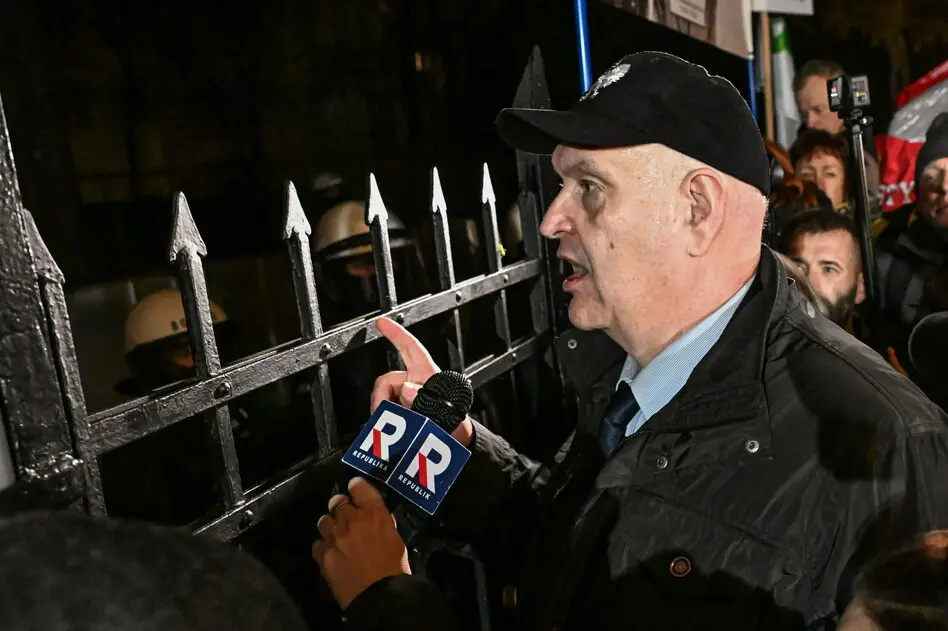
“This is Poland!” chanted a few men in front of the Polish Constitutional Court in Warsaw on Saturday afternoon. “We won’t give up the tribunal!” shouts another group standing next to the red and white advertising stands of the right-wing nationalist Gazeta Polska. Someone is waving a banner with the name of the largest opposition party PiS spelled out: “Prawo i Sprawiedlowosc” – “Law and Justice”.
Police officers in black uniforms and flashing helmets have closed Szucha Avenue, where the Constitutional Court is located, as well as two ministries and the embassies of the Vatican and Ukraine, to car traffic. But compared to Friday evening, when thousands of demonstrators spontaneously came together here and supporters of right-wing parties and newspaper publishers set up their red and white stands, it is downright quiet. There were no riots.
The big politics took place here for just a few hours, which even prompted Poland's President Karol Nawrocki to cancel his state visit to Senegal during the outbound flight and fly back to Warsaw. What had happened? Poland's Attorney General and Justice Minister Waldemar Zurek had the immunity of the chairman of the Constitutional Court Bogdan Święczkowski and his deputy Bartlomiej Sochański lifted on Friday afternoon after months of investigations.
Swieczkowski, once an active PiS politician, was supposed to answer in a criminal trial for four “misdemeanors in office” that he was accused of. The prosecutor general's messengers unloaded 50 files containing investigation results to the longest-serving judge, Anna Korwin-Piotrowska, who then deposed the two chairmen and declared herself interim chairwoman of the Constitutional Court.
The march of mostly right-wing national demonstrators only began when she made this decision public on the Constitutional Court's website. One of the first on site was the now 77-year-old PiS chairman Jaroslaw Kaczynski. Outraged, he accused the center-left government under Prime Minister Donald Tusk of a “coup,” as if he and his followers were still in office – despite the defeat in the 2023 parliamentary elections.
The broad-based Tusk coalition is only trying to restore the rule of law in Poland, which was severely damaged by eight years of PiS rule (2015-2023). Some things have already been achieved, but Poland's PiS-affiliated presidents - first Andrzej Duda and, since August 2025, Karol Nawrocki - keep throwing a stick between the government's legs.
The Constitutional Court is one of the remaining PiS bastions. In December 2015, Andrzej Duda sworn in four PiS-affiliated constitutional judges, whose posts were already filled by judges who had been legally elected by the previous Sejm. As a result, all judgments of the Polish Constitutional Court could be challenged before the European Court of Justice (ECJ) or the European Court of Human Rights, even if only a double judge had participated in the judgment.
At the end of 2025, the ECJ ruled that the Polish Constitutional Court was not an “independent and impartial court”. It does not meet the requirements of EU law. Some of the constitutional judges came to office due to “serious irregularities”. The Tusk government expressly welcomed this ruling, but found itself unable to turn the “non-court” into a functioning constitutional court again.
The appointment of new judges to replace those whose terms of office had expired could have made the Polish Constitutional Court a court recognized in the EU again. But President Karol Nawrocki refused to swear in some of the judges legally elected by the Sejm, Poland's House of Representatives. Most Polish constitutional lawyers are of the opinion that Nawrocki is acting unconstitutionally. Poland's constitution does not provide for the president to make his own personal choice of judges after parliament has elected judges.
Swieczkowski, in turn, a PiS hardliner and former chairman of the Constitutional Court, did not allow any of the new judges to take part in the proceedings. He was also unable to request a constitutional court budget during parliament's current budget deliberations because he would have had to invite most of the constitutional judges to do so.
There is a lot at stake for President Nawrocki, who entered the Constitutional Court on Friday night and had himself photographed there as an active head of state: If the Constitutional Court were to become a real constitutional court again in the next few days, he and the PiS would have lost an important instrument of power.