
World taz
The French state is looking for a test of strength: organized confusion
Rallies in the center were allowed on a case-by-case basis, then banned again or, as in Paris, banished to the outskirts of the city. An increasingly authoritarian government wants to push the protest movement into the Ill
Deutsch (original) ·Auto-translated to English
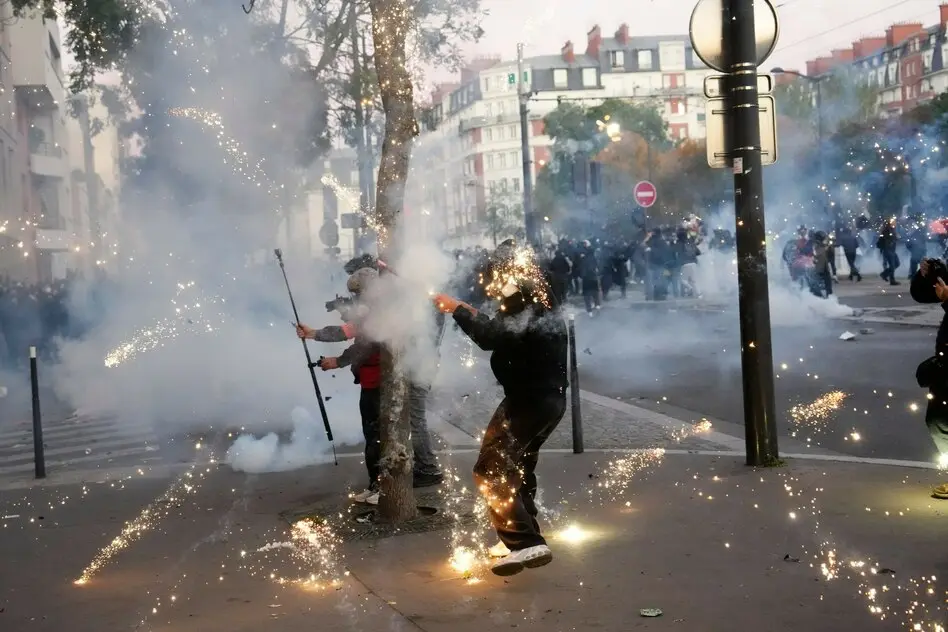
The protesting young people are not letting up as quickly as President Emmanuel Macron wanted them to. Again, on the third consecutive Saturday, more than 400,000 people demonstrated for a different education policy and for better living conditions. The authorities did not make it easy for them to organize the actions. In several cities, no march route had been approved in the city centers.
As a result, incidents almost inevitably occurred when law enforcement tried to drive away the “illegal” demonstrators. This was particularly the case in Marseille, Lyon, Toulouse and Rennes. In Paris, the demonstration was quiet with more than 70,000 people (according to the Interior Ministry) who were only allowed to march outside Paris on the outskirts, from the Porte de Bagnolet to the Porte de Charenton. It was only when the police tried to force everyone to go home with lots of tear gas before the last demonstrators arrived that there were very violent clashes. The intersection at Porte de Charenton was enveloped in a thick fog of irritant gas at 5:30 p.m.
The authorities' stance had already sparked controversy on Friday. Until shortly before the start of a third day of action, there was complete confusion in Paris. The police prefecture on Friday did not agree to the CGT union's request to organize an orderly rally from the Bastille to Place Nation on October 31 and banned all demonstrations in the capital. But the administrative court ruled in favor of the union and thus allowed the route it wanted to march within the city walls of Paris. On behalf of the government, the police prefect filed an appeal. And the higher authority, the Conseil d’État, decided in the interests of the government. The protesters were then offered a route from Bagnolet to Charenton at very short notice. It was officially legal to demonstrate on this route on the outskirts of the city.
Interior Minister Laurent Nuñez said he feared serious incidents based on information from his intelligence services. In particular, calls circulated on the networks to use the Halloween festival as an opportunity to violently riot and loot shops using appropriate masks and disguises. In addition, around 600 “ultra-leftists” are expected. The leadership of the CGT said that with such dramatic predictions the minister wanted to divide the movement and scare young people and their parents. Nuñez's intention was definitely to banish the protesters from the center and thus marginalize them in public. 40 metro and RER rapid transit stations were also closed to make it difficult for people to even get to the starting point.
At the same time, however, business owners who were victims of looting or feared further damage to property in the event of unrest are alarmed. Fear of chaos is spreading in public opinion, fueled by part of the media. The state leadership no longer seems to be able to maintain order normally. The right-wing populists are not afraid to promise these concerned citizens that things will change radically with them in power.
This back and forth between police and government authorities and the judiciary created great uncertainty. Where and when were the protests legal or illegal? Was there perhaps even an intention to escalate the conflict behind the general confusion that arose because orders changed at short notice? And: Are you still allowed to demonstrate in France?
Just a few years or months ago the question would have sounded absurd. In the last six weeks, however, the French government has done its utmost to stop a legitimate demand movement by middle school and university students with an outrageous policy of intimidation and police repression. Since it has not succeeded in this and since the movement has spread from the school gates to the streets of all cities and to already battle-hardened circles such as yellow vests and trade unions, the government, on the instructions of President Emmanuel Macron, is trying to ban demonstrations and go out at night. The success is not exactly spectacular.
During the riots on the sidelines of the demonstrations on October 17th, it became clear that even the massive contingents of law enforcement were overwhelmed by hundreds of thousands of very determined protesters and that the operational doctrine of preventative encirclement of the gatherings was not very successful or had a counterproductive effect on public opinion due to the often brutal approach. And the young people have so far neither been intimidated nor appeased by a few half-concessions from the government. They have announced blockades in front of schools and faculties for Tuesday and Thursday. The unions are calling for a general strike on Thursday. The social movement is becoming increasingly political.