
Germany · taz · · 1h
Performance artist Madame Nielsen: “The Germans are just strange creatures”
Deutsch (original) · Auto-translated to English
By Lea De Gregorio (talk) and Sophie Kirchner (photo)
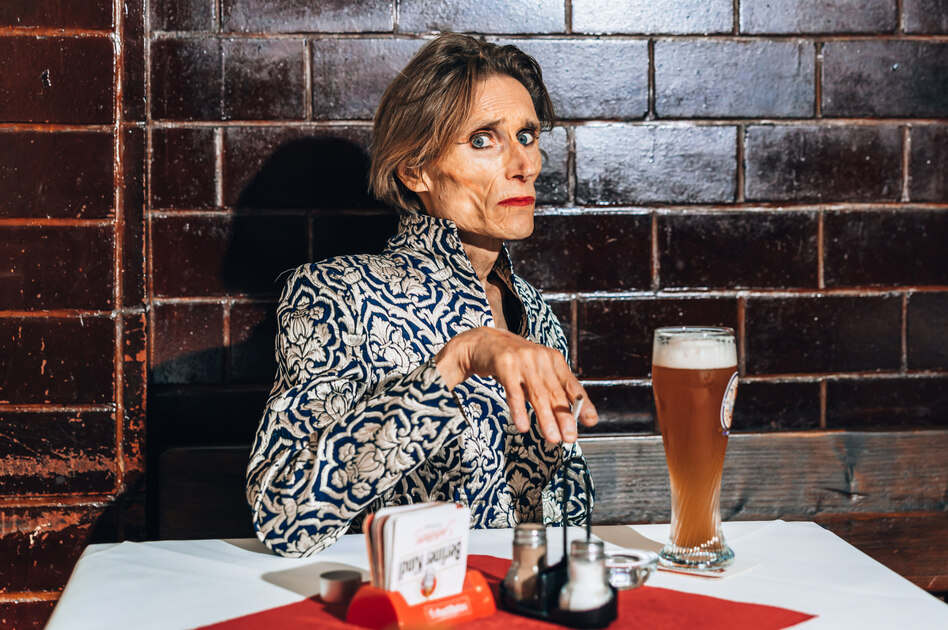
A restaurant labeled “German cuisine”. Inside on the walls: brown tiles. The author, performance artist and actress Madame Nielsen strikes up a conversation with a guest at the next table. He says that he has been coming to the restaurant in Berlin since the 80s. She says that she lives in Copenhagen, “there are fewer brown taverns there”. Later she comments on a painting of mountains on a wall. It's not very German. The gentleman calls out: “This is Bavaria!” Nielsen also deals with the question of what constitutes German in her two most recently published books.
taz: Madame Nielsen, what do you associate with German?
Madame Nielsen: Lots of different things. When I was a child, we lived in Tønder for six years, which is six kilometers from the German border. Back then, the Danes mostly drove through Germany, to the Alps or to the Mediterranean. I went camping with my grandparents to Niebüll, Langballigau and the Kiel Canal. In the spring of 1990 I hitchhiked to East Berlin. Since then I have had friends in Berlin and have always come back. In the 90s I did two theater productions in Hanover. And when my novels translated into German came out in 2018, everything opened up. I've been to the theaters here a lot. In 2019 I lived in Berlin at Stuttgarter Platz for a year.
taz: You also write about this in your book “Portraits of Germans and Other Living Beings,” which was published in 2025.
Madame Nielsen: I wrote a lot at Stuttgarter Platz. A novel in Danish, but I also started writing in German there. This is how the book came about. Germany has brought great art to the world, theater, literature and even philosophy. However, there is also this dark side. It has a lot to do with the Nazi era, but also with structures and hierarchy.
taz: In the book you collect various essays about being German and identity. The apartment of a German 1968 professor appears, as do right-wing extremists. When you read it, you ask yourself to what extent “German” as such even exists and how it can be determined.
Madame Nielsen: I play with that with a smile because it also has to do with prejudices and clichés. At least there is something German that is claimed. For the book, I also spent an afternoon with Marc Jongen, the AfD philosopher who trained with Peter Sloterdijk. And I spoke to two beautiful little innocent identities.
taz: ... who want to return to the great German nation. How was meeting Jongen?
Madame Nielsen: We talked animatedly, but were also silent. At times it became very fairytale-like, for example when I asked him to paint for me his ideal German vision, which I would then bring to the stage of the Royal Theater in Stockholm, and he then completely lost himself in the description of the primal German spirit.
taz: There is a big debate about the extent to which one should talk to right-wing extremists and offer them a platform.
Madame Nielsen: This debate is something very German! You think that because you don't talk to each other or deny something, it will disappear. But it's not like that. I really want to talk to those with whom I disagree.
taz: You succeed in something that is not self-evident. There is something revealing about your texts. For example, if you confront Marc Jongen with the fact that he keeps saying what he rejects, but not what he is actually committed to.
Madame Nielsen: That's what happens when you talk to the right. They start with everything they don't want: immigration. Or they say: There are men and there are women. I wanted to know: What do you want, what is your vision?
Madame Nielsen: He couldn't really tell me that at first. But I massaged his imagination with my questions. And then it poured out of him, this vision of the German primal spirit as a small, secret, barely surviving back burner.
taz: Elsewhere Jongen says he wants the “disinfection of the cultural sector”. Many are afraid of election results like those in Saxony-Anhalt. They don't want to give AfD people any more space. Can you understand that too?
Madame Nielsen: I certainly understand that many Germans are afraid of a possible future under AfD rule. But I think that you have to approach people with open ears and eyes.
taz: In your book you write about the encounters and also about yourself. You say that the book is a picture gallery. It is also a gallery of self-portraits. Or?
Madame Nielsen: Yes, I'll play along. I'm always involved. I am also very involved in the essay about Peter Handke in the book. It's about people and also about me and why I actually have sympathy for Peter Handke, who goes to Serbia, even though nobody actually goes to Serbia anymore. At the same time, of course, there are problems because he romanticizes.
taz: According to criticism, Handke trivialized the Srebrenica massacre. The book is not just about the Germans, but, as the title says, also “about other living beings”. About a female heron, about your father and about Peter Handke, who is Austrian.
Madame Nielsen: I thought that was funny: “other living beings”. The Germans are just strange creatures. Evolution has produced the strangest creatures, including the German.
Madame Nielsen: Yes, and ultimately the herons too.
Madame Nielsen: I also write about that in the book that I often went to lakes. And there, in a bare tree, sat a heron. And she looked just like me.
taz: The question of who you are is a big topic for you. You deal a lot with identity.
Madame Nielsen: I don't care who I am. I'm interested in what potential I have for being completely different. It's about transformation. Actually, I'm on my way to some spider or insect at the same time. You can see and hear that (Madame Nielsen changes her voice and makes animal noises).
taz: You were born in Denmark, under a different name.
Madame Nielsen: A few weeks after I was born, my parents named me Claus Beck-Nielsen, or mostly Claus.
taz: There was a funeral for Claus Beck-Nielsen later. And then you decided to be nameless.
Madame Nielsen: Yes, Claus Beck-Nielsen was declared dead. And then we realized: Maybe that was just the identity that was dead, deceased, wandered out, missing. Then I was nameless for ten years and just a test subject for the company “Das Beckwerk”. This wasn't just an art project, but a company with a board of directors, accountant, producer and employees.
taz: You traveled a lot for the Beckwerk. You say you gave up your identity and your free will to do this.
Madame Nielsen: The Nameless Man was in the world a lot. The board made decisions about me, about what I should do: introduce democracy in Iraq in 2004 using Central European means. It was later about initiating a second and better revolution in Iran and about walking down the Afghan mountains through Kabul in 2008 with the flag of friendship. And then I or we, the nameless one, were involved in the Egyptian revolution.
taz: Were you really traveling to all of these crisis regions?
Madame Nielsen: Yes, and always as the ideal European, in a gray suit, white shirt and black tie, unarmed. Language and cosmopolitanism and willingness to engage in dialogue were my and our only weapon. In 2014, when I had now become Madame Nielsen, I traveled all over Ukraine as “Miss World” in a white dress and with a black guitar and sang gentle love songs in front of and in the Donetsk region for the Ukrainian nationalists and the Russian so-called patriots.
Madame Nielsen: I lived in Paris in 2013, and through the French language I became Madame Nielsen.
taz: Would you say that the renaming was about getting rid of something?
Madame Nielsen: It wasn't just a renaming. It was a transformation, a different way of being. It became clear to me that the feminine had not been very present in his life's work so far, even though Claus Beck-Nielsen was also very feminine as a boy and child. Then I thought: Now it's about femininity and exploring what it means to be a female being. I'm not operated on, just transformed. There were no interventions, just what I live from within myself, from the full potential that is a living being.
taz: Your works not only revolve around identity, but also around the question of what art is. How would you define art for yourself?
Madame Nielsen: For me it goes hand in hand. I don't care about identifying art. I simply formulate what is there: the world, life and what happens in life and living beings. Everything has to be formulated, have a form. Only through this form...
taz: ...some things actually exist, so to speak?
Madame Nielsen: The world becomes visible, tangible and analyzable. My novels are also a formulation. I want to tell. I want to formulate a material, an experience.
taz: Your current novel is called “The Zeitgeisterhaus. A German Story”. He tells about a performance artist from the “far north” named Milady, who works in a “Gesamtkunsthaus” and causes offense and is ultimately thrown out. Why did you choose this title?
Madame Nielsen: Because I think it is a very German story and at the same time a very zeitgeisty one. The hierarchies that the book is about also exist in the Gesamtkunsthaus that the book is about. Hierarchies are something that is denied the most in hip, woke theaters. But they also exist where people believe that everything is a “community,” as the German saying goes. At the same time, it isn't. I think these hierarchies are very German.
taz: What exactly is different about Danish theaters?
Madame Nielsen: In the Scandinavian art institutions there is of course inequality and more or less formal power relations. But the hierarchies are much looser.
taz: In the central scene of the book, Milady gives the Hitler salute in the dressing room out of anger at the theater and the hierarchies there, and great outrage then breaks out. You describe them in the novel in the form of witness reports. Is this outrage also something German?
Madame Nielsen: Yes. You don't want these dark sides. But you can't get rid of them by saying that it's forbidden to do the Hitler salute in a cloakroom. Simply because it preserves his magic. We would have to get to the point where this gesture would only be seen as strange and harmless.
taz: The Hitler salute in the novel, like the encounter with Jongen in the previous book, has something revealing. It is not a Hitler salute that is meant to be a Hitler salute. Rather, the protagonist wants to hold a mirror up to the Germans with this greeting.
Madame Nielsen is a Danish-born writer and performance artist who has since been nameless. She now lives in Copenhagen and Vienna.
In her works, Madame Nielsen allows the boundaries between identity and art, reality and fiction, to merge. She has written numerous novels and essays. Her books “Portraits of Germans and Other Living Beings” were most recently published in German by Matthes & Seitz and “Das Zeitgeisterhaus. A German Story” by Alexander Verlag.
Madame Nielsen: It wasn't about the fact that I was a Nazi or that Milady in the novel was a Nazi. It wasn't me. (Madame Nielsen changes her voice) It wasn't me, it was Milady! I didn't want to portray her as a victim, but rather to create a novel with multiple voices; I didn't want to burden the world with another I-me-me autofiction, but rather let the voices of the "others" be heard, those who have sued me and perhaps hate me. They're right too!
taz: Milady says in the book: “My existence on stage cannot be separated from my life off stage.” Art and everyday life merge?
Madame Nielsen: Exactly, I don't work with roles either. I am who I am not, or I am who I am not! This is an expansion of Rimbaud. He said: “Je est un autre” – “I am another”. I say: I am others. I try to formulate all the potential I have: as a way of life.
taz: In the novel, the theater management tries to pathologize the Hitler salute. Does this reflect a refusal to deal with it?
Madame Nielsen: Of course! Someone was thrown out in response to the Hitler salute, but they don't dare say what happened: someone gave a Hitler salute, that would be a scandal. For me it's also about the truth.
taz: The blurb for “Zeitgeisterhaus” says that it is an autofictional story…
Madame Nielsen: That came from the publisher. It is a completely open question whether it is complete fiction or whether it is a report in which everything is real and only for legal reasons Madame Nielsen is transformed into Milady and the name of the theater is not mentioned. Maybe it is. But maybe everything is fiction and there is no Germany at all.
taz: On Wikipedia you can read that the novel takes place in the Munich Kammerspiele, where you worked: "After a conflict over work processes, Nielsen gave the Hitler salute in an argument with a theater employee, whereupon the collaboration with the theater was ended."
Madame Nielsen: You never know whether you can believe Wikipedia. The texts on wikipedia.de are only written by Germans.
taz: You are currently in Berlin to present your novel. Is there outrage over your scolding of Germans?
Madame Nielsen: The book premiere was at the Volksbühne, and it was a success. Since then I have been on my first tour. Now I'm going to go to the second one. The book will be staged in Hamburg at the end of January by a major German director. And later we will hopefully also perform it in the Vienna Volkstheater. I would also like to do it at the Munich Kammerspiele. It's a nice theater, they have a lot of money, good actresses. A beautiful stage.
Read the full story at the source
Source: taz