
Germany · taz · 3h
Performance in the Gemäldegalerie: A Scream of Objects
Deutsch (original) · Auto-translated to English
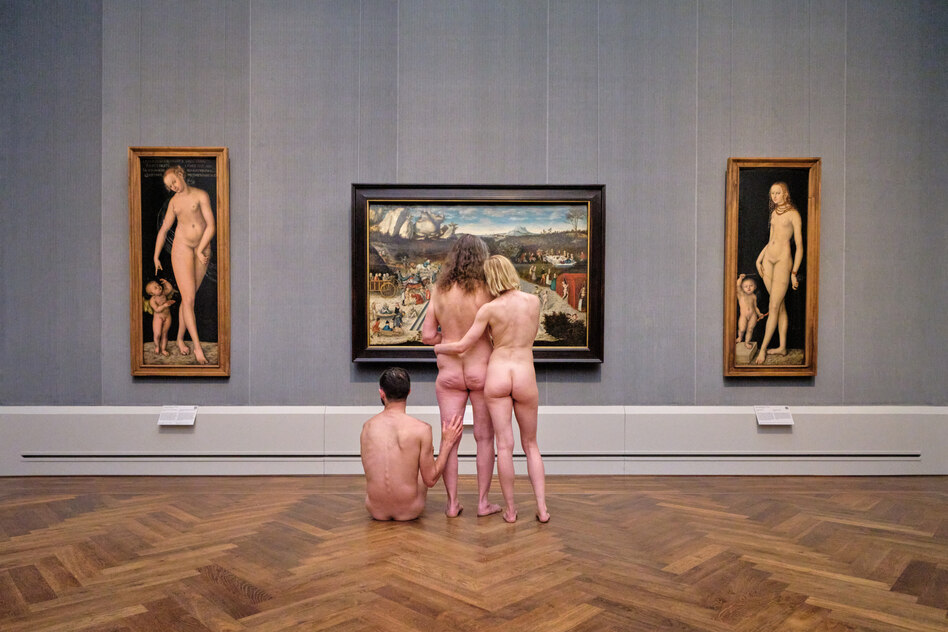
The room in the Berlin Gemäldegalerie has something of a time capsule: a high hall, herringbone parquet, stone-gray walls. On them hang images that have survived centuries: the eight surviving panels of the “Wurzach Altar” by Hans Multscher from 1437, an altar panel from the 13th century, whose gold background still shines. But on this Monday morning, a different picture attracts attention.
In the middle of the hall, a woman in a white nightgown lies on a wooden museum bench, her back to the audience, her long gray hair loose, dirty white socks on her feet. A younger woman in an oversized white T-shirt lies under the bench, her legs drawn up, her face turned towards the entrance. The paintings on the walls are there. But the visitors' gaze belongs to the two living bodies in the room.
Suddenly the woman sits up. She gets up and slowly walks into the next room. The visitors follow her. As soon as we get there, a human body attracts attention again in the next hall: this time all black, hanging limply from a pole dance pole.
It is the press tour for the performance “Aging Masters” by director Ersan Mondtag and curator Nadim Samman. They staged 25 performers of different generations in 16 rooms of the Gemäldegalerie, where the audience can move freely. The co-production between the Gemäldegalerie and Berliner Ensemble celebrates its premiere on Friday as part of Art Week.
What is promised is a dialogue between the imagery of the Old Masters and today's bodies, a tableau vivant that revolves around exhaustion and renewal, disappearance and continued existence. What is experienced is more of a monologue of the performing bodies, at least in the excerpts that can be seen during the press tour. One, however, with strong, sometimes disturbingly beautiful images.
They accompanied all of the performances with a mini story, says Mondtag. In the Botticelli Hall, the actor Frank Büttner goes through a car accident and visitors can watch him die for ten minutes. And Eva-Maria Keller wakes up from a nightmare in the room with the early German panel painting and then commits suicide.
In the corner of the hall, Paul Herwig sits at a black dressing table and looks at himself in the mirror with a frown. Behind him: Adam and Eve with the bitten apple. Candice Breitz stands on a square white sheet and peels potatoes, Peter Luppa lies naked on a museum bench and “feels the space”. In front of Cranach's “Fountain of Youth,” the dancer FRZNTE becomes an image of exhaustion and renewal.
In the central Rembrandt Hall, around ten women in white dresses stand and sing one of Gustav Mahler's “Kindertotenlieder”. They are accompanied by a self-playing grand piano. Here the performers come together every twenty minutes for a ritual, says Mondtag, a kind of staged funeral.
Mondtag is also about the question of what we actually see when we look at a person. As he says, he wants to “look at a person before the person becomes an image.” Today people are all too quickly reduced to their biography, their position and their successes. “Aging Masters,” on the other hand, wants to show people before they have become such images.
This approach is not entirely convincing, as Mondtag himself plays with the “image” of his performers. Some of them are certainly part of this work precisely because of their biography and public role: techno legend Westbam, for example, the former bouncer Frank Küster or the former director of the Nationalgalerie Udo Kittelmann. Their names already bring images with them.
Ersan Mondtag and Nadim Samman: “Aging Masters”. Picture Gallery, Friday, September 11, 7 and 8:30 p.m.; Saturday, September 12th and Sunday, September 13th, 10:30 a.m., 1:00 p.m. and 3:30 p.m
Berlin has long been defined by youth, night and the idea that the party never has to end. Well, says Mondtag, it's morning. Berlin is aging. And with him a scene that liked to see itself as young and non-conformist. “Aging Masters” therefore gathers their bodies where everything seems to be permanent: between images that have survived centuries.
But in the end the announced encounter between the old images and today's bodies largely fails to materialize. The picture gallery provides an impressive backdrop, but the paintings rarely become real partners in the production. The living bodies attract attention, the images remain silent objects, background noise.
This becomes particularly clear when a shrill howl interrupts the background noise: a visitor in the crowded rooms repeatedly sets off the alarm system. A scream of objects: For a brief moment, the living bodies lose their sensuality and the paintings come into the foreground. Of all things, the alarm system creates the most intensive dialogue with the Old Masters.
Read the full story at the source →
Source: taz