Politics · taz · 6h
Pankow before the election: Where are the children?
Deutsch (original) · Auto-translated to English
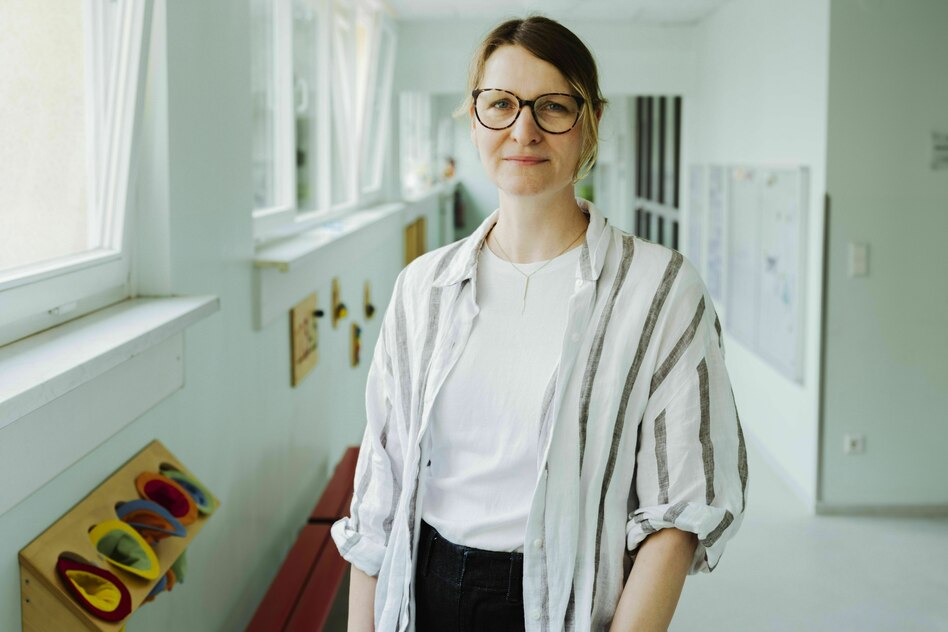
Kerstin Stechow would like to be seen more. Become more visible. Not personally. But yes, when it comes to the daycare center that she has been running for three years. The daycare center at Jablonskistrasse 33 in Prenzlauer Berg has a problem: out of 195 places, only 90 to 120 are occupied - depending on the time of year.
This Wednesday, at the beginning of September, Stechow has an appointment with Rainer Oetting. The commercial manager of the Nordost kindergartens came to Jablonskistrasse to make her a suggestion. “There is an interested party for the empty spaces,” he said. Stechow nods. “Maybe this is an opportunity too,” she says. “We have space, we should come together and initiate new things.”
Stechows daycare center is one of the kindergartens Nordost's own operations. Not a children's store, not an independent provider, but rather a municipal daycare center with plenty of space. But now with too much space. Hence the conversation this Wednesday.
When the Berlin House of Representatives is re-elected on September 20th, voters can also tick the box for the district parliament, officially: District Assembly (BVV). Although the districts are not independent municipalities, they carry out important administrative tasks, for example in schools and green spaces, in the citizens' offices and in youth work. And although they always have too little money, the district authorities sometimes make important political decisions - for example about environmental protection areas, development plans or cycle paths.
On-site visit: What's going on in the 12 major cities that make up Berlin? What motivates citizens, where are the problems, what is at stake? Until the election, the taz will make an on-site visit every Monday. You can find all parts of the series here on taz.de.
Rainer Oetting says it this way: “We run a total of 82 daycare centers in Pankow, Lichtenberg and Marzahn-Hellersdorf.” Three new daycare centers would be built in Lichtenberg and Marzahn-Hellersdorf. So there is something growing there. “In Pankow and especially in Prenzlauer Berg, the number of births is declining, and we have to see how we can get new uses for the daycare centers.”
Children and Prenzlauer Berg used to belong together like Wilmersdorf and widows. The former trendy district was affectionately and mockingly referred to as “Pregnancy Hill”, and the image of latte macchiato mothers traveled across the country and beyond.
Today there is often little going on in the playground at Kollwitzplatz, the former epicenter of the “Prenzlmuttis”. Statistics know why. Since 2022, fewer children have been born in Prenzlauer Berg. And the trend continues. In 2024 there were 1,503 children. A year later only 1,435.
Of course, the negative trend is also noticeable in daycare centers. 22,142 daycare places were occupied throughout Pankow in 2019. In 2025 there were only 18,581 places. A decline of 16 percent, which is in clear contrast to the population growth in Pankow.
Is the liaison between Pankow and Kinder over? Visit to the responsible city councilor. Rona Tietje is based on Berliner Allee in the Weißensee district. The SPD politician has been the city councilor for youth and family since 2023 and is therefore also responsible for ensuring that the daycare centers in her district work.
“The dip in births began in the southern districts in 2019,” says Tietje. So at Kollwitzplatz and Mauerpark, where Prenzlauer Berg borders Mitte, but also at Helmholtzplatz. “And as with gentrification, this development then moved further north.” Overall, there is a shrinkage in Pankow among both 0 to 3 year olds and 3 to 6 year olds. “The only exception is Blankenburg-Heinersdorf,” says Tietje. “There is still slight growth among 3 to 6 year olds.”
Tietje can also explain the contradiction between a growing district and declining numbers of children. The growth primarily affects young adults, i.e. those aged 18 to 25. “There is also growth among seniors aged 65 to 80,” says Tietje. “The same applies to those aged 45 to 65.”
The district: With 427,256 residents, Pankow is by far the most populous district in Berlin. It would be in 16th place in the German city ranking and would leave Bochum, Bonn or Mannheim behind. Pankow grows especially in the northern districts. The district was created in 2001 from the merger of the old districts of Pankow, Weißensee and Prenzlauer Berg. Today Prenzlauer Berg is a district, but with nationwide excitement potential. The saying of today's Interior Minister Alexander Dobrindt (CSU) from 2018 will never be forgotten: "Germany is not Prenzlauer Berg, but Prenzlauer Berg determines the public debate."
District mayor: After the repeat election in 2023, the Green Cordelia Koch replaced the left-wing politician Sören Benn at the head of the town hall. Koch owed her election to a counting community with the CDU and FDP. When she was elected, she received 28 yes and 26 no votes in the BVV.
The district parliament: With 15 seats, the Greens are the strongest faction in the BVV Pankow. This is followed by the CDU with 12 seats, the Left with 11, the SPD with 9, the AfD with 6 and the FDP with 2 seats.
Rona Tietje has a clear explanation for all of this. “My hypothesis is that mobility in Pankow has decreased.” This is particularly extreme in Prenzlauer Berg, where there is hardly any fluctuation. “People stay and get older.” Couples who are of age to start a family hardly ever move to Prenzlauer Berg anymore. For many it is also a question of wallet.
Demographic change is not a snapshot, it has become a trend. In Prenzlauer Berg, which was once full of children, children are missing, as is the case in Pankow. And that has an impact on the district's infrastructure. The formula that Rona Tietje has for planning in response to the aging of the population is: “We need fewer daycare centers, more primary schools and later also more secondary schools.”
The child crisis has long since become a problem, especially for privately run daycare centers. The average occupancy rate in the district is 77 percent. Small providers who may only run one daycare center can get into difficulties - and often increase the parents' own contribution.
Large providers such as the municipal company Nordost are more flexible. “We can do something with the staff,” says Rainer Oetting. On the other hand, the municipal daycare centers pay their employees the full collective wage and waive the parents' own contribution. This is also why, says Oetting, “a socio-spatial opening to the outside world” is an important measure.
This has already been achieved in Mahlsdorf. A family center is to move into the “Zu den Seen” daycare center on Elsenstrasse. The prerequisite for this was structural measures that separated the two facilities from each other. This is intended to ensure child protection. Adults are not allowed to stay in children's rooms uncontrolled.
“We benefit from the fact that half of our daycare centers are standard buildings,” says Oetting. “That’s why we want to develop standardized and therefore inexpensive and quickly implemented solutions for structural separation.” Such spatial separation costs 65,000 to 80,000 euros. The district has already confirmed funding for the Matenzeile daycare center in Lichtenberg.
Kerstin Stechow's daycare center at Jablonskistrasse 33 is also a type of building. It has two entrances, and there is a poster on one: “We have free places”. The structural separation has already been completed at the right of the two entrances. A glass pane with a glass door separates the foyer from the daycare area. From the foyer you come into the rooms that Rainer Oetting has an interest in. It is the daycare center of an independent provider who is looking for new space. A daycare center that works a lot with nature. “This can have significant benefits for both sides,” says Kerstin Stechow.
Since the number of children has declined, Stechow has also had fewer employees. From 39 educators, the number of employees has shrunk to 23. “Some went to Marzahn-Hellersdorf or Lichtenberg, but some didn’t want to go,” says Stechow.
More visibility is not that easy for Stechow compared to private daycare centers. The daycare center's profile is only on the Kindergarten Northeast page. The daycare center introduces itself there with the claim: “Enabling sustainable learning through self-selected activities in everyday life”. The carrier is responsible for advertising on social media. This also has an advantage for Kerstin Stechow. She can concentrate more on educational work. A new artistic façade design is supposed to regulate visibility.
“There is funding for that,” says Rainer Oetting. He also sees the crisis as an opportunity. “This gives us the opportunity to develop strategies for how we connect with others.”
City councilor Rona Tietje is also not pessimistic about the future. She emphasizes that there is now the possibility for parents to choose the right one for their child between the different daycare centers with their different concepts. “In the past, many people had to take any care place they could find.”
At the same time, she calls for more objectivity in the debate. “It wasn’t the case that people in Prenzlauer Berg had significantly more children than elsewhere,” she remembers. “The reason for the image was the concentration of the age cohort that can have children.” And then of course the picture of the mothers sitting on the edge of the playground at Kollwitzplatz with a coffee in their hand.
This image of Pankow, as Tietje knows from numerous conversations across Germany, persists despite demographic change. “Within Berlin, however, it has been replaced by Pankow as the fastest growing district in Berlin.”
And what happens next? “If mobility remains as low as before,” says Rona Tietje, “then after the pressure on secondary schools, the pressure on retirement homes will at some point increase.”
Read the full story at the source →
Source: taz